Extortion on both banks of Buriganga, boatman pays Tk 150 a day - Prothom Alo English
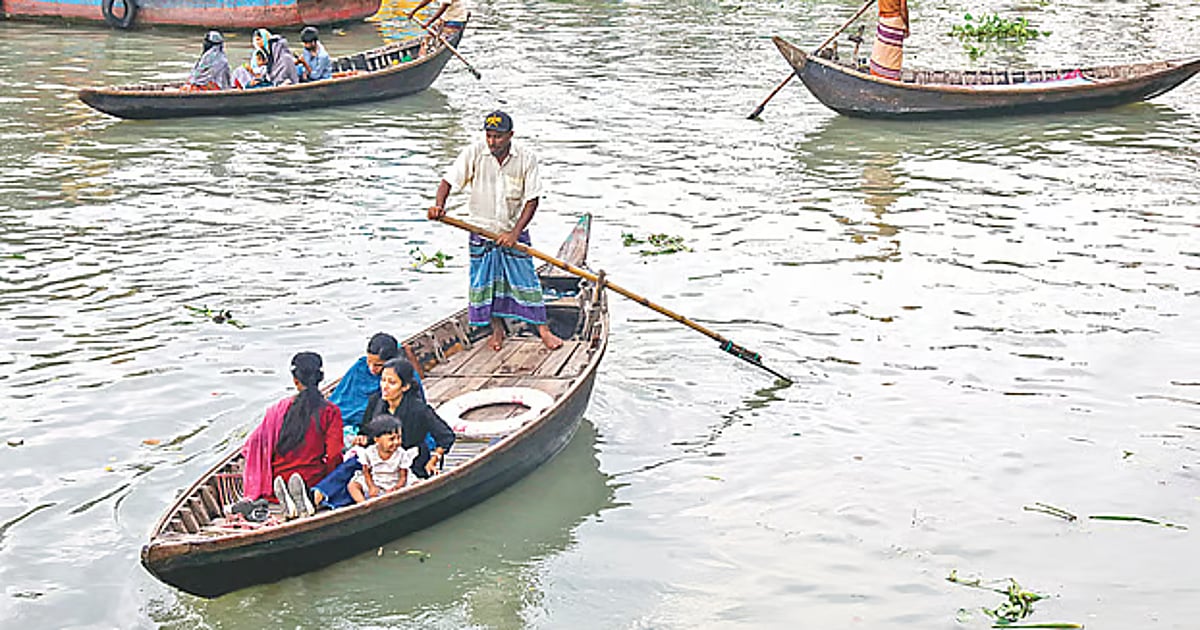
Despite three bridges over the Buriganga River, people still prefer boats for crossing. The photo was taken recently, near Babubazar at Sadarghat.Mir HossenRahmat Ali (a pseudonym) has been ferrying passengers in a dinghy across the Buriganga river for more than three decades.
On one side of the river is Old Dhaka, and on the other side is Keraniganj.
On 5 July, I boarded his boat from Keraniganj and asked how much he earns and spends.
Rahmat said his income ranges from Tk 700 to Tk 800 per day. The boat rental costs Tk 120 a day. If the boatmen pick up passengers from Dhopaghat, they have to pay Tk 100. If from Badamtoli, it’s Tk 50.
Picking up from both banks costs Tk 150. Some boatmen, therefore, choose not to take passengers from both sides to avoid fees and instead return with an empty boat. There’s an additional Tk 15 daily for ‘boat security'.
This extortion from boatmen has been ongoing for years. When the government changes, the collectors of these illegal fees change as well, much like nationwide extortions.
According to sources from the Bangladesh Inland Water Transport Authority (BIWTA), there are a total of 17 ghats on the Buriganga River, stretching from Fatullah in Narayanganj to Jinjira Tinpatti Ghat in Keraniganj.
Goods and passenger vessels stop at these ports. Among them, 15 ghats have 44 points from which passengers can cross by dinghy. Some ghats also have engine-powered boats.
BIWTA leases out the ghats. Their tariff schedule doesn’t specify charges for dinghy. While there are fees for other types of vessels, there aren’t any for dinghy.
Nevertheless, the lessees collect fees from the boatmen as they please. On visiting 18 locations across 15 ghats of the Buriganga River on 5, 6 July, and 3, 6 September, discussions with the boatmen revealed extortion amounts between Tk 35 and Tk 150.
BIWTA Joint Director Mobarak Hossain Majumder told Prothom Alo that the tariff schedule doesn’t specify anything about passenger transit by dinghy. However, it does mention the transport of goods on boats.
He said, “Boatmen and lessees have decided on a fee based on mutual understanding for a long time. I haven’t received any complaints of excessive charging.”
However, according to the boatmen, they have no choice but to pay. If any boatman refuses, they risk being assaulted. Without a specific fee schedule, BIWTA has inadvertently enabled extortion.
Many people come to Dhaka city from across the Buriganga for business and other purposes. Conversely, many also travel to the other side. For easy commuting, they rely on boats, as traveling by bridge requires a longer route to reach their destination. Around Sadarghat, boat fares are Tk 10 per person. Engine-powered boats at some ghats charge Tk 5 per person.
At some ghats near Sadarghat, an entry toll is collected. For instance, at Wiseghat-Aga Nagar Ferry Ghat, there’s an entry fee of Tk 5 per person. Upon exit, a fee of Tk 5 per person is also collected.
According to BIWTA’s tariff schedule, passengers are supposed to pay a toll of Tk 2 for entering ferry ghats, but this is often not adhered to.
Md Ibrahim, a resident of Aga Nagar in Keraniganj, works for a private hospital in Old Dhaka. Every day he crosses the Buriganga by dinghy to reach his workplace.
He told Prothom Alo that the situation at the ghat is such that you have to pay money to enter and exit.
He often ends up in arguments with the ghat staff over these fees.
At 4 PM on 5 July, a visit to Dhopaghat in Keraniganj found an elderly gentleman named Chittaranjan collecting money from boatmen. He claimed to be the ghat manager, responsible for collecting ‘tax’ and boat rental fees.
Boatmen taking passengers from Dhopaghat have to pay Tk 100 daily, which isn’t mentioned in BIWTA’s tariff schedule. The boatmen mentioned that before the July uprising, the fee was Tk 60 daily. After the uprising, fees were suspended for a few months, followed by a raised fee of Tk 20, which has now grown to Tk 100.
The ghat’s lessee, Aga Nagar union Swechchhasebok Dal General Secretary Meraj Hossain (Jummon), said, “Last time (2025-26), I suffered losses after leasing the ghat, so this time I discussed with the boatmen to raise the tax.”
Taking passengers from Wiseghat incurs a daily toll of Tk 35 per boat, and Tk 30 per trip for engine-powered boats.
The ghat's lessee, Suman Bhuiyan, is the convenor of Dhaka Metropolitan Dakshin Sramik Dal. He was unreachable on his mobile.
According to boatmen and BIWTA sources, most lessees of these ghats are affiliated with the ruling party’s leaders and activists.
Ramzan Ali came from Barishal in 1998 and started rowing boats on the Buriganga.
He doesn’t own a boat but rents one from others. Even though a boat can be bought for Tk 25,000 to Tk 30,000.
When asked why he doesn’t own a boat, Ramzan Ali told Prothom Alo that even if boatmen have money, they can’t buy boats. There’s a need for clout to launch a boat here. If a boatman buys a boat, it’s likely to be stolen.
According to the boatmen, a boat costing Tk 25,000 to Tk 30,000 can earn Tk 120 daily, totaling Tk 3,600 monthly. Thus, owning a boat is a lucrative business, which is why local influencers keep control of the ownership.
Aga Nagar union Swechchhasebok Dal's Merajul Hossain alone owns 40 boats.
Informal businesses nationwide are controlled through political and muscle power. The dinghy ports of Buriganga are merely an example.
Those responsible for preventing extortion and ensuring low-cost travel shift the responsibility by stating ‘no complaints received'.