Eyeing the Rs 4.49 lakh iPhone Duo? What if you invested the money instead
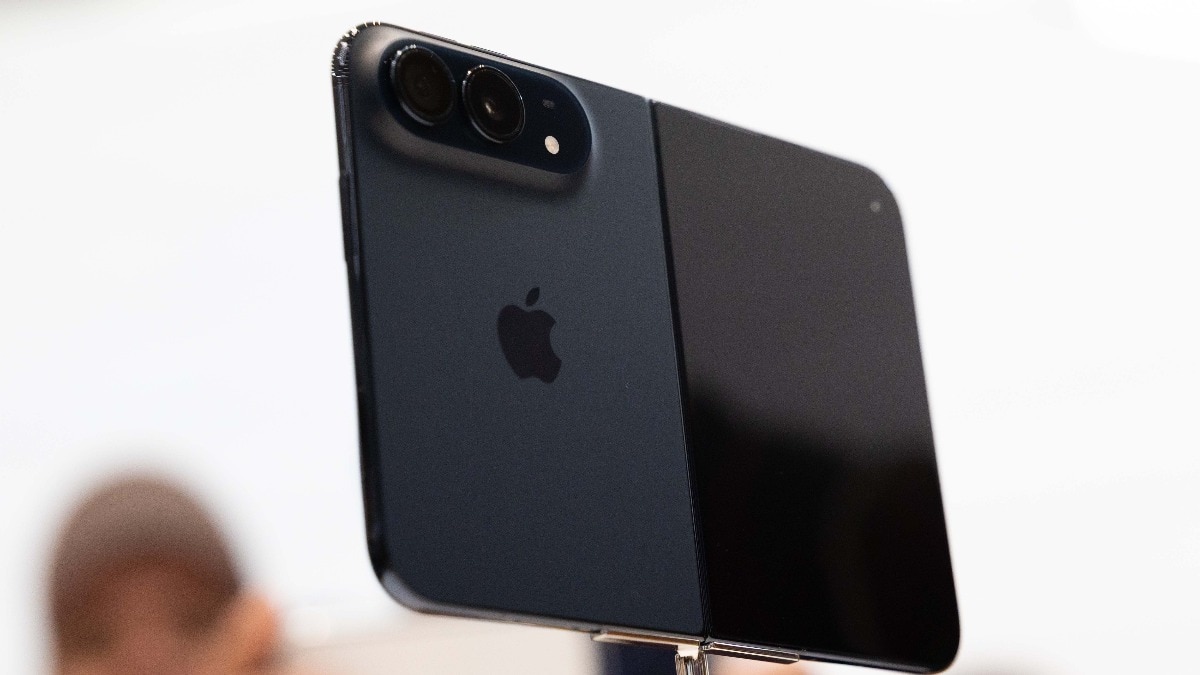
For Apple fans, the wait is over. The latest iPhone is here, and people are already eyeing the shiny new device. This time, however, Apple has brought something very different to the table — its first-ever foldable smartphone, the iPhone Duo.
The excitement around the new iPhone is understandable. But there is another number grabbing attention: Rs 4.49 lakh. That is the price of the top-end 2TB iPhone Duo in India.
At that price, buying the phone is more than just a technology upgrade. It is a sizeable financial decision. And for those weighing the purchase, there is an interesting question to consider: What if that Rs 4.49 lakh was invested instead? How much could it potentially grow through an SIP in a year?RS 4.49 LAKH PHONE OR AN SIP?
Apple unveiled the iPhone Duo on September 9, 2026, marking its entry into the foldable smartphone category. In India, prices start at Rs 2,99,900 for the 256GB model. Pre-orders open on October 16 at 5:30 pm, with sales beginning on October 23.
But the top-end 2TB version takes the price into an entirely different territory at Rs 4,49,900.
For simplicity, let’s call it Rs 4.49 lakh.
Now, divide that amount into 12 equal monthly instalments and the figure comes to around Rs 37,417 a month.
Instead of using that Rs 37,417 every month to pay for the phone, what if the same amount was invested in an equity mutual fund through an SIP?
“An EMI is a SIP running backwards. Same amount. Same schedule. One pays off something that is worth less the day you open the box. The other buys something that has a chance to grow,” said Harsh Soni, founder, Nyvo Money.
That comparison gives the eye-watering price of the phone a very different perspective.AT 12%, RS 4.49 LAKH COULD BECOME RS 4.78 LAKH
Let us assume, purely for illustration, that the SIP earns an annualised return of 12%.
Investing around Rs 37,417 every month for 12 months would mean putting in roughly Rs 4.49 lakh in total. At a 12% annualised return, the investment could grow to around Rs 4,77,680 at the end of one year.
That would translate into a gain of about Rs 28,680.
If the investment earns 8%, the SIP value after a year would be around Rs 4.68 lakh. At 10%, it could reach about Rs 4.73 lakh, while a 15% return would take it to roughly Rs 4.85 lakh.
But there is a catch. These figures are based on assumed returns and are meant only to illustrate how the money could grow. They are not guaranteed.
And when it comes to a one-year investment in equity, assuming a particular return can be particularly misleading.THE ONE-YEAR RETURN QUESTION HAS NO EASY ANSWER
It may be tempting to assume that equity investments can deliver 10%, 12% or even 15% in a year. But markets do not work that neatly.
“For one year, none of them,” Soni said when asked which return assumption is reasonable for a one-year investment.
The reason is simple: a fund can deliver a strong long-term average even as individual years produce wildly different outcomes.
For instance, the five-year annualised return of the flexi-cap fund category during the period considered was 12.92%. That sits comfortably in the commonly assumed 10-15% range.
But when individual 12-month periods are examined, the picture changes sharply.
Returns landed between 10% and 15% only around 8% of the time. More than half the time, returns were below 10%, while around 13% of the periods were negative. The worst 12-month period saw a loss of about 5.2%, while the best delivered a gain of 45.5%.
So, a five-year annualised return of 12.92% does not mean an investor can expect 12.92% every year.
“The easy answer to ‘what could it earn’ is a rate. The more uncomfortable answer is a date,” Soni said.
For someone deciding whether to spend Rs 4.49 lakh on a phone, that distinction matters. The iPhone price is certain. The return on the alternative investment is not.SIP VS LUMP SUM: WHICH COULD GROW MORE?
There is another important difference to understand.
If someone had the entire Rs 4.49 lakh available on day one and invested it as a lump sum at an assumed 12% annual return, it would grow to around Rs 5,02,880 after one year. That represents a gain of about Rs 53,880.
That is significantly higher than the roughly Rs 4.78 lakh value of the SIP.
Why? Because with a lump-sum investment, the entire Rs 4.49 lakh is working from day one. With an SIP, the money enters the market gradually. The first instalment remains invested for 12 months, while the last instalment is invested for only one month.
However, when comparing an iPhone bought on EMI with an investment, the SIP is the more relevant comparison. An EMI takes money out of your bank account every month, and an SIP would put money into the market in much the same way.
“The case for a SIP was never a steady market. It's an unsteady one,” Soni said.
That is also why the one-year outcome should not be treated as the final verdict on the investment.WHAT HAPPENS IF THE MONEY STAYS INVESTED FOR LONGER?
The picture starts to change when the investment horizon stretches beyond a year.
Suppose the investor contributes Rs 37,417 every month for 12 months and then makes no further investments, but leaves the accumulated corpus invested.
At an assumed 10% annual return, the money could grow to around Rs 5.72 lakh in three years, Rs 6.92 lakh in five years and Rs 11.15 lakh in 10 years.
At 12%, those figures rise to approximately Rs 5.99 lakh, Rs 7.52 lakh and Rs 13.25 lakh, respectively.
At 15%, the investment could grow to around Rs 6.41 lakh in three years, Rs 8.48 lakh in five years and Rs 17.05 lakh in 10 years.
These are, of course, mathematical projections based on assumed rates and not promises from the market.
The broader point is that equity is generally better assessed over a longer investment horizon rather than by looking at what happened in a single year.advertisementSO, SHOULD YOU BUY THE IPHONE DUO OR INVEST THE MONEY?For someone who has already decided to buy the iPhone Duo, the SIP-versus-phone comparison may not change the decision. After all, an investment cannot replace the utility or enjoyment a buyer expects from a new device.
“If the phone genuinely makes your work or your life better, that's a fair trade,” Soni said.
But for someone still on the fence, the calculation offers a useful reality check.
A Rs 4.49 lakh phone will almost certainly lose value over time. How quickly the first-generation foldable iPhone depreciates, however, remains to be seen. The investment alternative, meanwhile, carries market risk but also has the potential to grow over the years.
There is also the question of how the phone is financed. A monthly EMI may make Rs 4.49 lakh appear more manageable, but buyers should look at the total amount payable, including any interest and applicable taxes, rather than focusing only on the monthly instalment.
Ultimately, the real question is not whether Rs 4.49 lakh is affordable. It is what that money means to you.
If you spend it on the iPhone Duo, you get the latest foldable technology today. If you invest it, you give the money a chance to become something much larger over time.
And that is where the real cost of the phone lies. The Rs 4.49 lakh on the price tag tells you what you pay for the iPhone. It does not tell you what you give up by not investing it.
As Soni puts it, “The number that matters isn't the return. It's the number of years.”
The iPhone may fold in your hand. The bigger question is what your money could unfold into over the next 10 years.- EndsPublished By: Jasmine anandPublished On: Sep 15, 2026 12:48 IST