Fact check: How disinformation fuels Houthi-Saudi conflict
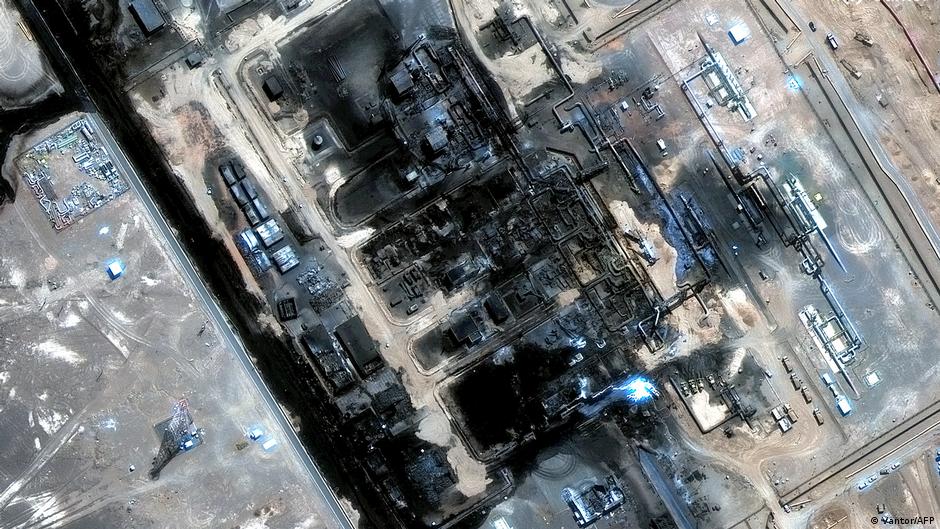
This satellite image shows a pumping station along the general route of Saudi Arabia's East-West pipeline following an attack by Yemen's Iran-backed HouthisImage: Vantor/AFPAdvertisementThe conflict between Yemen's Houthi rebels and Saudi Arabia has sharply escalated in recent days, with Houthi forces making rapid gains along the Red Sea coast and taking control of key areas around the Bab el-Mandeb Strait.
Saudi Arabia has responded with airstrikes, while Houthi forces have launched drones and missiles towards Saudi territory. The renewed fighting has also raised concerns about global trade through the Red Sea.
The conflict has also spread online, where significant disinformation has circulated.
DW's fact-checking team examined what is circulating and why a conflict that is so hard to observe independently leaves so much room for this kind of disinformation.
One nine-second clip has gone viral. It shows a huge explosion between buildings, with fireballs and screaming in the background.
Claim: A user posted the video on X with the Arabic caption, "Yemeni forces are carrying out the strongest strikes in various areas in Saudi Arabia, including Abha." The video has more than 340,000 views.
It was also posted in other languages, falsely claiming it showed real footage from the current fighting.
The video is not only old, but also artificially generated. There are several visual clues in the clip: the pattern of the explosions and the uniform way the smoke spreads.
A large-scale explosion of this kind would also have generated a very bright flash, and nearby buildings would likely have collapsed or at least had their windows shattered. Neither appears to have happened.
One can also see, in the final seconds of the video, how a lamppost appears out of nowhere in the middle of the frame.
The audio is mostly unintelligible, but the speaker's tone does not appear to change after the huge explosion. Such a large explosion would normally be expected to trigger some audible reaction in the speaker's voice.
On the technical side, Hive Moderation's AI detection analysis also confirmed that the video was artificially generated.
And this is not the first time this video has been posted. The very same video was shared this June, claiming to show explosions in Iran, as we found with a reverse image search.
The recycling of old or unrelated footage is not new to the Yemen conflict.
Hannah Porter has spent years researching fake news and disinformation in Yemen and the country's wider information environment. She says this has been happening for years.
"There is less international attention in Yemen than there might be in other conflicts around the world. And because there is not sufficient attention paid to Yemen, I think that allows more space for disinformation to spread not only within Yemen and in the region, but globally about Yemen," Porter said in an interview with DW.
The Houthis seized Yemini capital Sanaa and expanded their control in 2014. Saudi Arabia intervened militarily in 2015 in support of Yemen's internationally recognised government.
A UN-brokered truce in 2022 sharply reduced fighting, but it did not resolve the conflict. Fighting has since intensified again.
The Houthis now control large parts of northern and western Yemen. Saudi Arabia supports forces opposing them, while Iran has provided the Houthis with military support.
Experts and media watchdogs like Reporters Without Borders have repeatedly pointed out that reporting from some parts of Yemen remains extremely difficult. Journalists face threats, while independent media outlets are under intense pressure. This contributes to the spread of disinformation.
It is "very difficult to get reliable information, especially now and especially in the North [of Yemen]," Porter said.
She said researchers and the international community are also struggling to establish what is happening in northern Yemen.
The second video that DW Fact check examined shows how genuine footage can become a source of disinformation.
Claim: A 30-second clip posted on X shows a convoy of military vehicles passing through a desert. Moments later, large explosions erupt and several vehicles are engulfed in smoke and flames. The caption reads: "The most beautiful thing I've seen: Houthis ambush against the Saudi-Backed Mercenaries' convoy in Yemeni."
The video is old and unrelated to the ongoing conflict.
A timestamp visible in the video points to March 10, 2024. A reverse image search led DW to an older video published on YouTube in April 2024.
That video claims to show a Houthi military exercise. Its caption, written in Arabic, describes a simulated ambush on Israeli positions and attacks on US and British forces. Israeli and American flags can be seen in the footage.
DW also traced the sequence to a 42-minute video published by Yemeni War Media, an outlet affiliated with the Houthi movement.
Interestingly, the audio of that clip was changed. The version that is now circulating contains dramatic commentary, which is actually sports commentary from a football match played in 2018, as clips from that match show.
As is often the case, the clip with the convoy has also been used previously in different contexts.
With much of Yemen's media landscape weakened by the conflict, reliable information about events can be difficult to obtain.
That makes it harder for people to independently assess footage circulating online, Porter says, adding that such unverified or misattributed videos can significantly shape perceptions of how battles are unfolding elsewhere.
"Any image or video that you see that is purported to be of a specific battle in Yemen, you have to be really skeptical and you have to find a way to fact check it."