
Far-right AfD wins state election in Mecklenburg-Western Pomerania, CDU fails to enter parliament
Tired of missing our real-time updates? Click here to add us as a Preferred Source on Google. Then tap the "Star" or "Preferred" to keep DW News at the top of your feed.
The far-right Alternative for Germany (AfD) party won the state election in Mecklenburg-Western Pomerania, while the conservative Christian Democratic Union (CDU) failed to secure any parliamentary seats.
According to the preliminary results announced by the election commission early Monday morning, the AfD secured 38.2% of the vote on Sunday. The Social Democratic Party (SPD), which is led by state premier Manuela Schwesig, garnered 35.5% of the vote.
The socialist Left Party (6.5%) and the environmentalist Green Party (5.7%) were the only other parties to make it into the state parliament.
Chancellor Friedrich Merz's CDU suffered disastrous losses, failing to secure a seat in parliament with only 4.9% of the vote.
The populist Sahra Wagenknecht Alliance (BSW), which combines left-leaning economic, conservative migration and pro-Russian foreign policy initiatives, also fell short of entering the state parliament with 4.8%.
The business-focused Free Democratic Party (FDP) failed to regain a seat, securing only 1.0%.
The AfD will therefore hold 32 seats in the new state parliament, while the SPD will hold 29. The Left Party and the Greens will each hold five seats.
The previous SPD-Left Party coalition no longer has a majority, but a three-party alliance with the Greens would have one. All three parties have ruled out forming coalitions with the AfD.
The left-wing populist BSW has acknowledged it would not be represented in the next state parliament in Mecklenburg-Western Pomerania, as it failed to secure the legal minimum of 5% of the votes.
"We didn't make it," BSW's top candidate Peter Schabbel told the DPA news agency late on Sunday. This marks a contrast with his comments hours before, when he said the party was "very confident" about entering parliament.
In his latest remarks, Schabbel said his party failed to qualify due to the polarizing battle between the AfD and the SPD, which harmed smaller parties. He also said the BSW wants to overcome this polarization and would continue to work towards this goal.
Another senior BSW representative in Mecklenburg-Western Pomerania, Sabine Firnhaber, also said the BSW will continue its work in the northeastern state.
"We have a state association, we have regional groups, we have active members," she said. "And we represent goals that would also be worth fighting for in four or five years."
Elections in Berlin and Mecklenburg-Western Pomerania have dealt the CDU a historic defeat while the AfD saw a massive gain.
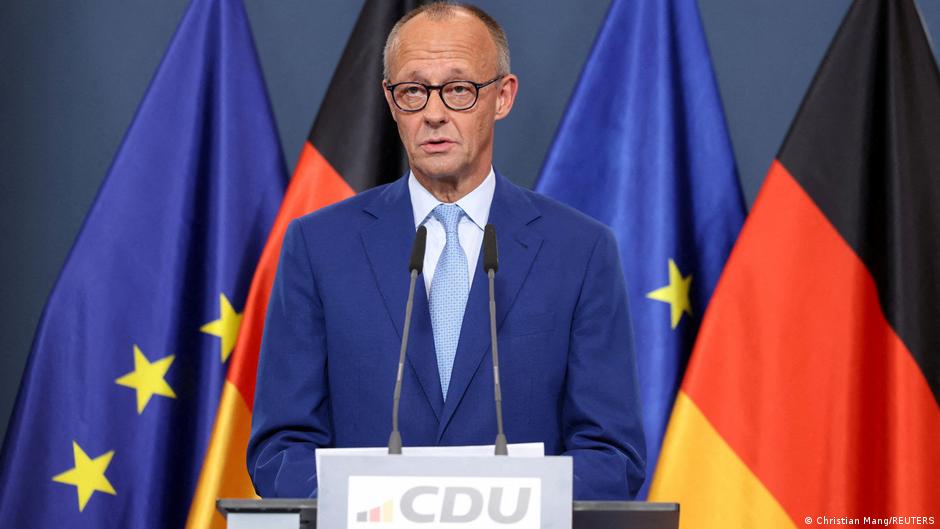
Just minutes after the first projections were released, Merz made a statement: "We can't sugarcoat the results in Mecklenburg-Western Pomerania — it was a disaster." As for the heavy losses in Berlin, he described the outcome there as "reasonable."
Read the election night analysis by DW's Marcel Fürstenau here.
The center-left SPD placed second in the German state of Mecklenburg-Western Pomerania, securing around 35,4% of the votes compared to the AfD's 38.3%.
However, the current head of the state government, Manuela Schwesig, might still keep herself and her SPD party in power.
With the center-right CDU and the leftist populist BSW both projected to stay out of parliament, the assembly is likely to be comprised out of only four parties: the AfD, the SPD, the Left Party and the Green Party.
Schwesig's current administration is backed by the Left Party. According to projected results, a new alliance between the Left Party and the SPD would fall short of a majority, but a three-way coalition involving the Greens would form a ruling bloc of 39 seats, enough for a majority in the 71-seat assembly.
While other coalitions are theoretically possible, it appears unlikely that any of the other parties will enter a coalition with the AfD, despite its success at the ballot box.
Other German political parties rule out working with the AfD in a strategy known as the "firewall" against the far right.
With the socialist Left Party securing the largest share of the state parliamentary vote in Berlin, the party's mayoral candidate Elif Eralp celebrated the victory of "love and justice over hate."
"Starting today, we are changing Berlin together and make it a better place," said Eralp, who hopes to become the first female mayor of Berlin with immigration background.
Eralp was born in Munich in 1981 to a family of Turkish refugees. While her victory speech was mostly in German, she also shouted out "We wrote history, friends" in Turkish during her address.
The Left Party has big plans for Berlin, including tackling its housing crisis by expropriating real estate own by large corporations. In order for Eralp to become the mayor of Berlin and the head of its state government, however, her party would need to form a coalition, with the center-left SPD and the environmentally friendly Green Party being the most likely contenders for a power-sharing deal.
Germany's conservative Christian Democratic Union (CDU) will not enter the next parliament in the northeastern state of Mecklenburg-Western Pomerania, according to projections published by Germany's top public broadcasters.
The latest predictions published by public broadcaster ARD put the party of Chancellor Friedrich Merz at 4.9%, cementing its worst-ever defeat in a state election of this kind. Another German public broadcaster, ZDF, initially maintained its 5% projection before also adjusting its estimates to 4.9%.
The conservative party is not the only one in danger of falling below the legal limit, with the leftist populist Sahra Wagenknech Alliance (BSW) also seemingly just below the threshold.
If both of these factions are kept out of the next parliament, the new assembly would have only four parties: the far-right AfD, the center-left SPD, the socialist Left Party, and the environmentally friendly Greens.
The AfD would still require a coalition partner to form a majority.
Friedrich Merz's Christian Democratic Union (CDU) is fighting to stay in the Mecklenburg-Western Pomerania parliament, with its result hovering around the 5% mark.
However, even if the conservatives are represented in the next state parliament, the Sunday election already marks their worst ever election defeat in the state parliamentary votes held anywhere in Germany. The party, founded in 1945, was traditionally considered one of the country's "big tent" political factions seeking to accommodate a wide spectrum of voters.
Its previous worst score was 9% of the vote they secured in Bremen in 1951, according to a report published by NDR, the public broadcaster covering Mecklenburg-Western Pomerania.
German citizens in Berlin aged 16 and 17 were able to cast their ballots in the state election for the first time on Sunday — and they were among a group that voted overwhelmingly for progressive parties.
According to results on Sunday evening, some 43% of voters aged 16-24 voted for the socialist Left Party. Another 12% voted for the Greens, while 7% voted for the Social Democrats (SPD).
Meanwhile, around 12% of voters aged 16-24 for the far-right Alternative for Germany party (AfD).
It was voters in the 25 to 34 age group who were the biggest bloc to have supported the Left Party, with 48% casting their ballots for the far-left party.
Support for the Left Party dims as the age groups grow older, with voters around 33% of voters above 70 having voted for the incumbent Christian Democratic Union (CDU).
Commenting on the Berlin state election, the city's Protestant Bishop Christian Stäblein said the majority of the voters endorsed "liberal democracy."
"We are a church bound by the Christian view of humanity and by the dignity of every person," he said.
His Catholic colleague, Heiner Koch, said his church would "continue to critically observe politics, and warn against the supposedly easy solutions, and speak up for those, who are insufficiently seen or heard in the political debate."
Berlin "is and stays diverse," the Catholic bishop said.
The head of Germany's Verditrade union has called on Chancellor Friedrich Merz's government to change course on planned reforms following the elections in Mecklenburg-Western Pomerania and Berlin.
"I hope Mr Merz realizes that he has screwed up," Verdi chairman Frank Werneke told the Süddeutsche Zeitung newspaper.
Werneke called on the government to abandon plans requiring employees to provide a doctor's note from the first day of illness and ending full retirement benefits after 45 years of contributions.
"Many people reject abolishing the full pension after 45 years of contributions. That is an important reason for the CDU's poor performance in the recent elections," Werneke said. "People are worn out and exhausted. They want to stop working, and they need to."
Werneke also described the recent electoral gains of the far-right Alternative for Germany party (AfD) as "extremely threatening."
"An AfD federal government would be a catastrophe," he said, arguing that leaving the euro and European Union would be economically disastrous and that Germany needed immigration.
"Everything must be done to ensure that the AfD does not enter government," Werneke said.
Verdi and other trade unions plan a nationwide day of protest on Saturday, with demonstrations expected in 15 cities.
The top candidate for the center-left SPD in Berlin, Steffen Krach, refused to discuss cooperation with other parties in the city's Senate.
"It's too early to talk about coalition options," he said, when asked if his party would prefer to rule with the Left Party or the CDU conservatives.
Talking to state broadcaster ARD, Krach noted that the incumbent CDU-SPD coalition was clearly defeated at the polls, and that future steps will be decided within the party committees in the following weeks.
Meanwhile, the Green party indicated they were ready to rule together with the Left Party and the SPD.
"We want to take responsibility and forge a progressive alliance for Berlin together with the SPD and the Left," said senior Green representatives Nina Stahr and Philmon Ghirmai, saying that Berliners voted in favor of political change.
According to incomplete projections published by German media, the leftist populist Sahra Wagenknecht Alliance (BSW) will not be entering the state legislature of Mecklenburg-Western Pomerania, depriving them of the kingmaker role they had previously secured in Saxony-Anhalt.
The estimates published by German state broadcasters ARD and ZDF just after 8 p.m. on Sunday show BSW at 4.9% of the votes, just shy of the 5% threshold they need to secure in order to be represented in the state parliament.
Moreover, the latest available numbers show Friedrich Merz's Christian Democratic Union (CDU) hovering around 5%, also putting it at risk of not having a parliamentary presence. A failure by the center-right CDU to enter the chamber would ramp up pressure on the chancellor, whose power is already shaken by the Saxony-Anhalt vote and his party's already staggeringly low result in Mecklenburg-Western Pomerania.
The numbers are subject to change as the official count continues.
With the far-right populist AfD leading the pack in Mecklenburg-Western Pomerania, but still projected to fall well short of the parliamentary majority, the leftist populist BSW rejected the possibility of officially joining forces.
BSW's top candidate Peter Schabbel said there would be no coalition with the AfD.
However, he noted that cooperation between the two parties was still possible, including voting together.
This language reflects BSW's attitude following the Saxony-Anhalt election two weeks ago. With the AfD also falling short of a parliamentary majority in this German state, the BSW said it would "decide on the substance" when it comes to supporting them in parliament.
On Sunday, Schabbel also sought to dispel doubts that BSW would clear the 5% hurdle to enter the Mecklenburg-Western Pomerania parliament, despite the projections showing them at the very edge of the required percentage of the vote.
"We are very confident that we will get into the state assembly," Schabbel said.
Senior Christian Democratic Union (CDU) politician Philipp Amthor has blamed members of his own party who questioned its firewall against the far-right Alternative for Germany (AfD) for contributing to the CDU's poor showing in Mecklenburg-Western Pomerania.
Amthor, a minister of state in Chancellor Friedrich Merz's Chancellery, told public broadcaster ZDF that there was a "very clear position" across the state CDU on maintaining its distance from the AfD.
He said individual party figures had tried to soften that position, but that this had instead contributed to "even greater uncertainty among our voters here in Mecklenburg-Western Pomerania."
"I am very grateful that everyone kept their nerve and did not draw the wrong conclusions," Amthor, who himself hails from the state, said.
The CDU is hovering around the 5% threshold in the latest projections, a big drop from the 13.3% it won in 2021.
Amthor described the CDU's result as a "historic defeat" and a "tectonic shift" for a party that governed Mecklenburg-Western Pomerania from 1990 to 1998.