
Fed Interest Meeting: Kevin Warsh Raises Rates Despite Trump’s Desires - Newsweek
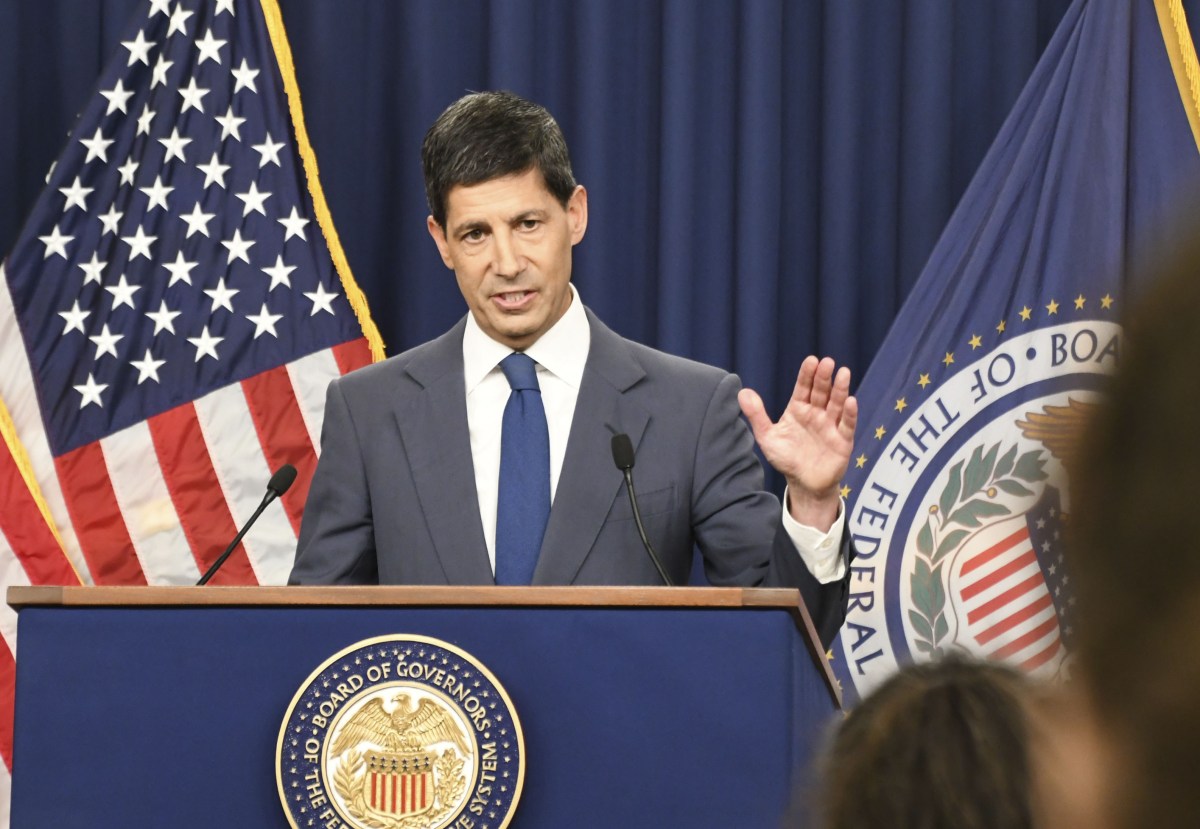
The Federal Reserve raised interest rates Wednesday — a move that puts new Fed Chair Kevin Warsh squarely at odds with President Donald Trump’s demands for lower borrowing costs.
The Fed raised its benchmark interest rate by a quarter percentage point, taking the federal funds target range from 3.50-3.75 percent to 3.75-4.00 percent. It was the first rate increase since 2023 and the first major test of Warsh’s approach to monetary policy since he took over as chair.
“The plain fact is that inflation is too high and has been for too long,” Warsh said at his post-meeting news conference. “Today, the FOMC decided that this standard has not been satisfied.”
Warsh said the decision reflected the Fed's assessment that the economy remains resilient even as inflation stays elevated. “Our decision comes at a time when the American economy appears to be strengthening,” he said, pointing to new hiring, private-sector earnings and business investment.
The rate hike comes despite Trump's repeated calls for lower interest rates. Trump has said the United States “should be paying the lowest interest rate in the world.”
When asked what his message was to Trump amid the hike announcement, Warsh declined to comment, saying, "I've got nothing for you on a discussion with the president.”
While Trump himself has not yet publicly reacted to the hike, Special Assistant to the President Kush Desai called it an "unfortunate decision."
"I think the president has been abundantly clear on where he wanted interest rates to go," he said on Fox News after the rate announcement. "And certainly today's rather unfortunate decision by the Federal Reserve to hike interest rates was not, from the administration's point of view, backed by a particularly compelling economic case." Desai said that inflation, "to the extent that we still do have inflation" was being "entirely driven by an energy supply shock, by what's going on with oil prices in the Middle East. And these are things that have nothing to do with, with interest rates and are not affected really by by higher interest rates," he added.
Meanwhile, Democratic leaders and lawmakers have begun to blame the president for the hike.
Sen. Chuck Schumer posted on X that, "Trump can put whoever he wants in charge of the Fed, but the same inescapable truth remains: His economy is awful, and it’s getting worse by the day. The Fed hiking rates was the inevitable result of his failures and will raise Americans’ costs in countless ways."
Sen. Elizabeth Warren added that Americans would be directly affected by the decision.
"You will pay more for your mortgage and your credit card bills because of Donald Trump," she posted on X.
Warsh pointed to an economy that he said was strengthening, with resilient consumer spending, strong productivity growth and robust business investment. But inflation was the central concern as it remained above the Fed's 2 percent target, while higher energy prices have added to concerns about renewed price pressures.
He said the latest inflation readings suggested that total PCE inflation was around 3.6 percent in August, with core PCE inflation around 3.2 percent.
“Too many categories are still posting increases above 3% on both a six and 12 month basis,” Warsh said. He also pointed to rising commodity prices as another concern.
Warsh said the latest data put 12-month PCE inflation at roughly 3.6 percent in August, with core PCE inflation around 3.2 percent. “Too many categories are still posting increases above 3 percent on both a six and 12 month basis,” he said.
The Fed said economic activity was expanding at a solid pace, while domestic spending remained resilient, productivity growth was strong and capital investment was robust.
“Today’s policy action will support a timely return to the committee’s 2 percent goal,” Warsh said. "This committee will deliver price stability.”
Warsh said three things had changed since the Fed's July meeting: the economy had strengthened, inflation trends had not improved enough, and geopolitical risks had shifted.
On the economy, Warsh said data covering the intervening seven weeks showed that “the economy has strengthened.” On inflation, he said he had seen little since July that would change his assessment that inflation trends remained too high.
“I've seen very little information since that would make me reverse that decision,” Warsh said. “So I've stuck with it.”
Geopolitics was the third factor, with Warsh pointing to “hotspots around the world” and changes in the Fed's assessment of the geopolitical outlook. “All three of those things lend themselves to a firm unanimous decision today,” he said.
Warsh rejected the idea that the hike was driven by a particular piece of economic data, including the latest retail-sales report or August inflation figures.
“I'm not a data point dependent guy,” he said, adding that policymakers should focus on broader trends. “Data points are noisy,” he said. “Data point dependence is a dangerous preoccupation.”
He said markets and reporters had become accustomed to waiting for individual economic releases, but that was not how he approached the decision. “I was not waiting breathlessly on what any particular data was,” Warsh said.
Warsh declined to commit to whether the Fed was considering additional hikes, telling reporters, “I’m not in the forward guidance business.
Warsh said the Fed had been “preparing for and thinking about” the decision during his time as chair. “I’m not going to prejudge any future decisions we make,” he said.
When asked whether Wednesday's unanimous decision represented another test of the Federal Reserve's independence, given Trump's repeated calls for lower interest rates, Warsh declined to discuss his communications with the president, but offered a broader defense of the Fed's independence.
“Part of the independence of the Federal Reserve is we stay in our lane. Independence is a two-way street," he said. “We let people that do trade policy and fiscal policy stay in their lane too,” Warsh said. “That's how we can stand up here and call them the way we see them.”
He also pushed back on the idea that the Fed had simply followed financial markets, which had priced in a high probability of a rate increase before the meeting.
“Sometimes the market tries to prejudge our outcomes,” Warsh said. “I’ll observe market prices and see what they have to say. But today was our decision.”
Asked how his view of the economy had changed since before he became Fed chair, Warsh said his initial suspicion was that the economy was strengthening.
“Now, my suspicion 110 or 20 days ago when I showed up was that the U.S. economy was strengthening,” Warsh said. He said subsequent data had reinforced that view.
“I think we now have data broadly defined that says the economy has indeed strengthened,” he said. “Underlying growth is higher.”
But he said inflation remains the problem.
“Stable prices have been the problem for now, more than five and a half years,” Warsh said. “What the committee decided to do today was take an action to ensure a timely return to our price stability objective,” Warsh said. “Price stability is foundational to economic growth, and I think we took an important step today to deliver it.”
Trump has repeatedly called for lower interest rates, arguing that the United States should have cheaper borrowing costs.
Just days before the Fed's September meeting, Trump said the United States “should be paying the lowest interest rate in the world.” He has also threatened additional tariffs if the Fed does not lower borrowing costs.
Trump has been more restrained in his comments about Warsh personally than he was with Warsh's predecessor, Jerome Powell. On Aug. 31, when asked about Warsh's suggestion that rates could rise, Trump said: “I have a lot of respect for him, and he'll do what he has to do.” Trump immediately added: “I think our interest rates are too high.”
Trump has nevertheless continued to press for lower rates. Earlier this month, after the August jobs report, he wrote on Truth Social: “High interest rates put the U.S.A. at a very unfair disadvantage, and I won’t allow that to happen!” He also wrote: “A STRONG COUNTRY MEANS A LOWER INTEREST RATE - IT’S A BETTER CREDIT…Very simple!”
Wednesday's quarter-point increase therefore represents a clear difference between Trump's stated preference and the Fed's latest policy decision. Warsh's comments following the decision will offer further insight into how he views the Fed's policy path and its relationship with the White House.
Trump’s clashes with Warsh's predecessor Jerome Powell centered largely on interest rates — with Trump repeatedly pressing the Federal Reserve to cut borrowing costs while Powell and other Fed officials emphasized the central bank’s independence and its responsibility to control inflation.
The tensions became especially public during Trump’s second term. In April 2025, Trump said Powell’s termination “can’t come fast enough,” accusing the Fed chair of being too slow to lower interest rates. Trump also accused Powell of “playing politics” over monetary policy.
Powell pushed back against the pressure by emphasizing the Fed’s independence. The central bank was facing a difficult policy environment at the time, with inflation still above its 2 percent target and Trump's tariff policies adding uncertainty about the future path of prices.
Trump's criticism continued as the Fed resisted calls for more aggressive rate cuts. The president argued that lower rates would reduce borrowing costs and support economic growth, while Fed officials had to weigh those benefits against the risk of allowing inflation to remain elevated.
The dispute also became a question of whether a president could remove a Fed chair over policy disagreements. Powell's term as chair was set to expire in 2026, but he maintained that he intended to serve his full term. The controversy prompted renewed attention to the Federal Reserve's statutory independence from the White House.
Trump ultimately selected Kevin Warsh to succeed Powell. Warsh's first rate increase as chair on Wednesday may now create new tension with the latest federal reserve chair.
Wednesday's increase does not necessarily mean the Fed is committed to raising rates at every remaining meeting.
The focus now shifts to the Fed's updated economic projections and Warsh's comments about the path of interest rates. Before the decision, economists surveyed by Reuters expected at least one more rate increase by March, although future decisions will depend on incoming inflation, employment and economic data.
Markets will also be watching the Fed's so-called dot plot, which shows policymakers' expectations for future interest rates.
The Federal Open Market Committee met Tuesday and Wednesday, Sept. 15-16, with the rate decision announced Wednesday afternoon. The committee voted unanimously to raise the federal funds target range by a quarter percentage point.
Warsh emphasized that the decision was based on the Fed’s assessment of the economy rather than financial-market expectations.
“We made this decision today based on our assessment of the situation, based on our assessment of the trajectory for employment, based on our judgment on the strength of the economy,” Warsh said.
This is breaking news, updates to follow.


