Fighting transnational crime opens space for China-US cooperation
By continuing to browse our site you agree to our use of cookies, revised Privacy Policy and Terms of Use. You can change your cookie settings through your browser.
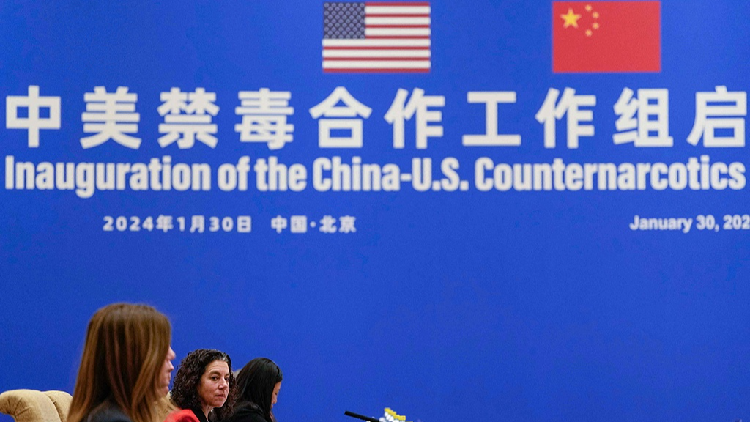
The China-US counternarcotics working group is launched at the Diaoyutai State Guesthouse in Beijing, capital of China, January 30, 2024. /VCG
China and the United States have stepped up law enforcement cooperation in recent months, with joint operations targeting transnational drug trafficking and other cross-border crimes, even as the two countries continue to face significant competition in other areas.
Earlier this month, China's Ministry of Public Security (MPS) and the US Federal Bureau of Investigation (FBI) jointly cracked a transnational case involving the trafficking and manufacture of synthetic cannabinoid precursors. According to a media report, the US side provided key leads, while Chinese authorities carried out the arrests.
In May, the MPS and the US Attorney's Office for the Southern District of Florida separately announced the resolution of a transnational drug trafficking case. The operation led to the arrest of five suspects – two Chinese nationals and three US nationals – and the seizure of drugs including protonitazene and bromazolam, disrupting a trafficking route spanning the two countries.
Following his visit to Beijing in late July, FBI Director Kash Patel said exchanges between China and the United States on combating crime had become unprecedentedly frequent this year.
"Every month, they send their working-level MPS officers here, and the following month we go there," Patel said in an interview. "They are speaking with us daily, which has also never happened before."
Patel said China and the United States had strengthened cooperation against transnational crimes, including fentanyl trafficking, cyber fraud and child sexual exploitation. The partnerships have involved personnel exchanges, joint investigations and intelligence sharing.
In July, China's Ministry of Public Security said law enforcement agencies from both countries had carried out a series of practical cooperation initiatives since the beginning of the year, achieving tangible results in counternarcotics, combating telecom and online fraud, and repatriating fugitives.
The ministry cited several cases. In May, Chinese, US and UAE law enforcement agencies jointly targeted telecom and online fraud operations in Dubai, dismantling nine scam centers and arresting 276 suspects. In another case, Chinese authorities repatriated to the United States a US national accused of serious violent crimes.
Experts say counternarcotics is a priority for the Trump administration, and China and the United States share common interests in it and other transnational crimes. However, they said structural contradictions between the two countries, along with Washington's zero-sum approach to bilateral relations, continue to constrain cooperation in other areas.
"Counternarcotics, fugitive repatriation and combating telecom fraud are relatively low-sensitivity issues of transnational public governance. With clear shared interests, cooperation in these areas is comparatively easier to advance," Zhang Tengjun, deputy director of the Department for American Studies at the China Institute of International Studies, told CGTN.
Zhang added that friction between the two countries in technology and geopolitics stems in part from Washington's zero-sum view of China's development.
"Some people in the United States are unable to accept other countries challenging its technological and geopolitical hegemony," Zhang said, describing this as "an extremely narrow-minded and fundamentally misguided perception."
Zhao Minghao, a professor at Fudan University's Center for American Studies, said that tangible progress in counternarcotics and international law enforcement cooperation could help strengthen the "security factor" in bilateral ties.
"Under the current circumstances, whether China and the United States can maintain consultations and cooperation in law enforcement and security will have strategic significance for sustaining the resilience of bilateral relations in the next stage," Zhao said.
Since the meeting between the two heads of state in San Francisco in November 2023, China-US relations have shown signs of stabilization, with dialogue resuming or being established across multiple fields. Consultations and cooperation on law enforcement and security have taken on growing importance in the broader bilateral relationship.
Following the meeting, the two sides agreed to establish a China-US counternarcotics working group, which was formally launched in 2024.
Zhao said both sides should attach great importance to law enforcement as an irreplaceable channel of engagement, strengthen interagency coordination, expand exchanges among experts and think tanks, and continue to deliver practical results to support the stable development of bilateral ties.
He added that, given the growing security challenges posed by emerging technologies such as artificial intelligence, China and the United States should also strengthen dialogue and coordination in these areas.
Wang Honggang, director of the Institute of American Studies at the China Institutes of Contemporary International Relations, said China-US relations are likely to continue to be defined by both competition and cooperation. The challenge, he said, lies in keeping competition manageable while expanding areas of shared interest.
During US President Donald Trump's visit to China in May, China proposed positioning bilateral ties as a "constructive strategic stability" relationship. Wang said China's proposal for a constructive strategic stability relationship underscores the importance of preserving dialogue, deepening practical cooperation and preventing differences from escalating into confrontation.