Financial Report Reveals Billions in Losses for Indonesia’s High-Speed Rail
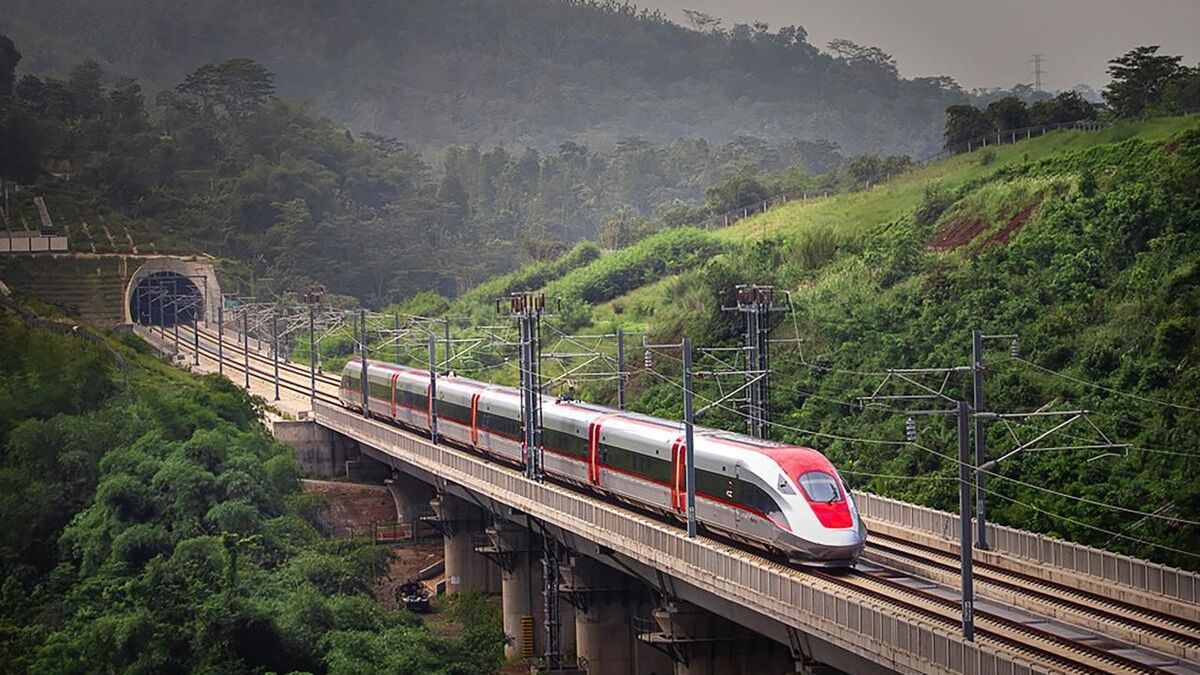
JAKARTA, KOMPAS.com - Indonesia’s first high-speed rail project, the Jakarta–Bandung line known as Whoosh, has continued to weigh heavily on the country’s state-owned enterprises (SOEs), even after the line officially began operations.
Instead of generating profits, the service has consistently posted steep financial losses. Four Indonesian SOEs involved in the project are carrying the burden of mounting debts and high interest payments owed to Chinese lenders.
Most of the project’s financing came from loans issued by the China Development Bank (CDB). Additional funding was drawn from Indonesia’s state budget (APBN) and joint capital injections by Indonesian SOEs and Chinese companies.
The project, launched in 2016, has been plagued by cost overruns, with an additional US$1.2 billion (around 18 trillion rupiah) in expenses, making it even more costly than an earlier proposal by Japan. The overruns were eventually covered by more Chinese loans and Indonesian state funds.
According to the unaudited financial report of PT Kereta Api Indonesia (KAI), the country’s state railway operator, its subsidiary PT Pilar Sinergi BUMN Indonesia (PSBI) recorded a loss of 4.19 trillion rupiah (about US$260 million) in 2024.
Losses continued into this year. In the first half of 2025 alone, PSBI reported another 1.62 trillion rupiah deficit.
PSBI is the majority shareholder of PT Kereta Cepat Indonesia China (KCIC), the joint venture running the high-speed rail. As a shareholder, PSBI is responsible for covering KCIC’s debts and losses, which in turn directly impact its four parent SOEs.
PSBI is a consortium of four Indonesian SOEs formed specifically for the project. KAI holds the largest stake at 58.53 percent, followed by construction firm PT Wijaya Karya (WIKA) with 33.36 percent, toll road operator PT Jasa Marga with 7.08 percent, and plantation company PTPN VIII with 1.03 percent.
On the Chinese side, five state-owned firms under the China Railway consortium are involved: China Railway International, China Railway Group, Sinohydro, CRRC, and China Railway Signal & Communication Corp. Together, PSBI and the Chinese consortium established KCIC, with Indonesia holding 60 percent and China 40 percent.
The cost overruns and debt from the Jakarta–Bandung line have made the government cautious about extending the project to Surabaya, East Java’s capital and Indonesia’s second-largest city.
The proposed Jakarta–Surabaya high-speed rail could cut travel time between the two biggest cities on Java to about 3.5 hours, compared with the current nine to ten hours on conventional trains.
The Ministry of Transportation said feasibility studies are being updated to reflect demand and on-the-ground conditions. One option under consideration is to build a “medium high-speed rail” running at 160–200 kilometers per hour, instead of replicating the full-speed 350 km/h model used on the Jakarta–Bandung route.
This approach is seen as more cost-efficient and better suited for the densely populated cities along the corridor, including Cirebon, Semarang, Solo, and Surabaya.
The exact route alignment is still under review, with options including a northern route, a southern route, or a combination of both.
Coordinating Minister for Infrastructure Agus Harimurti Yudhoyono (AHY) said President Prabowo Subianto has issued firm instructions to move forward with the extension.
“President Prabowo Subianto has clearly directed that the Jakarta–Bandung high-speed rail be extended to Surabaya,” AHY said at the opening of the Indonesia Railway 2025 forum in Jakarta.
According to AHY, the president envisions connecting the entire island of Java through a modern, efficient transport network, without overburdening the state budget.
He added that the government is preparing new regulations to attract private investment and reduce reliance on public funds.
“This is more than just an extension. It reflects the broader vision of connecting mobility across Java. We are drafting a new regulatory framework to make this possible,” AHY said.