
First Blair, now Cameron… why are two pro-EU leaders against rejoining? - The Independent
Want to bookmark your favourite articles and stories to read or reference later? Start your Independent Membership today.
David Cameron is unpopular with Remainers because he was the prime minister who ignited the Brexit wars by staging the referendum that took us out of the European Union. He is given no credit for fighting hard for Remain, or even for calculating that a referendum was the best way to stay in.
So there will be many people on what is now the Rejoin side of the argument who will not be impressed by his intervention in an interview with Bloomberg’s Mishal Husain in which he says we should stay out and “make that work”.
He said that “instead of launching an argument about rejoining, which I think would be a very long and painful argument, and who knows where it would end up”, Britain should “focus on how do we be the best friend, best neighbour, best partner”.
He even said that a customs union is not necessarily “the right answer”, which puts him firmly in the Better Off Out camp.
But Rejoiners should listen to Cameron because he is not a lone maverick. Even more surprising, perhaps, was Tony Blair’s argument in May that Britain should seek to change the EU before seeking to rejoin it, and that we should only attempt to do so “from a position of economic strength”.
This was interpreted as “Blair advocates rejoining”, although its real message was that we should not join the EU as it currently is – and the chances of the EU being reshaped according to the Blair blueprint are similar to those of Elvis Presley being discovered on the Moon.
Blair’s argument is that, since we left, the EU has moved in the wrong direction, making its economy less competitive and trying to constrain, rather than promote, the artificial intelligence revolution.
Cameron’s argument is also about growth. “If you look at the economic problems we have today, I don’t really think they’ve got anything to do with Brexit at all,” he said. “Our economic problems are that we are overspending, over-borrowing, over-taxing, over-regulated, and far too much being spent on working-age welfare. Those are a set of problems that have nothing to do with Brexit.”
But part of his argument is tactical – and similar to Blair’s “negotiate from strength” point – in that if we say we want to rejoin, the EU will know that it can drive a hard bargain.
Cameron said: “If you start endlessly producing this idea that we’re actually on a path to rejoining, I think you’re in danger of getting a less good partnership deal because of course the EU countries will just think: ‘Well, these guys are going to rejoin anyway, so what’s the point in giving them a good partnership deal?’”
That doesn’t strike me as a good argument, because it would apply to any country applying to join the EU. Indeed, it applied to Britain during its attempts to join in the 1960s, when the obstacle was not the terms offered but Charles de Gaulle’s reluctance to accommodate a disruptive influence.
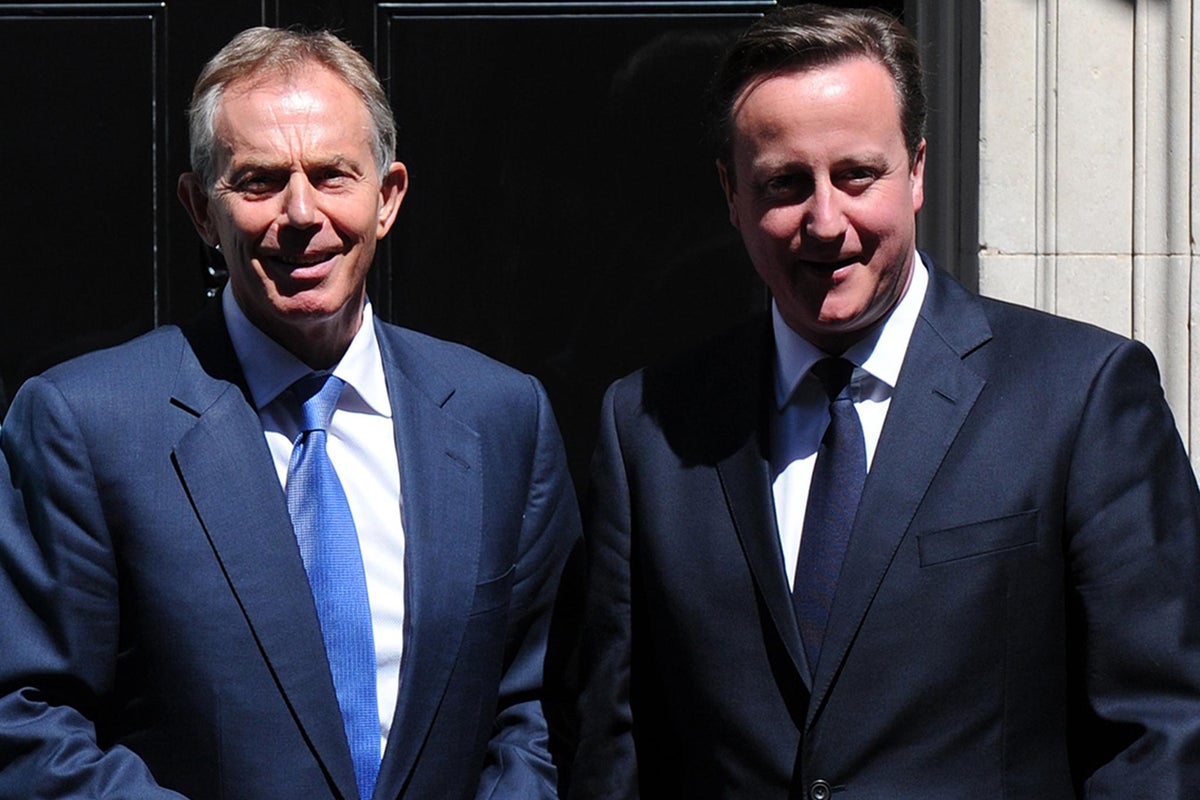
Even so, I think we should pay attention when two former prime ministers, both of whom were deeply committed to EU membership while they were in office, caution against a premature attempt to rejoin.
Without being explicit, they both point to the biggest obstacle to rejoining, which is that both sides have a say in the decision, as the history of de Gaulle saying “Non” in 1963 and 1967 reminds us. Why on earth should EU members spend any time and effort on considering Britain’s re-application if they think we might change our minds yet again?
Nigel Farage last night rejected the idea that he and Cameron were now “blood brothers”, saying “read the small print, folks”. Well, I have read the transcript of what Cameron said to Husain and what is striking is how similar it is to Farage’s line. Farage said: “We’re worse off because of high taxes. We’re worse off for a host of reasons, but not because of Brexit.”
Farage missed a trick there: he could have welcomed Cameron (and Blair) to his club, especially as he is prepared to admit that “the 11 per cent of the British economy that is exporting to EU countries, if it’s physical goods, they found it harder”, and that “I fully accept that if you’re selling oysters or beef to the European Union, it’s harder. I get that. There are bits of the economy that it’s harder for”.
But if he is prepared to admit that, his opponents ought to listen to Cameron and Blair and recognise that rejoining the EU is more difficult and may take longer than the enthusiasts think.
At The Independent, our mission is to deliver unbiased, fact-based journalism. Journalism that's free from political allegiances and the influences of shareholders and commercial interests.
But we need your help. Your support enables us to uncover crucial stories that would otherwise have gone untold, hold power to account, and amplify voices often unheard.
Whether $5 or $50, every contribution counts. It fuels our reporting, invests in investigations, and maintains our independence.
It’s a reminder that our trusted, fact-based, free-thinking journalism remains available to everyone thanks to the generosity of our readers. To show your support and help us tell more of the stories that matter, please make a donation today.
Not ready to donate? Choose 'Maybe later' to start reading.


