Flydubai attack: How Israel’s security lapses almost led to another ‘October 7’ - The Indian Express
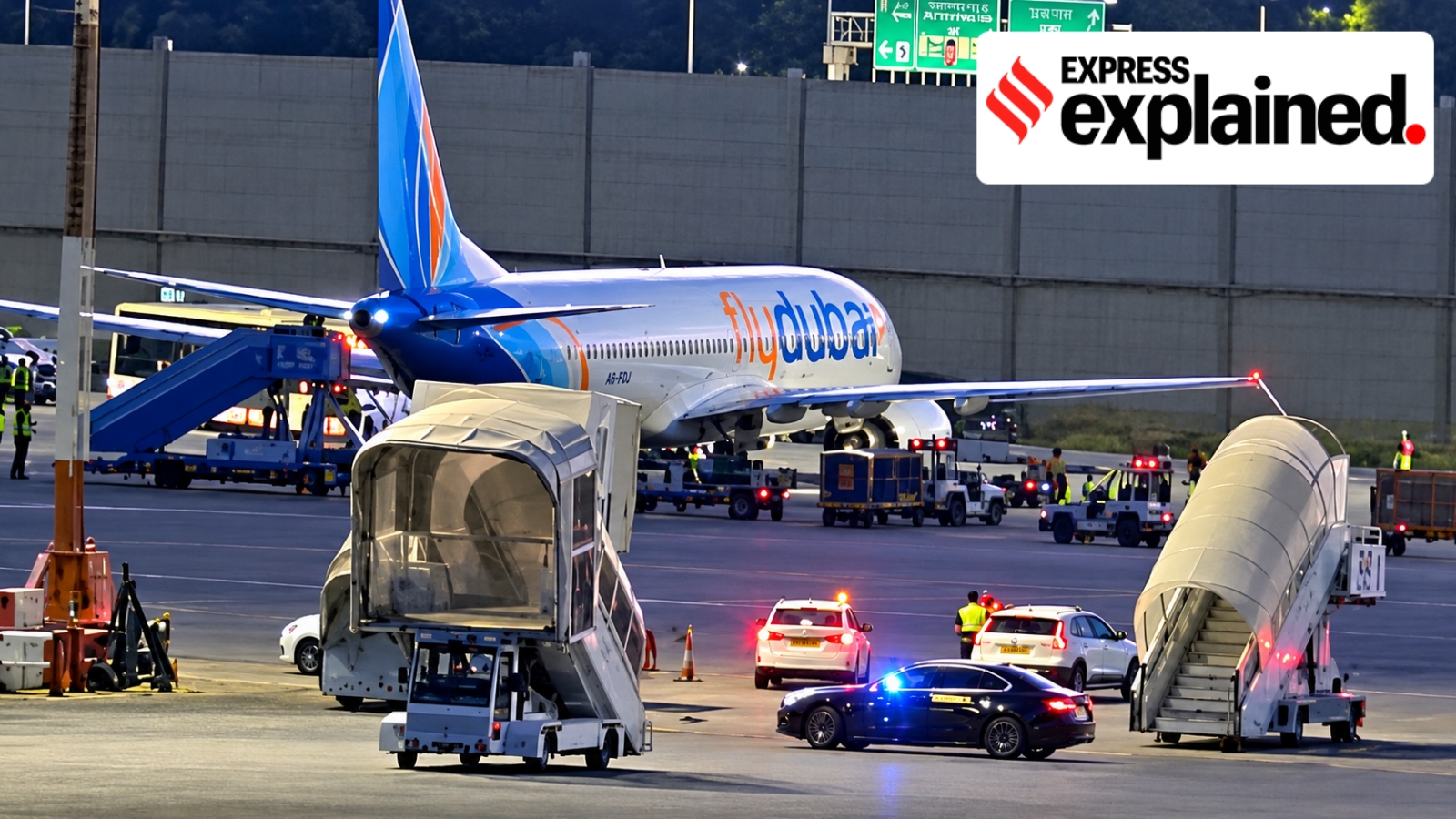
As the dust has begun to settle around last week’s flydubai flight incident, the initial euphoria regarding a potential “terrorist attack” being averted has given way to the realisation that there were security failures on multiple fronts in three countries: Israel, Oman, and the United Arab Emirates (UAE).
A series of revelations showed how there was sufficient opportunity for authorities to prevent the Dubai-Tel Aviv Flight FZ1073 co-pilot Hamam al-Hammami from even getting anywhere near the cockpit, let alone attacking his captain — the Indian pilot Smit Machchhar — mid-flight using an emergency axe that almost caused a crash.
We explain what these revelations are and how they indicate serious lapses on part of Israel’s security system.
Hammami, 29, was born to an Omani father and Syrian mother. Although a Dubai resident, he frequently travelled to Syria during the country’s prolonged civil war, where Islamist rebels fought against the Bashar al-Assad regime. Investigators in the flydubai incident said they were looking at the possibility of radicalisation during his time in Syria.
He then went on to study in Australia. He joined Oman Air in 2018 and became a pilot by 2022, although authorities raised concerns in 2024 about his radical views after he was found browsing extremist websites. He was disallowed from flying and made to undergo a deradicalisation programme, following which he was assigned an administrative job.
After leaving Oman Air in 2025, Hammami tried to join the Moroccan national carrier Royal Air Maroc but wasn’t hired. He eventually joined the budget carrier flydubai, owned by Dubai’s flagship airline Emirates, in February 2026.
Flydubai has been in the midst of an aggressive hiring spree to fuel its growth. Global demand for pilots is high and to meet its requirements, the airline set up a programme in 2025 to train pilots. It also operates its own flight training centre.
As things stand, international aviation licensing works on a country-by-country basis. Citing sources, The Wall Street Journal reported that Oman mishandled the situation: had Oman withdrawn Hammami’s pilot licence over its concerns, the matter would’ve been flagged to the UAE and other Gulf countries.
At the time of hiring, flydubai didn’t contact Oman to verify his experience, although a criminal-background check was done, sources within the airline said. Hammami was then assigned to fly on the sensitive route to Tel Aviv, where he flew multiple times. The airline said it wouldn’t comment on the investigation while it was ongoing.
According to a 2023 law passed in Israel, foreign airlines have to submit lists of passengers and crew to the Israeli government ahead of time. A database of these lists are maintained by the country’s Tax Authority, primarily as a measure of preventing terrorism.
Although the Shin Bet — Israel’s internal security service — oversees the domestic carriers, it is the Ministry of Transportation that oversees pilots and crew on flights of foreign airlines to ensure they come from countries Israel considers “friendly”.
As per the law, the Tax Authority’s database can be accessed by authorised bodies such as the Transportation Ministry as well as Israeli security agencies like Shin Bet and Mossad in order to vet people on flights.
The ministry, however, said it didn’t know that the database was operational — or that it could access it. Since the database was set up in 2023, the ministry has never asked for a passenger or crew list for vetting purposes, sources told WSJ.
The ministry also said that while it was indeed responsible for the security of inbound flights, it lacked the intelligence capabilities to stop onboard threats. Foreign carriers were required to make those checks and in this case, it had asked flydubai — the ministry said that the airline agreed in writing to check its pilots’ backgrounds and nationalities.
The final opportunity to stop Hammami from getting onboard FZ1073 was in Israel itself. Notably, Oman doesn’t have diplomatic relations with Israel, and pilots from such countries are barred from flying to the country. So, the co-pilot could’ve been stopped from boarding the flight merely on the basis of his nationality, but was instead allowed to fly multiple times to Tel Aviv instead.
Meanwhile, a classified May 2024 report by Israel’s comptroller general had flagged the country’s Transportation Ministry for failing to adequately secure foreign carriers’ flights, WSJ reported. It found that officials in the ministry were failing in their oversight in part due to manpower and budget issues. Although Israeli airlines flying between Dubai and Tel Aviv were subjected to scrutiny and even stopped from flying considering the risks posed by the ongoing war in West Asia, flydubai continued to ply on the same route.
What is significant is that the attack happened barely a week ahead of the three-year anniversary of the armed attacks on October 7, 2023, which were carried out by the militant group Hamas and other Palestinian groups. This also comes about a month ahead of Israel’s parliamentary election, scheduled for October 27.
Israeli Prime Minister Benjamin Netanyahu’s office “has instructed the head of the National Security Council, Shmuel Ben Ezra, to appoint an examiner to conduct a thorough review of all security aspects of foreign civil aviation to Israel,” a statement from the prime minister’s office said.
Opposition leader Yair Lapid dismissed Netanyahu’s announcement, pointing that the “chain of failures” leading up to the incident could’ve led to a “disaster of historic proportions”. In a reference to the October 7 attacks, he added: “Just as Netanyahu escaped an investigation into the Oct. 7 massacre, he is now running away again.”
Even as calls for a serious investigation into the security lapses have been growing in Israel, Transport Minister Miri Regev rejected responsibility for the failure and said that security oversight for flights operated by foreign carriers fell under the remit of security agencies such as Mossad and Shin Bet.
Keren Terner, a former director-general of the transport ministry who is now an opposition candidate in the upcoming Israeli parliamentary elections, blamed Regev for the security failure, noting that the Civil Aviation Authority was under the “direct subordination” of her ministry.
Gadi Eisenkot, a leading challenger to Netanyahu in the upcoming election, wrote on X that “in a proper and functioning government, the minister of transportation would have submitted a letter of resignation”.