Flydubai co-pilot Hammam al-Hammami: His past, a crash axe, a ‘terror’ plot — 5 big updates - The Indian Express
The flydubai FZ1073 incident has taken a new turn, with the co-pilot identified by multiple media reports as Omani national Hammam al-Hammami and the UAE saying its investigation found that he attacked Indian Captain Smit Machchhar with a crash axe and attempted to take control of the aircraft.
The developments have also raised fresh questions about al-Hammami’s previous aviation career, his recruitment by flydubai and the security checks that allowed him to operate a flight to Tel Aviv. The UAE-led investigation is continuing, with investigators examining the motive and whether anyone else was involved.
Flight data, the captain’s account and passenger footage, in nine chapters.
Flydubai FZ1073, a Boeing 737 MAX 8 with 182 people on board, takes off for Tel Aviv. Watch the route rise into 3D: the height of the red line is the aircraft’s altitude.
Based on AP and Flightradar24 data. Altitude is exaggerated; the point where the plunge began is approximate.
Cruising altitude. Everything appears normal
For more than two hours, nothing looks unusual. Then, in about four minutes, the altitude line collapses.
Source: AP, Flightradar24. Climb and final descent are simplified.
05:21:09 GMT. Cruising. The descent begins.
05:22:40 GMT. In about 90 seconds the jet has lost more than half its cruising altitude.
05:24:29 GMT. …then drops again, to the height it holds until landing.
The aircraft lost more than half its cruising altitude in the first descent. Source: AP, Flightradar24
Machchhar, badly injured, reaches the cockpit door.
The door opens. Passengers and crew intervene and restrain the attacker.
The cockpit door is locked. The captain is on the floor, injured. The aircraft is falling.
Tap the cabin to see what passengers saw and heard.
Hears shouting. People can be heard shouting “he tried to crash the plane” and ordering others to “sit down”.
Passengers and crew rush forward through the open cockpit door and restrain the attacker.
Repeated calls for a doctor ring out through the cabin.
Dr Shota Musayev, an Israeli dentist, moves forward to give emergency care.
Crew and passengers keep the co-pilot under guard. “No one will release him,” one says.
A passenger asks if there is “an additional pilot on the flight”. Two off-duty flydubai pilots take control.
Source: Channel 12 passenger footage, via The Times of Israel. Positions in the cabin are illustrative.
Not independently verified by The Indian Express.
Pilots can signal trouble silently with a four-digit transponder code. Tap a code.
7700 tells air traffic control the aircraft has a general emergency.
7500 signals unlawful interference, including a possible hijacking. FZ1073 held it for about an hour.
Nearly four hours after take-off, FZ1073 lands in Tabuk, Saudi Arabia. The passengers, most of them Israeli, later flew home on a separate plane.
Why did the co-pilot attack? How was he vetted? Did he act alone? Why was an Omani pilot flying to Tel Aviv?
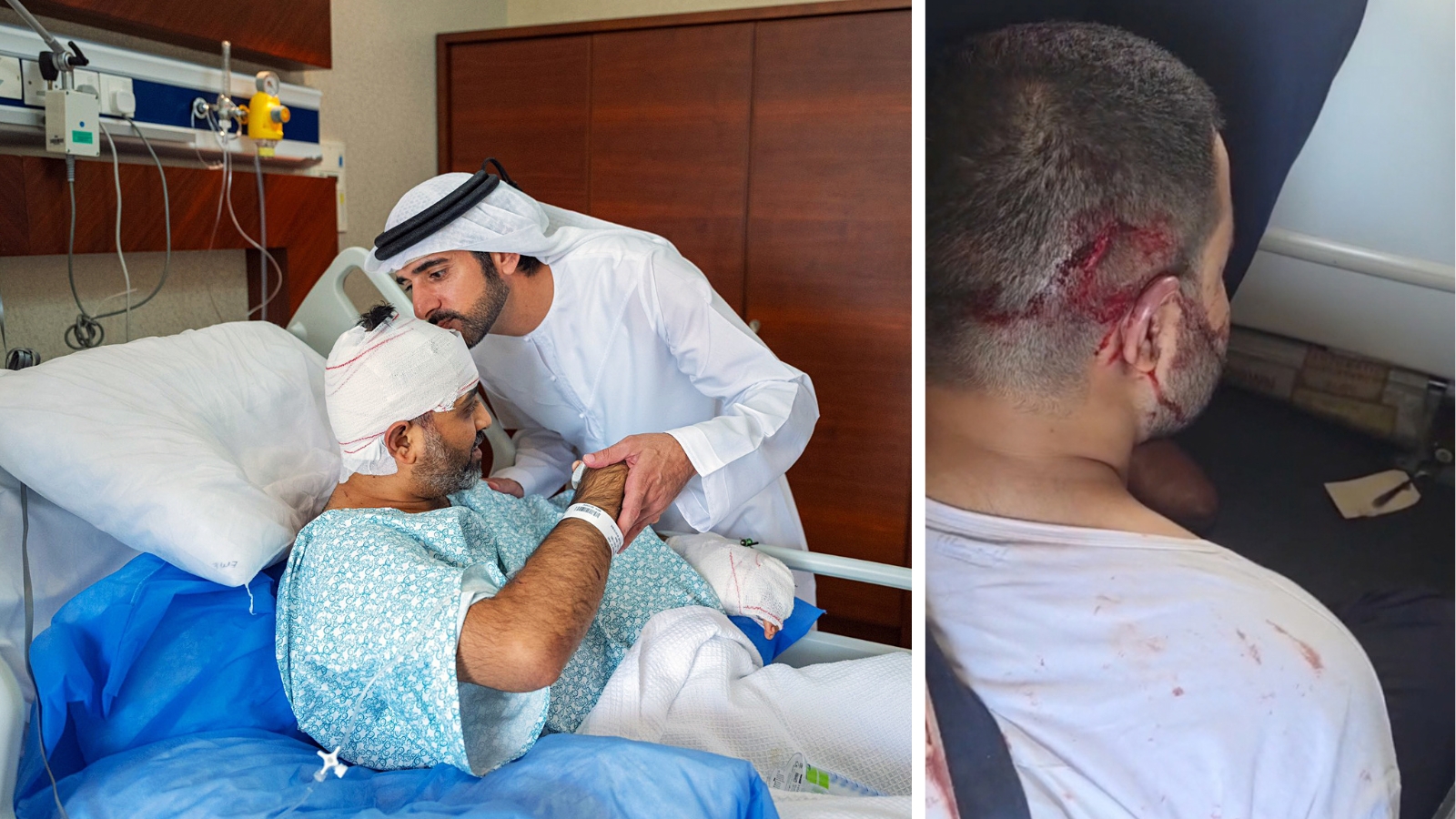
Meanwhile, Dubai Crown Prince and UAE Deputy Prime Minister Sheikh Hamdan bin Mohammed bin Rashid Al Maktoum visited Captain Smit Machchhar at the hospital Saturday, where the Indian pilot is recovering after the cockpit attack.
Following the meeting, Hamdan praised Machchhar for what he described as the “highest degrees of courage, responsibility, and care for human life”.
“From us, and from the leadership of the nation, he has our full appreciation and praise,” Hamdan said in a post on X. “We are proud that he is part of our team… part of the story of our nation… and part of what the UAE stands for… a nation of compassion… a nation of peace… and a nation of life.”
The co-pilot accused of attacking Machchhar aboard flydubai flight FZ1073 has been identified as Hamam al-Hammami, an Omani national. Reuters cited a source with direct knowledge of the matter and a second source briefed on the investigation who confirmed his name. The Associated Press cited three people with knowledge of the situation, including a Gulf diplomat and a Western diplomat.
According to CNN, he was born in the UAE to an Omani father and a Syrian mother and had spent several years in the UAE. His identity has not been formally confirmed publicly by UAE authorities or flydubai.
The identification has added a significant security dimension to the case because Oman and Israel do not have diplomatic relations. Reuters reported that it was not immediately clear how al-Hammami came to be assigned to the Dubai-Tel Aviv flight.
Israel has previously said pilots from countries without diplomatic relations with it are subject to restrictions on operating flights to Israel, making the question of how al-Hammami was cleared for the route an important part of the investigation.
UAE Attorney General Hamad Saif Al Shamsi said the co-pilot attacked Machchhar inside the flight deck with a "crash axe" and attempted to take control of the aircraft.
“The co-pilot attacked the pilot inside the cockpit with a crash axe and attempted to take control of the aircraft,” Reuters quoted Al Shamsi as saying.
He said investigators were continuing to establish the full circumstances, motives and any links related to the incident, as well as examining physical and digital evidence.
Flydubai said on Saturday the circumstances remained under investigation and that it was not in a position to comment further. The airline's chief executive, Ghaith Al Ghaith, had earlier said there were “many questions” about what happened and that a full official investigation was under wa
One of the biggest developments on Saturday was new reporting about al-Hammami's previous aviation career.
AP reported that al-Hammami had previously been barred from flying in Oman over concerns that he had adopted extremist views, citing a person familiar with the matter. The person said he was moved to an administrative role at Oman Air.
The Wall Street Journal reported that he had previously been barred from flying in Oman because of concerns about his radical ideological views. CNN reported that al-Hammami had been removed from flight training because of concerns over his views and was subsequently given another role at Oman Air.
He was later hired by Flydubai, according to people cited by AP. It added that a Gulf diplomat said al-Hammami underwent standard security checks before being hired by flydubai, but that those checks appeared to focus on criminal records rather than deeper examination of possible signs of radicalisation.
Flydubai has not publicly explained what information it had about al-Hammami's previous employment or what checks were carried out before he was hired.
A flydubai spokesperson told AP that the airline could not comment beyond its official statements and acknowledged that “there are many questions at this stage.”
Royal Air Maroc told Reuters that al-Hammami underwent three months of theoretical training with the airline in 2025 as part of its pre-employment process. The airline said his application was ultimately not selected for employment.
Buckinghamshire New University in England confirmed that al-Hammami had completed a distance-learning course in aviation management at the university but “did not undertake any pilot training” there.
CNN had earlier reported that a LinkedIn profile bearing al-Hammami's name said he had worked at Oman Air for seven years, leaving in February 2025, before joining Royal Air Maroc in June 2025. The profile had since been deleted.
Questions are also being raised over social media accounts attributed to al-Hammami. CNN reported that his deleted accounts contained posts about religion, women, the niqab and mixed-gender workplaces, as well as material featuring Israeli aircraft and images of former al-Qaeda leader Ayman al-Zawahiri.
The UAE investigation has yet to establish whether any of these elements were connected to the attack or provide evidence of a motive.