Former journalist turns invasive vegetation into a KwaZulu-Natal charcoal business - IOL
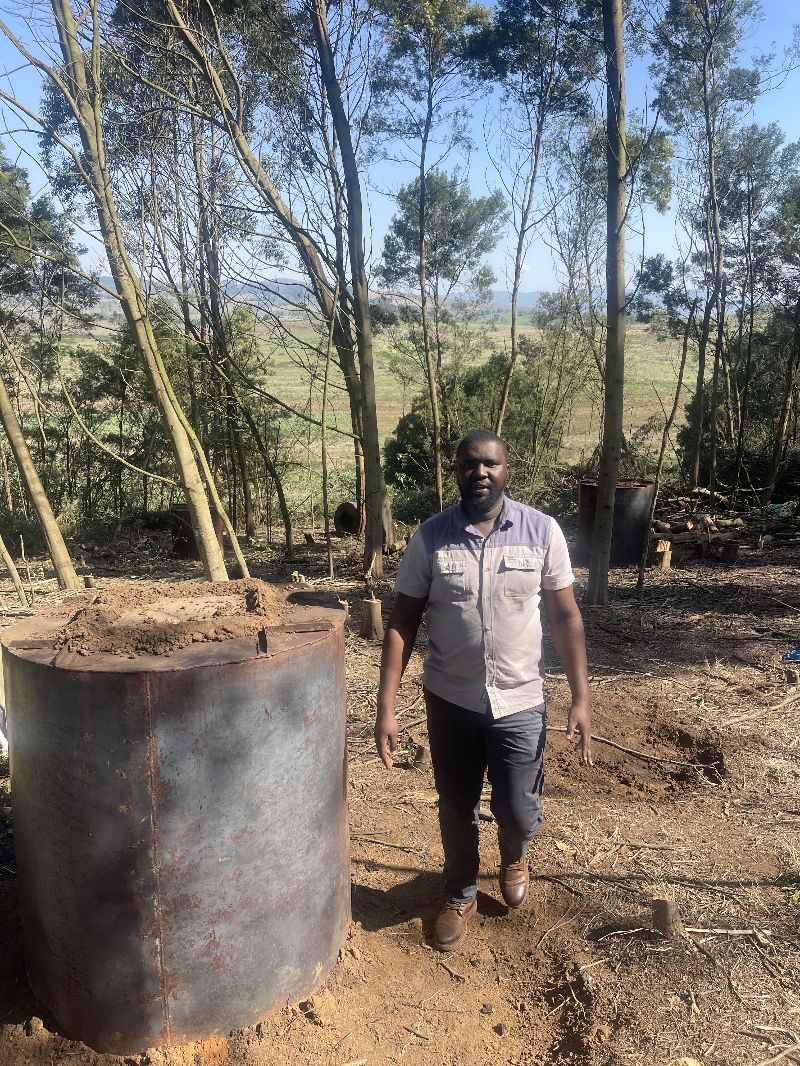
Euphrosyne founder Mxolisi Mhlongo stands beside the metal kiln used to convert invasive vegetation into charcoal in KwaZulu-Natal.
A KwaZulu-Natal entrepreneur who walked away from an uncertain media career and came close to selling his company after years of setbacks is now turning invasive alien vegetation into charcoal while creating jobs and supporting rural producers.
Mxolisi Mhlongo, 36, founder of KwaZulu-Natal green enterprise Euphrosyne, has been named a finalist in the Emerging Business Entrepreneur of the Year category of the 2026 Business Partners Limited Entrepreneur of the Year Awards. The winners will be announced on October 22.
His company clears about 60 hectares of invasive vegetation each month and converts it into roughly 40 tons of charcoal. Euphrosyne employs nine permanent workers and four temporary staff and works with smaller rural producers.
A former journalist, Mhlongo worked at eNCA, Media24, Kwesé Sports, and Kaya FM. Repeated resignations and job losses left him starting over several times.
“Losing a job meant starting over from scratch, and after going through the painful process of losing everything from my car to furniture, three separate times, it took a heavy emotional toll,” he said.
By 2018, he had reached a turning point.
“I decided I could no longer return to Johannesburg to chase corporate roles; I needed to build something of my own.”
Euphrosyne began when he explored supplying wood to a commercial buyer. He lacked the certification required for timber but discovered the buyer would accept charcoal.
Research into permits and wood sources in uMkhanyakude changed his thinking. Mhlongo said he saw the pressure charcoal production was placing on indigenous forests in water-scarce uMkhanyakude.
“I realised that simply telling communities to stop wasn't realistic when their livelihoods depended on it,” he said.
His answer was to use invasive alien vegetation as feedstock, linking land clearing to charcoal production.
Euphrosyne identifies invasive species, harvests the biomass, and converts it into charcoal in metal kilns using pyrolysis.
Mhlongo said the model gives communities an alternative to cutting indigenous trees while creating work around clearing, transport, and production.
Workers at Euphrosyne cut down invasive trees that will be converted into charcoal, supporting rural jobs and helping clear affected land in KwaZulu-Natal.
The company initially operated at Coastal Cashews farm in KwaNgwanase, where leased equipment helped it get started. Local political tensions later forced the farm to close, leaving Mhlongo to buy what equipment he could and relocate.
A contract with Durban-based Ilangabi Cooperative brought bulk orders, but Euphrosyne fell into another slump when it lost the client.
Then came the July 2021 unrest. Mhlongo said the loss of an entire truckload set the company back about four months and left it unable to pay employees.
Further difficulties followed in KwaJobe, where he said local groups demanded a minimum daily wage that the start-up could not sustain. Despite having approval to operate, Euphrosyne was eventually forced to leave.
By 2023, Mhlongo had reached his lowest point.
“We had no fixed land to operate from and were surviving solely by buying small volumes from local producers. Burnt out and exhausted, I almost gave up and was ready to sell the entire enterprise to an investor for R500 000.”
A mentor, Rest Kanju, persuaded him to hold on. Mhlongo said Kanju helped him recognise that the company’s environmental focus, rural impact, and business model had value beyond its immediate financial struggles.
A partnership with E&C Charcoal later became the breakthrough Euphrosyne needed, bringing greater market stability.
The company has since expanded beyond its own production. Smaller rural charcoal producers receive technical guidance, quality-control support, and access to buyers they may otherwise struggle to reach.
“Rather than keeping operations strictly centralised, working with rural producers creates a true multiplier effect throughout the local economy,” Mhlongo said.
Euphrosyne founder Mxolisi Mhlongo speaks to workers involved in clearing invasive vegetation and producing charcoal in KwaZulu-Natal.
One example is Sizakele Gumede from the Mtikini area in uMhlabuyalingana. Mhlongo said the knowledge she gained through her involvement with Euphrosyne enabled her to train five women-led enterprises. She also helps connect local producers with buyers.
On one occasion, a group delivered wet charcoal, causing what should have been a 10-ton load to register at about 16 tons on a weighbridge. The client rejected it and withheld payment.
Mhlongo said Gumede faced accusations from producers but helped explain commercial quality requirements and rebuild trust. She also encourages women she works with to register their enterprises formally.
Mhlongo said his journalism background continues to shape the way he runs Euphrosyne.
“In broadcast and digital media, you learn to take complex issues and distill them into clear, compelling narratives.”
Journalism also taught him to listen, build relationships, and work through unexpected problems — skills he uses with traditional leaders, landowners, workers, and clients.
The company’s name is a tribute to his grandmother, Euphrosyne Khathazile Mhlongo, a teacher and community builder who helped establish Vimbukhalo Primary School in northern KwaZulu-Natal.
She once told him about a young runner who was leading a race but looked back towards the crowd before the finish line and was overtaken.
“The lesson was clear: stay focused on your goal, never get comfortable or distracted by the crowd, and shut out the noise around you,” Mhlongo said.
It was a lesson he carried through periods when Euphrosyne appeared unlikely to survive.
Being named an Entrepreneur of the Year finalist, he said, has given the years of setbacks a different meaning.
“After going through periods of complete loss and starting over multiple times, this recognition confirms that our business model is not only viable, but meaningful.”
Over the next five years, Mhlongo wants Euphrosyne to move into eco-briquettes, activated carbon, exports, and larger restoration projects, while expanding its transport and production capacity.
“Environmental conservation and economic development in rural Africa do not have to be at odds, they can directly drive each other,” he said.
Charcoal produced from invasive vegetation by Euphrosyne, the KwaZulu-Natal business founded by former journalist Mxolisi Mhlongo.