From anxiety to joy: How Trump opened the door to hope
You have reached your maximum number of saved items.
Remove items from your saved list to add more.
You've used all of your gift articles. 3 more will become available on the 1st of every month.
The first few hours of watching election results come out of the United States are always a bit horrifying. The memory of 2016 looms, with The New York Times’ needle of anxiety becoming more a compulsion than a comfort.
That year, my first working on a presidential campaign, the entire world was shocked by Donald Trump’s victory. It’s one of those moments where I can remember every detail of where I was. The aftermath felt like a cross between mourning and reflux.
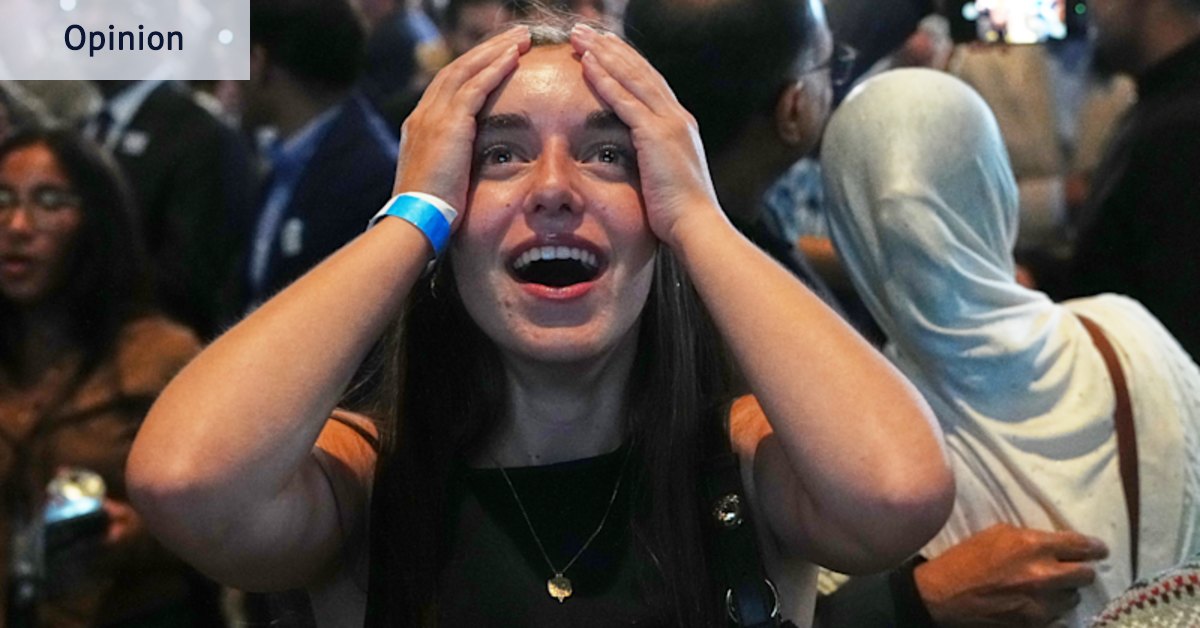
Sophia Umbreit watches election returns before Michigan Democratic Senate candidate Abdul El-Sayed arrives at a Michigan Democratic Party election night event on Tuesday.APOn Monday, I called a friend back in South Carolina, deep in the political weeds, asking how she felt about the Senate race coming up.
“I let myself believe we can win,” she said.
Like the long-suffering fan of any sports team that, no matter how hard you cheer, never seems to win much, we both understood that she meant this as an inoculation against hope. Allowing yourself to believe in the possibility of a win against Trump and the Republicans, whose support had been missed in the polls of 2016 and 2024, felt foolish.
Looking at the results on Wednesday as they arrived from local outlets, the world felt like it was tilting on its axis. Every few minutes, a new race would be called.
Democratic victories across Georgia, Kansas, Minnesota and New Mexico brought with them a new first. States would be represented or led by Democrats for the first time in generations. America saw the first black woman and Native American woman elected governor of a state.
Friends sent in videos from victory parties across America. They followed a similar pattern: a silent room listens to a TV anchor announce that a candidate has won. The graphic on the screen is quickly replaced by thousands of cheering supporters, embracing strangers like old friends, bound together in the possibility unlocked by victory.
The reaction to these midterm elections feels like entire communities have just translated hope into possibility.
The exhalation was like a release from the wariness of heartbreak that coloured the start of the day. Joy springs out in those moments.
The depth and breadth of the Democratic victories are hard to overstate. Democrats won every statewide election in both Texas and Georgia, states that had not been led by Democrats in the lifetimes of many of the voters who put their trust in new leaders.
While a great deal of those votes were a repudiation of Trump and the Republican Party he captured, the end result is all the same. Democrats will have to govern with that distinction in mind – but it is Democrats who will govern as a result.
Cynthia Aguiilon Bernard reacts as they watch results at an election night event for Democratic Texas gubernatorial candidate Gina Hinojosa in Austin, Texas on Tuesday.APAdvertisementIt was a long road to get to this moment.
In 2018, I sat in the pouring rain in Florida as Andrew Gillum, the Democratic nominee for Governor of Florida, conceded to Ron DeSantis by a razor-thin margin. Despite losing some favour at that time, Trumpist ideas still dominated the Republican Party and much of the country. Similar scenes played out with Stacey Abrams in Georgia and Beto O’Rourke in Texas.
While Democrats still did well in that cycle, winning back the House, the headline candidates did not sit back and lick their wounds. They got to work. They realised that as much as many Americans resisted Trump, he wasn’t simply going to go away.
Each of them founded organisations, registered voters, build donor and volunteer networks. Alongside other brilliant organisers, they build the infrastructure that would be necessary when the opportunity arose and the political climate made victory possible.
This year provided that chance. Donald Trump’s approval ratings pulled his party down so far that seats that Democrats hadn’t won since 1932 became realistic targets.
Campaigns were able to take advantage of a unique environment. They could only do so on the backs of a generation of people who believed that no state is permanently red or blue. That they could work together to redefine the possibilities of a place.
After losing her bid for Governor of Georgia in 2018, Stacey Abrams helped register more than 200,000 new voters in the state.
On Wednesday night, Keisha Lance Bottoms was elected by around 110,000 votes. She will now lead the state where her ancestors were enslaved, as a direct result of the work put in by other Black women in the face of their own short-term defeat.
I have spent so much time in Australia trying to convince people that my country can be good. Defending American democracy can seem Herculean under a president bent on destroying the republic.
I have tried to explain what America is capable of, that Donald Trump does not possess sole rights over what the possibilities of America’s future can be.
In the lifetime of my two-year-old niece, the world has only known a US president who denigrates women and pits people against one another. A country filled with anxiety and distrust.
In January, a senator from our home state of South Carolina will take office. A doctor, someone who won because she wanted to help kids live healthier lives.
My niece and that senator-elect Annie Andrews share the same name.
Readers have probably learned more than they wanted about South Carolina in the years I have written for this masthead. But let me close this midterm cycle with one last fact.
My state’s motto is dum spiro spero. While I breathe, I hope.
America has again given us a reason to breathe, a reason to hope.
Cory Alpert is a PhD researcher at the University of Melbourne looking at the impact of AI on democracy. He previously served in the Biden-Harris administration.
You have reached your maximum number of saved items.
Remove items from your saved list to add more.
You've used all of your gift articles. 3 more will become available on the 1st of every month.