
From hospital bed to Asian Games gold: Neeru Dhanda’s journey - The Indian Express
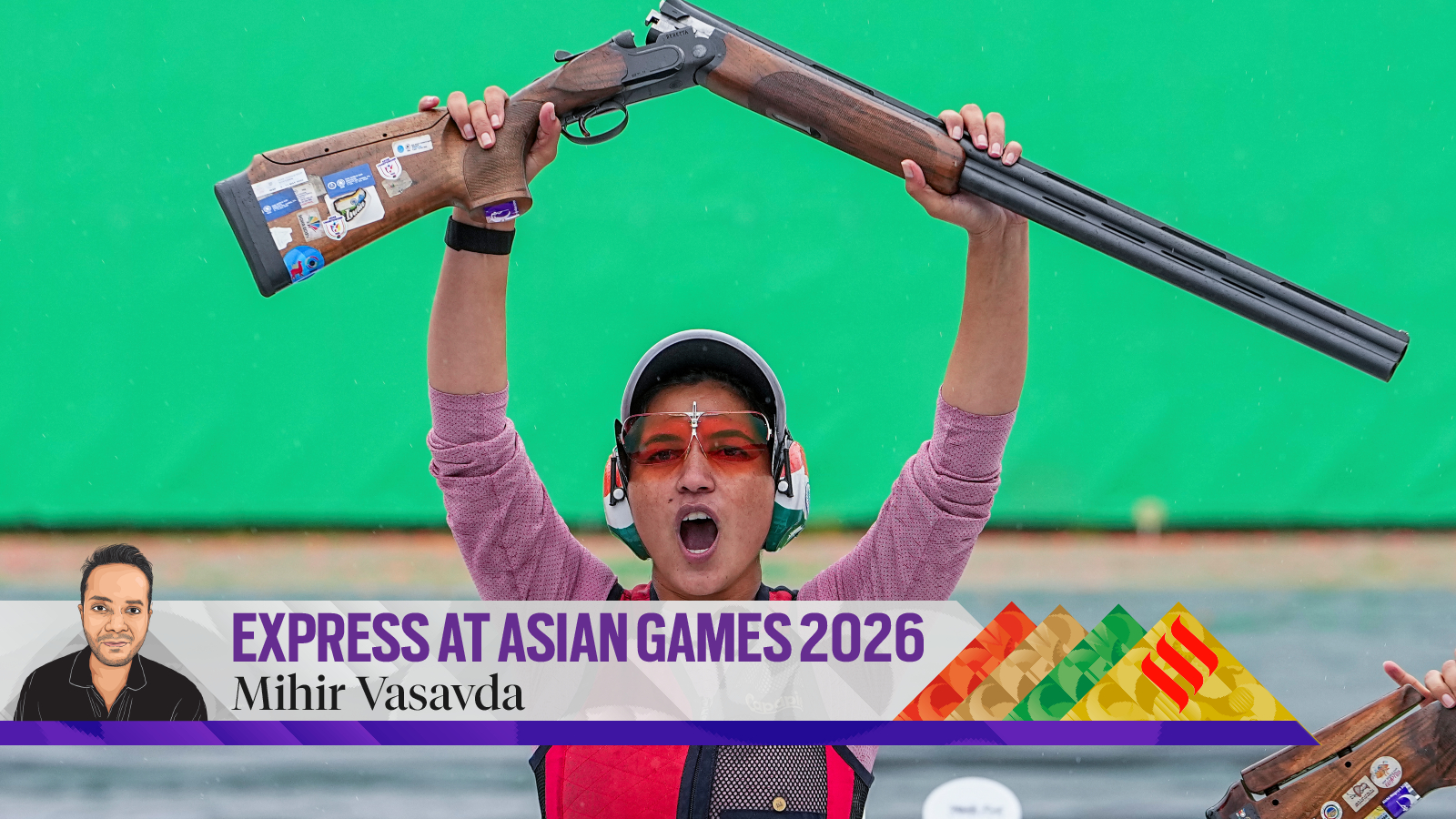
Ten days before she won a historic Asian Games gold medal, Neeru Dhanda was in a hospital bed, so ill that it was touch and go whether she would make it to Nagoya at all.
For three-and-a-half weeks, the Indian trap shooter had not trained. During the national camp in New Delhi, she spent most of her time confined to her room. For five days, she did not eat anything, surviving only on water. By the time she reached Japan for the Asian Games, the 26-year-old had barely had the opportunity to prepare for the competition that would define her career.
And yet, on Tuesday, as rain lashed the shooting range in Urenocho, in rural Toyota, Dhanda stood atop the podium, having done what no Indian woman had managed before, and no Indian shooter irrespective of the gender had since 1978: win an individual gold medal in trap shooting at the Asian Games.
She hit 28 of her 30 targets in the final, setting an Asian Games record and finishing ahead of China’s Sun Yunong, who took silver with 26 hits. It was India’s fifth gold medal at the Games and a landmark moment for a discipline in which the country had long struggled to reach the top of the podium.
The significance of Dhanda’s triumph stretched well beyond India’s medal tally. Not only had an Indian woman won this title at the Asian Games for the first time, it also brought an end to a decades-long wait for the country to claim the event’s gold.
The last Indian to win the trap gold was Randhir Singh, in 1978, as China and Kuwait dominated the event in the last 30 years. In the women’s competition, introduced at the Asian Games in 1990, China won gold in every edition except 2010, when Japan’s Yukie Nakayama claimed the title.
Dhanda, who also topped the qualifying round, had broken that pattern, and did so after a preparation that had been anything but conventional.
After picking up an infection during the camp, Dhanda said her ‘condition was quite bad’. Her coach, Arjuna Award winner Mansher Singh, kept calling her during the illness and throughout her stay in Japan, ensuring she remained in the right mind space.
“Every day, he kept me motivated, saying, ‘Nothing happens, even if you don’t train for four-five days, it doesn’t make any difference. You are super, and you will remain a star’,” Dhanda said, adding that she also received messages of support from former MP Sports Minister Yashodhara Raje.
Peter Wilson, India’s trap shooting coach, was struck by the scale of her recovery. “That’s what’s incredible. Ten days ago she was in hospital for three days. She was really, really sick and it was touch and go whether she would come,” Wilson said. “She has not trained for three-and-a-half weeks. She shot for two days here. She is very talented, but she puts a huge amount of work in. Put the work in and the results will come.”
The illness had left Dhanda with little time to regain her form. But the confidence she had built over years of training, and the reassurance from Mansher, helped her approach the competition without dwelling on what she had missed.
Dhanda’s journey to the top had begun in Jind, after watching her cousin, and shotgun shooter, Lakshya Sheoran win silver in the trap event at the 2018 Asian Games. Sheoran’s parents introduced her to the sport and five years ago, she moved to Bhopal to train at the Madhya Pradesh State Shooting Academy, where access to equipment and structured coaching helped her develop.
The early promise has since translated into major international success. Dhanda, who won the Asian Championship gold last year, arrived in Japan after becoming the first Indian woman to win an individual trap gold at an ISSF World Cup in July. But the Asian Games presented a different challenge, particularly with her preparation disrupted by illness.
On Tuesday, the weather offered little respite. Rain poured down on the shooting range in Urenocho, the drops striking the shooters’ hands as they took aim. The conditions were familiar to Dhanda from competitions in India, particularly in Bhopal, where rain often interrupts training and trials. But the intensity of the downpour in Japan made it harder to maintain concentration. “The challenge here was that rain was coming from above, falling on the hands, you feel it, and the mind strays a bit from the process,” she said.
Her response was to keep returning to the basics, reminding herself to stay focused even as the weather threatened to distract her. “Neeru, this will happen; even if a storm comes, don’t look down on yourself, keep looking up, elevate your process, polish yourself,” she recalled telling herself.
That discipline was evident in the final. So precise was she that by the time the final shots were fired, she had established a clear advantage over Sun Yunong and secured the gold.
The victory margin may suggest it was comfortable for the Indian. “(But) This was not easy. I made it look easy so that future juniors and other Indian players who are currently training in trap shooting, shotgun, and overall — meaning for the whole shooting team — can go on to win gold, thinking that if Neeru can do it, so can we,” she said.
Over the course of a 18-year-long career, Mihir Vasavda has covered 2010 FIFA World Cup; the London 2012, Tokyo 2020 and Paris 2024 Olympic Games; Asian Games in 2014 and 2022; Commonwealth Games in 2010 and 2018; Hockey World Cups in 2018 and 2023 and the 2023 ODI Cricket World Cup. ... Read More
