
From nuclear talks to Hormuz reopening: Iran President Pezeshkian speaks out
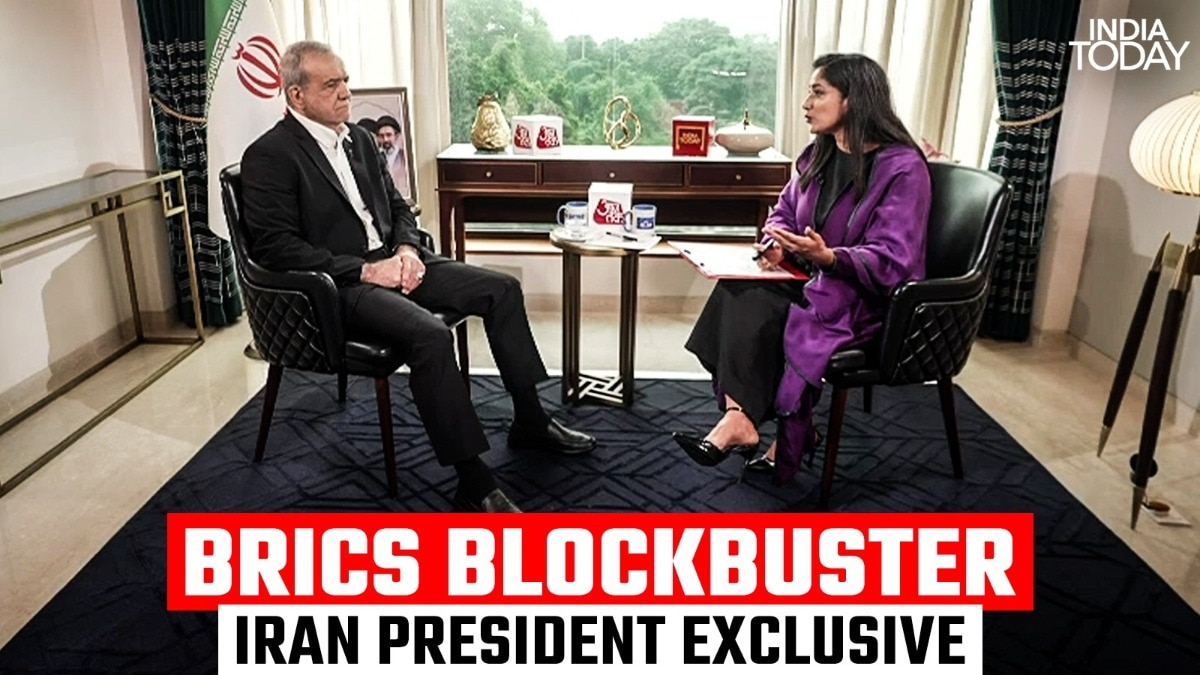
Iranian President Masoud Pezeshkian has said the Strait of Hormuz can be opened under internationally established principles, but only if the United States ends what Tehran describes as its blockade and other activities in the region.
Speaking exclusively to India Today's Group Editor (Foreign Affairs) Geeta Mohan, Pezeshkian said Iran was negotiating with Oman on a specific maritime framework for the strategic waterway. He was responding to concerns over the safety of Indian seafarers and vessels and the impact of the disruption on India's energy supplies.
"In this regard, we are dealing and have negotiation with Oman regarding a specific maritime framework," Pezeshkian said. He said a meeting involving Arab foreign ministers and Oman was expected to discuss an agreement on the Strait of Hormuz, after which the International Maritime Organization (IMO) would announce its status.
"Within the internationally established principles, the waterway would be open" on the condition that the US terminates its blockade and related activities, he said.
Pezeshkian's comments are particularly significant for India, which has been closely watching the safety of its seafarers and vessels passing through the Strait and the impact of the conflict on energy supplies.INDIA'S SEAFARER CONCERNS DISCUSSED: PEZESHKIAN
Asked whether he had given Prime Minister Narendra Modi assurances over Indian seafarers and vessels in the Strait of Hormuz, Pezeshkian pointed to the negotiations with Oman on the maritime framework.
He said Iran was seeking a mechanism that would allow the waterway to function within internationally recognised principles.
The remarks came after Modi and Pezeshkian held a bilateral meeting on the sidelines of the BRICS summit in New Delhi.'INDIA CAN INVEST IN CHABAHAR'
Pezeshkian also extended an invitation to India to deepen its economic engagement with Iran, specifically highlighting Chabahar port.
Asked whether Chabahar and Indian investment at the port had figured in his discussion with Modi, Pezeshkian said India could increase its investment and enter into partnerships with Iran.
"India can invest there. Currently, it has some investments, and it is underway," he said.
He added that the two countries could develop partnerships in trade and other areas and establish a wider network of economic cooperation.
Pezeshkian described Iran as a geographical crossroads capable of connecting north and south and east and west. He invoked the historic Silk Road and said Tehran was ready to help revive the connectivity routes that had linked civilisations in the past.
For India, Chabahar has strategic significance as a connectivity route to Iran and onward access to the wider region.'INDIA-IRAN TIES IMPROVING EVERY DAY'
Pezeshkian described relations with India as steadily improving and spoke warmly about his meeting with Modi.
"Our relation with the Honorable Prime Minister of India... is increasingly getting better on a daily basis," he said, attributing the relationship to the deep cultural and historical links between the two countries.
He said Tehran wanted to build a new structure for India-Iran relations based on those longstanding ties and expand cooperation.MOJTABA KHAMENEI IS ALIVE: PEZESHKIAN
One of the most significant claims in the interview came when Pezeshkian was asked about speculation surrounding Iran's new Supreme Leader, Mojtaba Khamenei.
"Thank God our supreme leader is alive," Pezeshkian said.
He added that the Supreme Leader was carrying out his duties, while his exact location was not known.
Pezeshkian said the inability of the US and Israel to locate him had contributed to speculation about his whereabouts.
"Since they cannot locate his exact place, they are spreading such speculations," he said.
Pezeshkian also made clear that the Supreme Leader remains the ultimate authority in Iran.
Asked whether the final decision on major issues rested with the Supreme Leader, the Islamic Revolutionary Guard Corps or the president, he said: "In our country, it is the supreme leader who has the final say."advertisementIRAN READY FOR NUCLEAR TALKS, BUT TRUST WITH US MUST RETURNPezeshkian rejected allegations that Iran is seeking nuclear weapons and said Tehran remains ready to negotiate on the nuclear issue within the framework of the Nuclear Non-Proliferation Treaty.
"We are a member of NPT," he said, arguing that Iran's nuclear activities had been monitored and conducted within international principles.
He said Iran was prepared to negotiate on the nuclear issue within the NPT framework.
However, he stopped short of agreeing to immediate direct talks with US President Donald Trump, saying the killing of Iran's leader had made such engagement extremely difficult.
Pezeshkian said trust would have to be rebuilt before Tehran could confidently return to negotiations.
"The atmosphere of trust should be established again," he said, adding that Iran needed assurances that any agreement reached would be honoured.
He also referred to earlier negotiations involving Pakistan and Qatar, saying Iran had signed a memorandum of understanding but that it was subsequently abandoned. Tehran's position, he said, was that sanctions should be lifted and attacks against Iran should stop.'US TRIED VENEZUELA IN IRAN, FAILED'
Iranian President Masoud Pezeshkian claimed the US believed it could topple Iran’s government within 24 hours and install a “puppet government”, as he said Washington had done in Venezuela and Syria.
“They envisioned that just like Venezuela, they would be able to conquer our country within 24 hours and establish their own puppet government in Iran,” Pezeshkian said.
He said the US expected Iran to follow a path similar to Syria, believing that killing the country’s leader, military commanders and senior officials would pave the way for the government’s collapse.'WE ARE NOT IN WAR WITH SAUDI ARABIA'
Pezeshkian rejected the suggestion that Iran was at war with Saudi Arabia and called for a new regional security framework involving Gulf and other neighbouring countries.
"We are not in war with Saudi Arabia," he said, while distancing Iran from attacks carried out by the Houthis.
He called on Iran, Saudi Arabia, Turkey, Pakistan and other regional countries to sit together and establish peace and security.
"There is no reason for this region to be in conflict," he said, arguing that countries in the region could maintain their own identities while cooperating on security and economic matters.
Pezeshkian also said Iran had no problem with the UAE or other regional countries. He blamed US military bases in neighbouring countries for creating tensions and urged those countries not to allow their territory to be used for attacks against Iran.advertisementPEZESHKIAN BLAMES US FOR REGIONAL DIVISIONSThe Iranian president accused Washington of pursuing a "divide and rule" strategy in the Middle East and attempting to turn Arab countries against Iran.
He said the resulting tensions allowed outside powers to exploit the region's oil resources while selling weapons to countries that were being encouraged to fear one another.
Pezeshkian said his own priority since taking office had been to maintain unity inside Iran and prevent differences from turning into divisions.
He also called for greater unity across the Muslim world and said Shia-Sunni differences should not prevent regional countries from working together.'US FAILED TO TOPPLE IRANINAN GOVERNMENT'
Asked to assess Iran's position several months into the confrontation, Pezeshkian claimed the conflict had strengthened internal unity rather than weakened the government.
He said the US had sought to topple the Iranian government militarily and had then targeted infrastructure, but had failed to achieve its objectives.
According to Pezeshkian, even Iranians who had been dissatisfied with the government rallied around the country's territorial integrity after the attacks. He said some Iranians living abroad had also returned to the country.
He accused Washington of subsequently using sanctions and restrictions on trade routes to put pressure on civilians, including by restricting access to medicines and other goods.BRICS CAN CHALLENGE US UNILATERALISM, SAYS PEZESHKIAN
Pezeshkian also placed considerable importance on BRICS as a platform for Iran to expand trade and reduce its dependence on the US-led economic system.
He said the grouping should help countries cooperate independently of unilateral sanctions and reduce dependence on the US economy and dollar.
"The objective of BRICS" was to counter what he called unilateralism, Pezeshkian said, arguing that countries including India, China and Russia could work together to change the nature of global trade and cooperation.
He said the BRICS New Development Bank could support joint investment and development among member countries.IRAN SAYS RUSSIA, CHINA TIES ARE NOT ABOUT EXTERNAL SUPPORT
Pezeshkian defended Iran's relations with Russia and China after being asked about allegations that the two countries were providing military, strategic and technological assistance to Tehran.
He described Russia and China as friends and neighbours and said Iran had longstanding relations with both.
Pezeshkian rejected the suggestion that Iran's resilience in the conflict was primarily the result of outside military or technological support.
"It is our people who stood against it. It is not the technology," he said, attributing Iran's ability to withstand pressure to unity among its people.'WE ARE NOT SEEKING WAR'
Throughout the interview, Pezeshkian maintained that Iran did not initiate the conflict and was acting in self-defence.
He said Tehran had entered negotiations several times and was close to reaching an agreement before further attacks took place.
"We are not seeking war," he said, adding that Iran would respond to attacks against it.
Pezeshkian's message from New Delhi was therefore two-pronged: Iran wants greater economic and strategic cooperation with countries such as India and wants regional countries to establish their own mechanisms for peace, while continuing to resist what he described as US pressure and unilateralism.- EndsPublished By: Shipra ParasharPublished On: Sep 12, 2026 20:51 IST


