
From serial collectors to reluctant recyclers: How Singapore’s beverage container return scheme is shifting habits - CNA
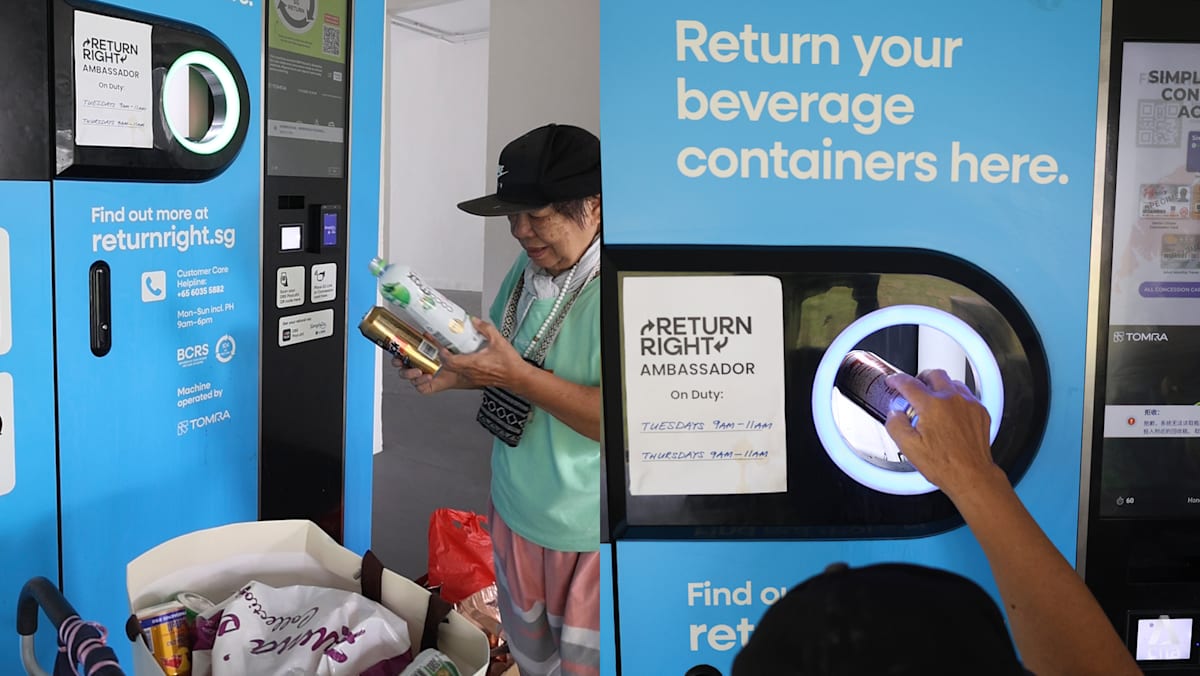
As the transition period for the Beverage Container Return Scheme draws to a close, how has the scheme changed consumer behaviour, and will this translate into better recycling habits in the long run?
Madam Tan Mui Sng, 79, a retiree, feeding a can into a reverse vending machine at the void deck of her housing block in Serangoon on Sep 17, 2026. (Photo: CNA/Ooi Boon Keong)
This audio is generated by an AI tool.
Koh Wan Ting & Charmaine Jacob 30 Sep 2026 06:00AM (Updated: 30 Sep 2026 08:30AM) Bookmark Bookmark Share WhatsApp Telegram Facebook Twitter Email LinkedIn Set CNA as your preferred source on Google Add CNA as a trusted source to help Google better understand and surface our content in search results. Read a summary of this article on FAST. Get bite-sized news via a newcards interface. Give it a try. Click here to return to FAST Tap here to return to FAST FAST SINGAPORE: Every few weeks, 79-year-old Tan Mui Sng heads to the reverse vending machine at the void deck of her Serangoon housing block with a trolley and bags of empty containers in tow.
The retiree returns dozens of containers each time, earning a few dollars in deposits — the result of hours spent scouring her neighbourhood for discarded drink cans and bottles.
While already a habitual collector before the nationwide Beverage Container Return Scheme (BCRS) was launched on Apr 1, the prospect of higher returns from reverse vending machines has spurred Mdm Tan to collect even more.
The scheme, which is still in a transition period until Thursday (Oct 1), may not have altered her desire to recycle discarded cans and bottles, but it has certainly made her weekly efforts more profitable.
"For this one, there's much more money," she said in Mandarin, adding that she used to earn S$0.50 (US$0.39) for every 1kg of containers she sold to the rag-and-bone man.
She has lost track of how often she has used the reverse vending machine, but estimated earning more than S$10 from returning containers.
Under the scheme, consumers have to pay a refundable 10-cent deposit on eligible beverage containers, comprising pre-packaged plastic or metal containers with volumes between 150ml and 3,000ml.
The deposit can be reclaimed by returning marked containers at one of around 1,300 Return Right reverse vending machines across Singapore.
On Sep 21, BCRS Ltd, the operator of the scheme, reported that more than 33 million bottles and cans had been collected by mid-September, up from 5.5 million as of Aug 5.
The operator has yet to say what proportion of eligible containers sold have been returned — also known as the return rate.
Singapore consumes more than one billion beverage containers annually, according to the National Environment Agency (NEA).
Dr Adrian Kuah, Professor of Strategy and Sustainability at James Cook University said while 33 million returned containers may "sound small" compared with the more than one billion consumed annually, this was not an apples-to-apples comparison, given that the scheme is still in transition.
"More significant is the acceleration — from 5.5 million returns in early August to more than 33 million by mid-September — showing participation is increasing."
The return rate would ultimately be a more meaningful measure of how well the scheme is working, he said.
While it may still be too soon to tell how overall recycling rates have changed with the scheme still in its infancy, there are signs that the 10-cent deposit is already influencing some behaviours.
Several consumers told CNA the scheme has reinforced their recycling habits, while collectors like Mdm Tan actively hunt for containers discarded by others. Others, however, dismissed the process as too much hassle to bother.
CNA Games Guess Word Crack the word, one row at a time Buzzword Create words using the given letters Mini Sudoku Tiny puzzle, mighty brain teaser Mini Crossword Small grid, big challenge Word Search Spot as many words as you can Show More Show Less What will happen after Oct 1 The scheme is currently in a transition period as retailers phase out beverage containers without the deposit mark.
It was initially slated to be fully implemented on Oct 1, after which containers without the deposit mark could no longer be sold.
NEA announced on Sep 18 a one-month grace period for eligible small retailers to clear unmarked stock by Oct 31.
Since then, over 2,000 smaller retailers have applied for more time to clear non-BCRS drinks stock.
For those who are making recycling containers through BCRS part of their routines, the process of collecting containers and returning them is a rewarding experience despite the extra effort.
When CNA met Mdm Tan on Sep 17 afternoon, she methodically placed a bag and cardboard box at the foot of her usual reverse vending machine to collect rejected containers for disposal in a rubbish bin nearby.
She said that she had already been collecting empty cans to sell to the rag-and-bone man for five to six years before the scheme began, having taken it up in her spare time.
In the evenings, when it was cooler, she would head out to hunt for containers in nearby bins.
Mdm Tan demonstrated the process of inserting 32 containers into the machine. But only 14 containers were accepted, as the rest were either unmarked or dented despite carrying the deposit mark.
Grumbling about how she ended up with so many rejected drink containers, Mdm Tan said she could not check every container due to her poor eyesight.
Nevertheless, the retiree said she is now well-versed in the process of returning the containers and crediting refunds to her EZ-Link card.
"At first my MRT card only had S$6. A few days I went to use and there was S$8, there was an increase," said Mdm Tan.
Others told CNA that they have developed a regular habit of returning discarded cans and bottles. Reclaiming their deposits was their main reason for doing so.
Mr Mark Zhang, 24, and his girlfriend save their containers for a trip to a reverse vending machine near their home in Hougang every two weeks.
The couple were spotted feeding 24 plastic bottles and 10 metal cans into a reverse vending machine for S$3.40 in refunds on Sep 23.
They said the scheme was already in place when they moved to Singapore from China six months ago, so they had little difficulty adopting the practice despite not having done anything similar back home.
Asked why he had taken up the habit, Mr Zhang said in Mandarin: "It is to recycle and to get my money back."
Another recycling convert, who gave his name as Roy, said the machine has incentivised him to recycle more.
The 71-year-old said he "seldom" used to recycle cans or bottles after consuming their contents, leaving them at tray return stations or occasionally depositing them in blue recycling bins if he came across them.
He has since used the reverse vending machine four to five times to return containers of sparkling Oldenlandia water he drinks at home.
Roy said using the machine required him to make a conscious effort to leave home and return the containers. He takes them to the reverse vending machine at Kang Kar Mall, the closest one to his home.
However, on one occasion, he tried to recycle his containers, only to find that the machine had reached full capacity. He suggested that full machines could direct users to the nearest alternative.


