Full List of Times Susan Collins Broke With Trump in His Second Term - Newsweek
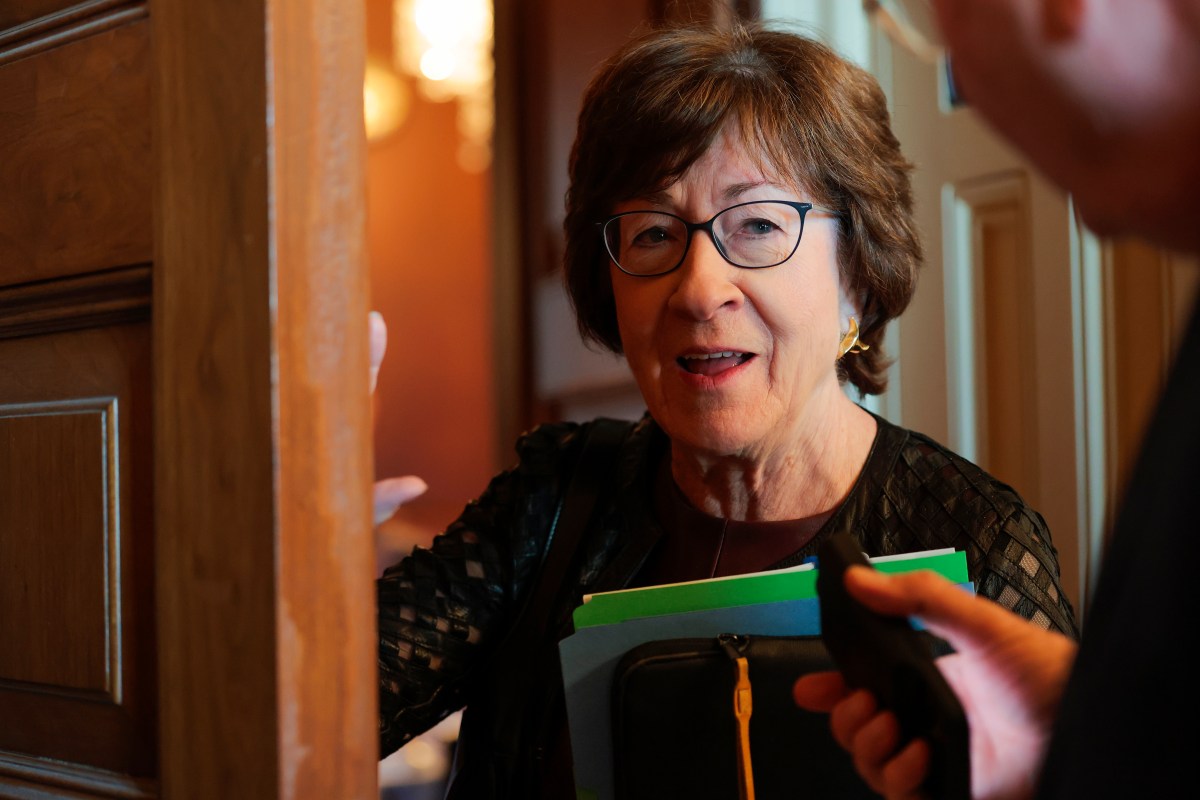
Senator Susan Collins’ record of being an independent voice has become a central flashpoint in the Maine Senate race, as she faces a competitive challenge from former Maine Senate President Troy Jackson, a Democrat, ahead of November's midterms.
Democrats hope to tie Collins, a Republican, to President Donald Trump, who is unpopular in the Pine Tree State, arguing that she only votes against him when her vote does not count. However, Collins has pointed to numerous major votes in which she has sided against the administration on some of Trump’s top priorities.
Maine generally leans toward Democrats, having backed former Vice President Kamala Harris by 7 points in 2024. But Collins has been able to easily win reelection in the past due to her personal popularity and moderate, bipartisan image.
Whether or not Mainers still view her as independent in the Trump era could be critical to her reelection chances, so this has become a key issue for both campaigns with less than six weeks until Election Day.
Blake Kernen, a campaign spokesperson for Collins, told Newsweek on Friday that the senator “has never missed a vote and has the longest perfect vote streak in American history."
Kernen continued: “She takes every single vote seriously and carefully considers her decision to act in the best interest of Maine and America. She's also consistently been recognized as one of the most independent members of the Senate—Georgetown and the nonpartisan Lugar Center have ranked her as the most bipartisan Senator in nine of their last eleven indexes.”
The senator's spokesperson added that Collins’ record is “in stark contrast to her opponent Troy Jackson, who spent his entire 20-year career in Augusta as an extreme partisan politician on the ideological fringes.”
Meanwhile, Jackson's spokesperson Maggie Amjad told Newsweek that Maine voters “aren’t stupid” and “see the game that Susan Collins is playing.”
“The vast majority of Collins’ votes—96% of the time—have been with Donald Trump. In the moments when it mattered, Collins sided with Donald Trump and Washington Republicans—including voting to confirm the justices who overturned Roe v. Wade and helping advance legislation that slashed nearly $1 trillion from Medicaid to pay for massive tax breaks for the wealthy. Susan Collins has spent 30 years in Washington selling out Maine and putting billionaires first,” Amjad said.
A report from CQ Roll Call found that Collins voted with Trump 95 percent of the time in 2025. The only Republicans with lower scores were Senators Lisa Murkowski of Alaska and Rand Paul of Kentucky, making her one of the least pro-Trump senators.
Still, Democrats have noted she does vote with Trump most of the time, with Jackson hitting out at her voting record earlier in September.
“It’s pretty clear to me that you can’t have it both ways,” he said. “You can’t vote with Donald Trump 96 percent of the time and then turn around and claim to care about working class families.”
She has faced criticism from Maine Democrats over several votes. Her vote in favor of Supreme Court Justice Brett Kavanaugh during Trump’s first term was seen as a major turning point in her popularity among moderate Democrats. Maine Democrats have also criticized her for voting to confirm several judges they say are opposed to abortion rights. Other positions she has taken, including her support for the Safeguard American Voter Eligibility (SAVE) Act and her vote to confirm Robert F. Kennedy Jr. as Health and Human Services secretary, have also drawn scrutiny.
Collins was seen as one of the most anti-Trump Republicans during his first term in office. She declined to support him in the 2024 election and voted to convict him in his impeachment trial after the January 6, 2021, riot at the U.S. Capitol building. She also voted against a repeal of the Affordable Care Act in 2017.
Still, there are several instances where Collins has broken from the president.
In addition to these key votes, she has also been critical of other parts of Trump's agenda such as his tariffs and proposal to send Americans $5,000 if Republicans win the midterms. She has also used her position as the chair of the Appropriations Committee to push back against some Trump priorities.
When Trump first launched the Iran war in late February, Collins declined to vote in support of a War Powers Resolution that would have limited his ability to wage war on the country, writing in a statement that passing the resolution “would send the wrong message to Iran and to our troops.”
However, she has become increasingly critical of the administration’s approach to Tehran and has voted in support of subsequent resolutions.
In April, she said in a statement that the War Powers Resolution “establishes a clear 60-day deadline for Congress to either authorize or end U.S. involvement in foreign hostilities.”
“Further military action against Iran must have a clear mission, achievable goals, and a defined strategy for bringing the conflict to a close. I voted to end the continuation of these military hostilities at this time until such a case is made,” she wrote.
The Iran war has become increasingly unpopular. Only 24 percent of Americans believe going to war with Iran was the “right decision,” according to a new YouGov poll, which surveyed 1,401 registered voters from September 18 to 21.
That unpopularity is compounded by the rising gas prices, which stem from disruptions to the Strait of Hormuz, a critical passageway for the global oil supply. Gas prices averaged $4.492 per gallon nationwide and $4.431 in Maine as of Friday, according to the American Automobile Association (AAA).
Collins also voted against the One Big Beautiful Bill, a landmark piece of legislation for the Trump administration, citing concerns about its “harmful impact” on Medicaid. She said at the time she supports other tax relief measures in the bill.
“This bill has additional problems. The tax credits that energy entrepreneurs have relied on should have been gradually phased out so as not to waste the work that has already been put into these innovative new projects and prevent them from being completed. The bill should have also retained incentives for Maine families who choose to install heat pumps and residential solar panels,” she said at the time.
However, her vote on the bill has become a contentious issue. She has faced attacks from Democrats, who point out that she did vote to move the package forward in a procedural vote. Democrats have cast her vote as being critical in advancing the bill. The Maine Democratic Party wrote in an October 2025 statement that it was “another reminder of how Collins will always put her party’s interests ahead of Mainers.”
Collins also voted against advancing a rescissions package backed by the Trump administration that canceled billions of dollars in federal funding including foreign aid and support for public media like PBS and NPR. She said the text provided by the administration offered too few details and did "not give an accounting of the specific program cuts that would total $9.4 billion."
“The rescissions package has a big problem–nobody really knows what program reductions are in it. That isn’t because we haven’t had time to review the bill. Instead, the problem is that OMB [Office of Management and Budget] has never provided the details that would normally be part of this process," she said.
She also said she opposed "excessive cuts" to the Corporation for Public Broadcasting.
Collins voted against the confirmation of Defense Secretary Pete Hegseth, writing in a statement that she was “concerned that he does not have the experience and perspective necessary to succeed in the job.”
“I am concerned that Mr. Hegseth does not have the management experience and background that he will need in order to tackle these difficulties. His limited managerial experience involved running two small non-profit organizations that had decidedly mixed results,” she wrote in a statement.
Collins also voted against the nomination of Attorney General Todd Blanche, pointing to what she viewed as an “increasingly political” Department of Justice during the Trump administration.
“Mr. Blanche has taken several actions that have further eroded the Department’s independence, and that is the basis for my vote to oppose his confirmation,” she wrote.
She specifically pointed to the anti-weaponization fund, designed to compensate people who claimed they were unfairly targeted by government investigations, as being key to her opposition to his nomination. The $1.7 billion fund drew criticism from Collins and other moderate Republicans.
Collins also opposed FBI Director Kash Patel’s nomination, raising issue with whether he could be “decidedly apolitical.”
“While Mr. Patel has had 16 years of dedicated public service, his time over the past four years has been characterized by high profile and aggressive political activity. Mr. Patel has made numerous politically charged statements in his book and elsewhere discrediting the work of the FBI, the very institution he has been nominated to lead,” Collins said.
She was also critical of other Trump picks whose nominations were ultimately pulled, such as Casey Means, his nominee to serve as surgeon general.
Trump and Collins have never been particularly closely aligned. She has said she did not vote for him in 2016 and 2024, and she did vote to impeach him in 2021. Collins is generally seen as a more moderate Republican than Trump.
She has frequently opposed his measures, beyond just voting against him on major GOP bills.
This week, Collins spoke out against what she views as an effort to politicize federal health research funding, after the Washington Post reported that Trump was considering an executive order to create a commission to review National Institutes of Health (NIH) grants.
"The Office of Management and Budget (OMB) should not be involved in agency decisions on the awards of grants," Collins wrote on X.
Vice President JD Vance in May during remarks in Maine said he is at times “frustrated” with Collins but acknowledged that a more partisan Republican may not win in a blue-leaning state like Maine.
"The thing I love about Susan is she is independent, because Maine is an independent state, and frankly, if she was as partisan as I sometimes wish that she was, she would not be a good fit for the people of Maine," he said. "So, let's give a shoutout to Susan Collins, who is doing a great job."
Polls have shown a close race between Collins and Jackson.
A new poll from The New York Times, The Portland Press Herald and Siena University released on Thursday showed Collins up 3 points, 49 percent to 46 percent. It surveyed 619 likely voters from September 15 to 22.
But two other polls also released Thursday showed Jackson with a lead over Collins.
Jackson led by 4 points in a new University of New Hampshire poll, which had him at 51 percent support to Collins’ 47 percent, an improvement from July when he led by 3 points. It surveyed 1,312 likely voters from September 17 to 21 and had a margin of error of plus or minus 2.7 percentage points.
Another poll from the University of Massachusetts Lowell gave Jackson a 5-point lead, 48 percent to 43 percent. Among independent voters, a critical voting bloc in the Pine Tree State, he led by 8 points, 40 percent to 32 percent, with 22 percent still undecided, the poll found.
This week, the Maine Senate race was rocked by a new report from ProPublica about alleged interactions between Collins and a major campaign donor.
The FBI sought to launch a probe into Collins' dealings with a major donor, according to a ProPublica report, and the effort was abandoned after Trump's return to office, according to an investigation by the outlet.
Collins’ office denied the report. Annie Clark, who serves as Collins’ deputy chief of staff, said the claims are “categorically false.”
“There have never been any allegations of wrongdoing by the Collins for Senator campaign, and the campaign was never the target of the FBI investigation,” she wrote.
Jackson responded to the report in a statement provided to Newsweek, accusing Collins of “corruption of the highest order.”
“Susan Collins doesn’t care that we’re losing our health care, that ICE is killing people on the streets, and that we’ve been dragged into a pointless war—as long as her donors get their contracts and her coffers get filled. We deserve answers about every contract and every conversation that Collins and her team facilitated on the backs of taxpayers,” he wrote. “The jig is up.”
Democrats’ path to a Senate majority runs through Maine.
Democrats are increasingly hopeful about winning the Senate despite a difficult map. Republicans hold a 53-47 Senate majority, so Democrats must flip four seats to win control if they win every race in a seat they currently hold. Vance serves as the tiebreaker in a split Senate.
In order to flip the Senate majority, Democrats have to win every seat they currently hold, flip GOP-held seats in competitive states and win some seats in more traditionally conservative territory.
Democrats are defending seats in Trump-won states Georgia and Michigan. In addition to Maine, they view a GOP-held seat in North Carolina as a top flip opportunity. The race in New Hampshire, which backed Harris by about 3 points, is also competitive.
No other Senate races are in Harris-won or single-digit Trump states, meaning Democrats must expand the Senate battleground and compete in more conservative areas if they want to win the majority. They are targeting GOP-held seats in Alaska, Iowa, Ohio and Texas as potential states to flip. The Cook Political Report classifies those four races as tossups.
The Maine Senate race is expected to remain one of the most competitive battlegrounds of this year’s midterms, with forecasters like the Cook Political Report and Sabato’s Crystal Ball classifying it as a pure toss-up.
Both candidates are likely to spend the coming weeks traversing the state to make their pitches to voters in hopes of winning over independent and undecided voters, while also motivating their bases to turn out.
Newsweek’s reporters and editors used Martyn, our AI assistant, to produce this story. Learn more about Martyn here.
Contact Newsweek editors for this story: Jason Lemon and Anthony Murray.