
Gaza three years on: International push for two-state solution stalls
By continuing to browse our site you agree to our use of cookies, revised Privacy Policy and Terms of Use. You can change your cookie settings through your browser.
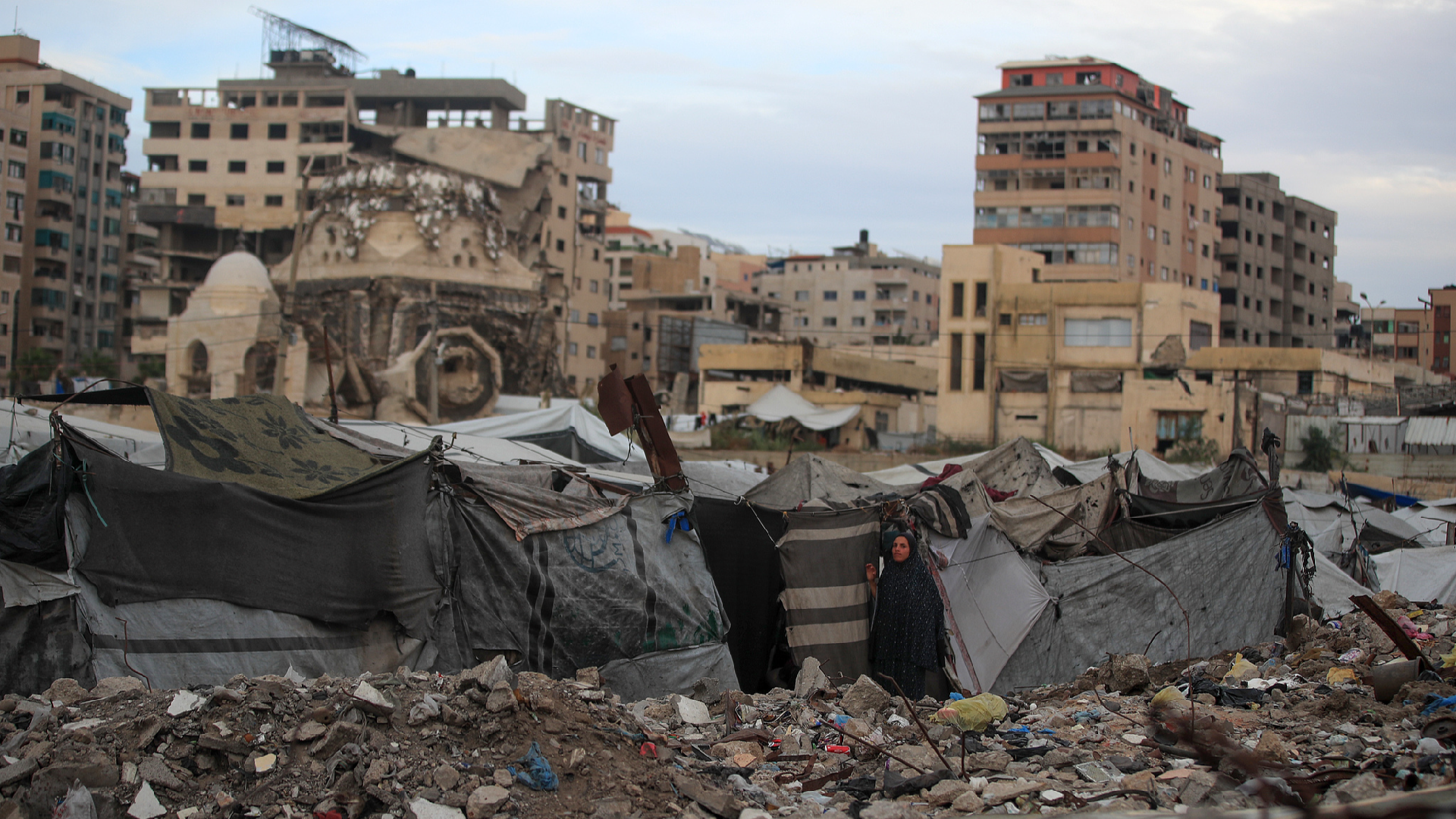
A Palestinian woman looks out from her tent in a displacement camp inside the port of Gaza City, Palestine, on October 5, 2026. / VCG
Three years into the latest Israeli-Palestinian conflict, a ceasefire has reduced fighting, but key issues needed to end the conflict remain unresolved.
The ceasefire that took effect in October 2025 brought a halt to major fighting and facilitated the release of hostages and prisoners, raising hopes for an end to the war. But throughout the year, Israel continues to carry out near-daily strikes in Gaza and controls nearly two-thirds of the enclave. At least 1,400 Palestinians have been killed since the ceasefire, according to Gaza health officials.
Meanwhile, Hamas' disarmament, an Israeli military withdrawal and the reconstruction of Gaza have made little progress.
Over the past three years, international mediators have repeatedly pushed for ceasefires and a broader political settlement based on the two-state solution. With Israel and the United States advancing plans for Gaza's demilitarization, questions remain over how the process can move from a ceasefire toward a lasting political settlement.
Beyond efforts to secure a ceasefire, the international community has continued to push for a broader political settlement to the Israeli-Palestinian conflict. The two-state solution envisions an independent Palestinian state alongside Israel and has long been the basis for such efforts.
Trump unveiled his 20-point Gaza peace plan in September 2025, which formed the basis for a new ceasefire that took effect on October 10, 2025. In July 2026, the US-led Board of Peace unveiled a 15-point roadmap linking Hamas' disarmament to a phased Israeli withdrawal.
While Trump said Hamas had agreed to the plan, Hamas said it would place its weapons under the control of a future Palestinian administration rather than agree to full disarmament. Israel, however, has said it will not withdraw its forces from Gaza until Hamas is fully disarmed.
Niu Xinchun, director of the China-Arab States Research Institute at Ningxia University, said the US-Israeli push to demilitarize Gaza could further destabilize the enclave. He said Washington and Israel were making Hamas' complete disarmament the only condition for moving forward, which had stalled humanitarian aid and post-war reconstruction.
The Gaza peace process had made no substantive progress over the past six months, while the humanitarian crisis continued to worsen, he said.
The ceasefire has reduced the scale of fighting, but Israeli settlement expansion and military operations have continued.
The area under Israeli control expanded from about 53% of Gaza after the October 2025 ceasefire to 64.9% by June 2026, according to the United Nations Office for the Coordination of Humanitarian Affairs (OCHA).
Meanwhile, the advancement of Israel's E1 settlement plan in the West Bank has drawn condemnation from Britain, France, Germany, Italy, the Netherlands, Canada, Norway and others. The countries warned that the plan flagrantly violates international law, would fragment the West Bank and undermine prospects for a two-state solution.
Israel says its operations target Hamas militants attempting to carry out attacks or rebuild their military capabilities, while Hamas denies rearming.
Data from OCHA show that, as of September 30, Palestinian health authorities had reported 1,431 deaths and 5,026 injuries in Gaza since the ceasefire took effect in October 2025.
Humanitarian aid also remains below the level envisaged in the peace plan. Citing an August report, Reuters reported that an average of about 227 trucks carrying humanitarian and commercial supplies entered Gaza each day between the October 2025 ceasefire and the end of May 2026, less than half the peace plan's minimum target of 600 trucks a day. However, Israel says around 600 trucks are entering Gaza each day.
UN Secretary-General Antonio Guterres said on September 22 that a two-state solution based on the pre-1967 lines remained the only credible path to lasting peace and security for Palestinians and Israelis.
He called for the full implementation of the peace plan and said Gaza and the West Bank, including East Jerusalem, must remain politically, economically and territorially integrated under a single, legitimate, sovereign Palestinian government.
In September, the foreign ministers of Qatar, Egypt, Jordan, the United Arab Emirates, Indonesia, Pakistan, Türkiye and Saudi Arabia also called for the full implementation of the Gaza peace plan. They stressed that Gaza is an integral part of the Palestinian territory and backed a credible path toward an independent and sovereign Palestinian state.
China has also called for the ceasefire to be maintained and the two-state solution to be preserved. On August 26, China's Permanent Representative to the UN Fu Cong urged efforts to uphold the Gaza ceasefire, implement relevant arrangements and safeguard the political prospects of the two-state solution.

