
German President Frank-Walter Steinmeier warns democracy under threat after 'bitter setbacks' since reunification
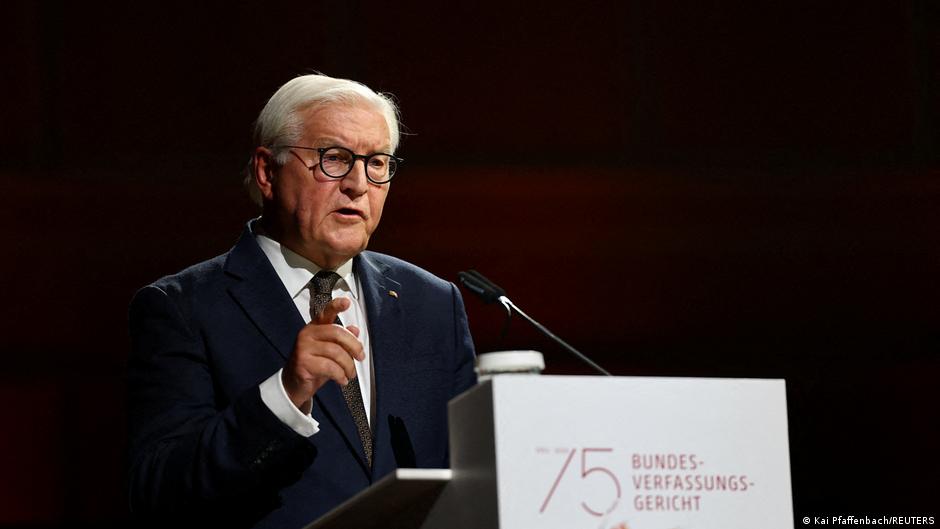
German President Frank-Walter Steinmeier has warned that Germany's democracy is once again being challenged.
The 70-year-old used his final German Unity Day speech as president to reflect on more than three decades of political change.
"I thought everyone had learned the lesson from history, and now I see supporters of right-wing extremism seeking to erase the memory of the victims of the Holocaust," Steinmeier said at the official ceremony in Bremen.
"I believed our democracy was secure and now have to experience it being challenged anew."
Steinmeier, whose second and final term as president ends in March, said his expectations after the changes that began in 1989 had been greater than what ultimately became reality.
Those expectations had included greater progress for liberal democracy and for "the undeniable reason of international cooperation," he said, acknowledging that there had been "bitter setbacks."
Looking ahead to his successor, Steinmeier warned that the presidency was "not an office to be taken lightly."
He said promoting social cohesion and preserving the country's unity would become more demanding in the coming years.
The official German Unity Day celebrations began earlier Saturday with an ecumenical service at Bremen's St. Peter's Cathedral attended by Steinmeier, Chancellor Friedrich Merz and other senior officials.
More than 550 events are being held in Bremen through Sunday to mark the 36th anniversary of German reunification. The celebrations rotate between Germany's 16 states and are hosted by the state currently holding the presidency of the Bundesrat, the upper house of parliament. Bremen currently holds the presidency.
Germany is marking German Unity Day on Saturday with celebrations across the country, with the main national festivities taking place in Bremen.
The national holiday commemorates October 3, 1990, when the five states of the former East Germany joined the Federal Republic of Germany, formally reunifying the country after more than four decades of division.
Following a service at Bremen Cathedral, political leaders and other guests are gathering at the Die Glocke concert hall for the official ceremony.
More than 400,000 people are expected to attend the public festival in Bremen, which runs through Sunday, with hundreds of events including free concerts, discussions, guided tours and exhibitions.
The festivities are being held under the motto "Many Strengths — One Country." Bremen is hosting the central celebrations because it currently holds the rotating presidency of the Bundesrat, Germany's upper house of parliament.
More than three decades after reunification, significant differences between eastern and western Germany remain, including in income, wealth and representation in senior positions.
The German government's commissioner for eastern Germany has called for the country's next president to come from the east, saying eastern Germans remain underrepresented in positions of power.
Elisabeth Kaiser, a politician with the center-left Social Democratic Party, told the Neue Osnabrücker Zeitung newspaper that none of Germany's current top political leaders comes from eastern Germany.
"That can quickly create the impression that eastern Germans play no role in leading our country and are only sitting at the children's table," Kaiser said.
"I think the time is right for an eastern German head of state again," she added. "Why shouldn't the next federal president be a smart woman from eastern Germany?"
President Frank-Walter Steinmeier's second and final term ends in March 2027. Germany's Federal Convention is due to elect his successor on January 30.
Joachim Gauck, who was born in Rostock and served from 2012 to 2017, is the only president from eastern Germany since reunification.
Kaiser also said significant differences remained between eastern and western Germany in income, wealth and representation in leadership positions.
"These differences must be overcome in order to truly complete German unity," she said.
ormer Chancellor Angela Merkel, who grew up in East Germany, led the country for 16 years but was never president.
Guten Tag from the DW newsroom in Bonn.
It's easy to forget these days, but this city on the Rhine River was once the capital of West Germany. Even after reunification on October 3, 1990, the government and parliament stayed here until the big move to Berlin in 1999.
And here's something else that's sometimes easy to forget: Germany has a president.
The chancellor runs the government, while the president has a largely ceremonial role. That's one reason Frank-Walter Steinmeier may not be a familiar name outside Germany.
But the job comes with an important role as a national voice — especially on days like German Unity Day.
Steinmeier is due to deliver his final Unity Day speech as president today, where he is expected to raise concerns about democracy and cohesion.
Meanwhile, attention is already turning to who should succeed him when his term ends next year.
Stay with us here for these stories and more of what Germany is talking about today.


