German state election losses risk snarling Merz's reform agenda
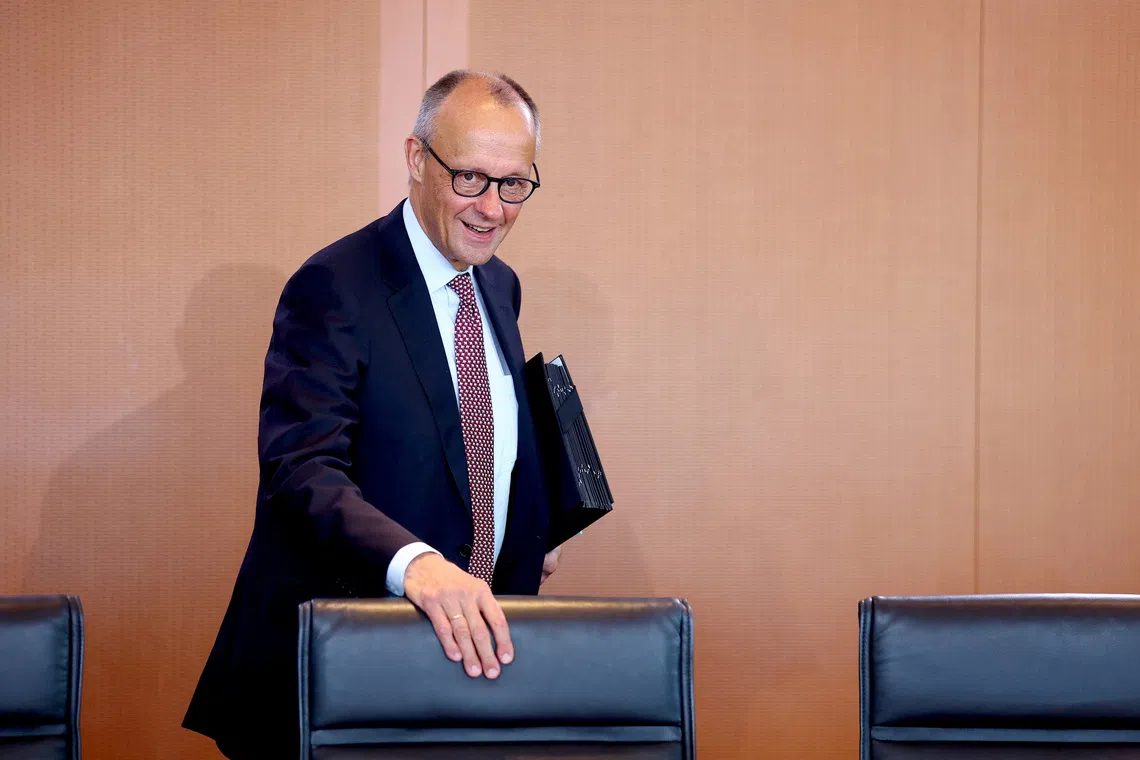
German Chancellor Friedrich Merz arrives for a cabinet meeting at the Chancellery in Berlin, Germany, September 23, 2026. REUTERS/Lisi Niesner
BERLIN, Sept 23 - Chancellor Friedrich Merz may have survived the triumph of the far right in this month's state elections in eastern Germany and Berlin but the shock to his coalition could force him to water down his promised reform agenda.
Merz took the unusual step of announcing immediately after exit polls showed his conservatives were on course for their worst-ever defeat that he would stay in office to get a raft of reforms to the tax, pensions and health systems through parliament.
His partners in the centre-left Social Democrats (SPD), who also lost heavily in elections in Saxony-Anhalt and Berlin while holding on in Mecklenburg-Western Pomerania, also pledged to continue their alliance with his Christian Democrats (CDU). But there has been increasing pressure from within the coalition for the government to do something to reflect the votes.
"There can't be a simple carrying on as normal after the state elections," an SPD strategy document circulated this week said, calling for a "German 'New Deal' that doesn't leave people alone in a period of transition".
It said a special party meeting would be called in December where the leadership would issue new policy proposals.
Despite stronger-than-expected growth in the first half of the year, surveys showed Sunday's election results were heavily influenced by squeezed living standards and voter worries over economic issues, notably rising inflation.
Aware of the mood of the electorate, two days before Sunday's votes in Berlin and Mecklenburg-Western Pomerania, Merz announced a €2.5 billion tax cut and plans for a price cap to help motorists deal with fuel prices sent soaring by the Iran war.
There has also been pressure from his partners to change sections of the reform package that have drained support for the ruling parties in the eastern German states which voted this month, including plans to change the rules on retiring early.
The SPD letter said there were "open questions" about the proposed scrapping of the option for people to retire on a full pension at the age of 63 as long as they had paid contributions for at least 45 years.
The measure was recommended by a government-appointed pension commission as part of a package of measures that included adding a capital markets element to public pensions to keep the system affordable as the population ages.
But many in the east, where people typically have lower savings than in the west and lots went through long spells of unemployment in the wake of German reunification in 1990, feel such a change would hit them disproportionately hard.
Eastern state premiers from both the CDU and SPD have already called for the proposed change to be scrapped and the SPD letter said the proposals had caused "enormous uncertainty" among both workers and employers.
Surveys after the elections in Saxony-Anhalt and Mecklenburg-Western Pomerania showed many voters feared for their personal economic security and mistrusted Merz, whose ratings have hit historic lows.
Manuela Schwesig, the SPD state premier in Mecklenburg-Western Pomerania, who has argued strongly against changing the early retirement rules, said this week Merz needed to regain the trust of voters. "I don't know if he will succeed," she said.
In the wake of the defeats, Merz himself recognized that the government needed to acknowledge that many voters did not feel it was being "fair" in its reform plans.
But already there have been warnings that picking apart reform plans agreed over the summer would undermine confidence in German policy planning just as Europe's largest economy looks like achieving modest growth after years of recession.
"If we start this whole process again now, it just delays these reforms and we need them," said Martin Jacob, a professor at Spain's IESE Business School and a member of the German finance ministry's scientific advisory board.
"And this matters, because international investors, German investors, companies in Germany need to know what policy environment they're in," he said.
However, opinion polls this week showing the far-right Alternative for Germany (AfD) party with almost 30% support across the country underline the political realities facing the government.
Merz, an instinctive pro-business fiscal conservative, came to power in 2025, pledging broad reforms to revive a German economy which has seen its industrial base steadily eroded by relentless competition from China and by the abrupt loss of cheap oil and gas from Russia due to the Ukraine war.
Turning his back on years of German fiscal orthodoxy, he unleashed a €500 billion spending package to rebuild Germany's creaking infrastructure and its shrunken armed forces and, after months of wrangling, approved the reform package in July.
But the political crisis laid bare by this month's elections could now put those reforms at risk, said Carsten Brzeski, global head of macro at ING.
"Years of economic stagnation helped produce that fragmentation. Now the fragmentation will make the stagnation harder to escape," he said. REUTERS