Germany cuts development aid despite growing crises
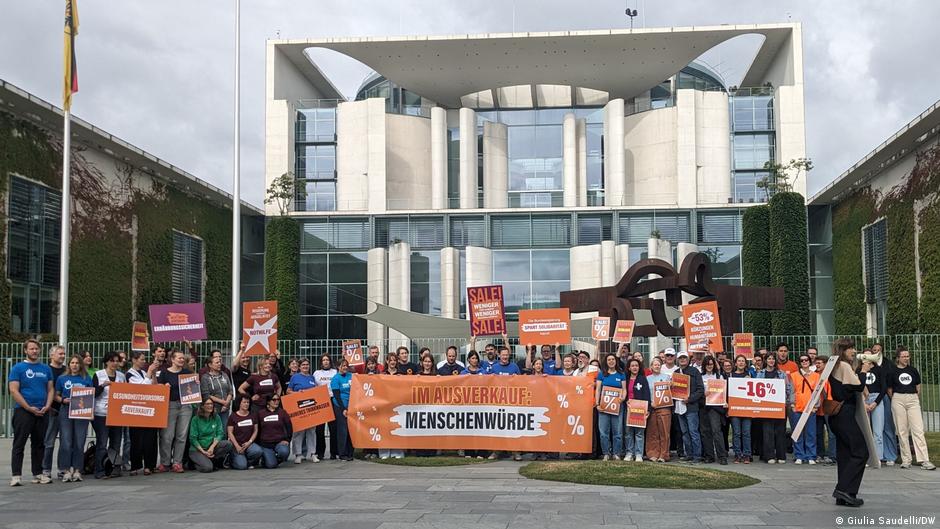
NGOs took to the street outside the chancellery to demonstrate against cutting development aidImage: Giulia Saudelli/DWAdvertisementGermany's Development Minister, Reem Alabali Radovan, opened her latest speech in the lower house of parliament, the Bundestag, with a litany of catastrophes and suffering: floods in Nepal, heat waves, forests engulfed in flames, rivers running dry, and crop failures caused by drought and lack of rainfall.
"Millions of people are facing hunger," said the minister from the center-left Social Democratic Party (SPD). "And one thing is clear: the climate crisis is threatening the entire world. No country can tackle it alone."
Radovan opened the debate on the federal government's proposed 2027 budget for her ministry with a stark assessment. The budget is set to shrink for the fifth consecutive year, falling from just over €10 billion to just under €9.5 billion. In 2022, it still stood at nearly €14 billion. Since then, the ministry's budget has been reduced by roughly one third.
How does this sharp decline square with the dramatic picture painted by Germany's development minister herself? She points to the new strategy she unveiled in January, when she declared: "Development policy will become an even more important pillar of German security, alongside diplomacy and defense."
Aid organizations reacted skeptically to this policy shift when it was first announced, and their concerns have deepened in light of the latest funding cuts. "The renewed reductions in funding for international cooperation are further exacerbating an already critical situation," said Michael Herbst of VENRO, the umbrella organization representing around 150 development and humanitarian NGOs.
Herbst also criticizes the stagnant budget for humanitarian aid administered by the German Foreign Office. While it exceeded €3 billion in 2022, it has remained at just €1 billion since 2025. In light of worsening global crises, VENRO is calling for a change of course. "Next year, we will need to invest more in combating hunger because the conflict involving Iran and the dry summer are expected to trigger a sharp decline in agricultural yields," Herbst said, explaining the organization's demand for substantially higher funding.
The impact of the cuts is already clearly visible, the umbrella organization stresses, citing a survey of its member organizations. The number of funded projects is declining significantly. "Our sample of 34 organizations shows that, among these organizations alone, more than ten million fewer people are being reached with assistance."
"And many local partner organizations, which are indispensable to effective development cooperation and humanitarian assistance, are no longer able to operate," Herbst added. He also stressed that the full impact of these far-reaching cuts is unlikely to become apparent for another three to four years.
The federal government's belt-tightening across virtually all ministries is a consequence of the Zeitenwende announced by then-Chancellor Olaf Scholz(SPD) in response to Russia's invasion of Ukraine. Since then, Germany has embarked on a major military buildup, increasing its defense budget year after year, while nearly all other ministries have had to make do with significantly less funding.
Herbst, a member of VENRO's executive board, is calling on the German Bundestag to exempt both development cooperation and humanitarian assistance from the country's so-called 'debt brake'. "After all, exceptions have already been made for the modernization of the Bundeswehr and for military aid to Ukraine," he points out. Herbst hopes that such a move would enable Germany to once again assume greater responsibility on the international stage.
Jamila Schäfer, a member of parliament from the opposition Green Party, made a similar argument during the Bundestag debate on the development ministry's budget. Climate action and development cooperation, she argued, are not acts of charity but are firmly in Germany's own interest.
"Germany must invest in its defense capabilities, but security is not created through investments in the defense budget alone," Schäfer argued. "Those who strengthen military security while cutting support for international stability have a blind spot in their security policy."
Nicolas Zippelius, a lawmaker from the governing centre-right conservative alliance, the Christian Democratic Union and Christian Social Union (CDU/CSU), sees the ongoing cuts to development spending differently. In his view, every ministry must contribute to consolidating the federal budget. "Less money does not necessarily mean a smaller impact. Instead, it should encourage us to focus more clearly on priorities and critically review existing structures."
Zippelius dismisses demands to exempt the development ministry from Germany's 'debt brake'. "The key question is whether every euro spent is directed to where it can make the greatest difference." The Christian Democrat argues that success in development cooperation, as in other areas of policy, should be judged not by the size of the budget but by the impact it achieves.
Jan Sebastian Friedrich-Rust, who heads the humanitarian and development aid organizationAction Against Hunger, has a very different view. "The cuts planned for the 2027 budget are short-sighted and dangerous. As a result, up to 22.6 million people worldwide could die by 2030," he said in a written statement to DW.
Cuts to development cooperation and humanitarian aid are also fiscally short-sighted, Friedrich-Rust argues. "Hunger, crises and instability generate long-term costs that far exceed the cost of prevention. Those who cut spending today are merely postponing the bill and ultimately making it much more expensive," he warned.
To underscore its concerns, the alliance Action Against Hunger delivered a petition to the leaders of the governing coalition of SPD and CDU/CSU parliamentary groups on the eve of the Bundestag's budget debate. The appeal, titled "Don't Balance the Budget at the Expense of Solidarity: Strengthen International Aid!", garnered around 100,000 signatures.
This article was translated from German.