Germany news: Bremerhaven port to receive defense boost
If you rely on our team for trusted reporting, please take a moment to select us as your preferred source on Google, so you'll always see our verified news first.
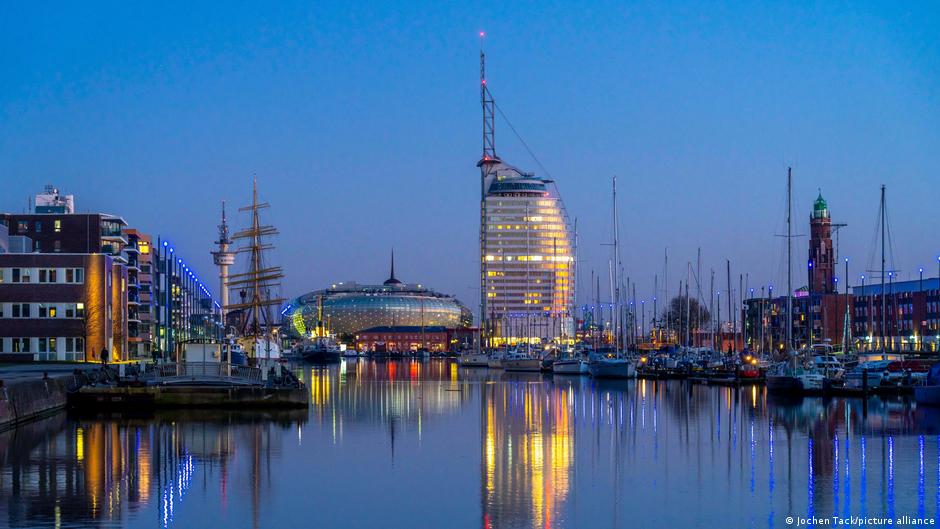
The North Sea port of Bremerhaven will be upgraded to better serve German and NATO defense needs, German officials said on Tuesday.
German Defense Minister Boris Pistorius signed a memorandum of understanding on Tuesday which will transform the port into a "Deployment Hub" in the case of an attack on the NATO bloc. The plan will cost some €1.5 billion ($1.7 billion).
Russia's invasion of Ukraine in 2022 has caused European countries to draw up plans in case of an attack on a NATO member, such as Germany.
"Tens of thousands of soldiers will need accomodation and food. Machinery and equipment must be maintained and operated accordingly," Pistorius said.
Bridges, roads and railways will need to be boosted to facilitate the transportation of NATO equipment arriving at the Bremerhaven port. Bremen's airport will also be expanded with more logistics space as part of the plan.
Police cars in the western German state of Rhineland-Palatinate will soon come equipped with a new cute and cuddly weapon ― teddy bears.
The state's interior minister, Achim Schweikert of the center-right Christian Democratic Union, said the bears will be given to kids by officers as a "source of comfort" in emergency situations. So far, 1,100 bears have been bought by police, equating to three bears per car.
It's up to police to decide when to give out the bears to children.
The decision to equip the police with teddy bears is due to a bachelor thesis at the Rhineland-Pfalz Police Academy by Kim and Kevin Zorn. The couple are both police officers in the major city of Koblenz.
The thesis researched the first aid provided to children in emergency situations. Children who witness situations such as domestic violence or sexual abuse can be distracted if they have an object hold on to.
Teddy bears are already being used by police in other German states, such as Saxony-Anhalt.
Parliamentary leaders from the center-left Social Democratic Party (SPD) have called for a formal review of whether Germany's far-right Alternative for Germany (AfD) should be banned.
"Democracy is threatened by it from within," SPD leaders from the federal parliament, Germany's states and the European Parliament said in a joint declaration after meeting in Bremen.
The resolution described the AfD as a right-wing extremist party that systematically attacks Germany's free society, normalizes racism and seeks to undermine the democratic order from within.
The SPD leaders called for a joint federal-state working group to be established before the end of the year to prepare the review.
"Preparing an examination procedure is a legal necessity required by the protection of our constitution," they said. "We see this as our democratic duty."
Defense Minister Boris Pistorius said such a review was important because every liberal democracy was vulnerable and could also be destroyed from within.
West Germans received more than four times as much inherited or gifted wealth per person as people in the east in 2025, highlighting the country's persistent wealth divide.
More than €2,100 ($2,390) per person was passed down or gifted in western Germany, compared with just under €500 in the eastern states and Berlin, the Federal Statistical Office said. The national average was just over €1,800.
Although the east and Berlin were home to 19% of Germany's population, they accounted for only 5% of the inheritances and gifts assessed for tax.
Tax authorities recorded transfers worth €142.5 billion in western Germany, dwarfing the €8 billion recorded in the east and Berlin.
The divide was also reflected in the tax assessed. Western states accounted for €20.4 billion, or 95%, of Germany's €21.4 billion in inheritance and gift taxes.
Eastern states and Berlin accounted for just €1 billion. The revenue goes directly to Germany's federal states.
Wolters brewery in the northern German city of Braunschweig is to stop producing beer at the end of the year, bringing almost four centuries of brewing at the site to an end.
The closure will affect around 90 employees, who have been informed of the decision, according to the law firm handling the company's insolvency proceedings.
Founded in 1627, Wolters filed for insolvency under self-administration in the summer, citing falling sales in Germany's shrinking beer market. Efforts to find an investor for the production site were unsuccessful.
Germany's beer market contracted more sharply in 2025 than in any year since reunification, according to the Federal Statistical Office.
The Food, Beverages and Catering Union criticized the speed of the closure decision, saying the process appeared less like an orderly restructuring and more like "slamming on the brakes."
The Wolters brand could still survive. The insolvency law firm said talks with several interested parties were continuing, although they would not necessarily keep production in Braunschweig.
"An era is coming to an end with the closure of the Braunschweig production site," managing director Nils Handke said, describing the decision as unavoidable.
German Foreign Minister Johann Wadephul has indirectly criticized Slovakia's stance on Russia's war in Ukraine, warning that doubts about NATO deterrence could endanger the entire alliance.
"The greatest threat to freedom on our continent comes from Moscow. The greatest danger to Europe is Putin's belligerent imperialism," Wadephul said during talks with Slovak Foreign Minister Juraj Blanar in Bratislava.
"Questioning these facts is not only lacking in solidarity, it would be irresponsible," he added. Wadephul said countries that doubted NATO's deterrence created risks for themselves and weakened security guarantees for all allies.
Slovakia's left-nationalist Prime Minister Robert Fico has increasingly accused Western countries of escalating tensions with Moscow and questioned the policies of both NATO and the European Union.
Fico recently said he would prefer Slovakia to be neutral and expressed doubt that NATO allies would send troops to defend the country in an emergency. However, he acknowledged that Slovakia remained bound by its NATO membership.
German Chancellor Friedrich Merz has praised teachers as "the most important professional group in our country" at the German School Award ceremony in Berlin.
"I speak as a father and grandfather: We entrust you with the most valuable thing we have. Our children," Merz said.
Against the backdrop of Germany's weak results in the PISA international education assessment, Merz said ensuring that young people receive a good education was "one of the most important, if not the most important, tasks facing our society."
The chancellor admitted that he "rarely felt like" going to school as a child but said the ceremony had encouraged him to visit schools more frequently.
The €100,000 ($114,000) top prize went to the Bertha von Suttner Comprehensive School in the central state of Hesse, for its data-driven teaching model and personal support for pupils.
The jury said dedicated departments at the school evaluate data and use the findings to improve lessons. Students also have designated staff members who serve as permanent points of contact.
Only 15% of pupils arrive with a recommendation to attend a gymnasium, Germany's academically oriented secondary school. However, two-thirds later obtain the Abitur qualification needed to enter university, according to the jury.
Ukrainian defense minister has canceled his trip to Germany on Tuesday as Russia hammers the country withround-the-clock drone attacks to wear down its capital and the economy.
Yevgeniy Khmara was scheduled to meet his German counterpart Boris Pistorius at a time when Ukraine has been pushing for allies to step up military and financial aid ahead of winter.
At least nine people were killed across the country on Monday when Moscow's forces pounded apartment buildings, offices as well as a building of the National Academy of Sciences of Ukraine in downtown Kyiv.
The AFP news agency cited an unnamed source telling it that Khmara had canceled trips to both Germany and Norway "due to the situation in Ukraine and intensification of Russian attacks, which requires rapid attention."
The former director of Berlin-based broadcaster RBB (Rundfunk Berlin-Brandenburg) is to stand trial in connection with allegations of financial mismanagement and misuse of company resources that emerged when she was heading the channel in 2022.
The public prosecutor's office filed criminal charges against Patricia Schlesinger and three others last year in December.
The Berlin regional court on Tuesday accepted that indictment, meaning that it believes the case has enough weight to move to trial.
The trial, which is scheduled to begin on November 10, is set to see 56 hearing days because the trial is likely going to be a complex one.
The case is a very high-profile one because it involves someone who was at the helm of Germany's public broadcasting system as Schlesinger was also the director of ARD, the powerful association of the country's nine regional stations.
Schlesinger has denied all allegations. "Ms. Schlesinger based all her decisions as director solely on the interests of RBB. We will fully refute the accusations," her lawyer Oliver Sahan told German press agency DPA.
The trial ends at the end of June 2027, a spokesperson for the Berlin court told reporters.
The German government intends to block the sale of logistics firm Zippel to Chinese state-owned group Cosco over security risks, the Handelsblatt newspaper reported.
The newspaper cited a restricted government memo that mentioned security and strategic risks that could come with the planned deal.
Cosco, which is one of the world's largest container shipping companies, last year announced that it would like to acquire an 80% stake in Zippel. It already has a minority stake in Hamburg's port terminal.
Zippel, a traditional German company based in Hamburg, the country's largest port city, arranges transportation of freight and cargo.
A number of ministries have been in favor of blocking the deal.
A final decision has yet to be made.
The center-right Christian Democratic Union (CDU) led by Chancellor Friedrich Merz's party has seen better days: Most recently, it suffered unprecedented defeats in state elections in Saxony-Anhalt, Mecklenburg-Western Pomerania, and Berlin. At this time of voter disenchantment, two prominent CDU politicians have come under fire on social media: Jens Spahn and Philipp Amthor have been facing accusation of being out of touch and self-absorbed.
A few weeks ago, Spahn resigned from his powerful position as parliamentary group leader of the CDU and CSU bloc in the Bundestag after Spahn had announced that had become a parent with the help of a surrogate mother in the United States. He was accused of hypocrisy because surrogacy is banned in Germany and the CDU and Spahn himself had repeatedly voted to uphold this ban.
Spahn was then given a seat on the influential Budget Committee. He called in sick for a meeting, but at the same time the tabloid BILD published a photograph of him vacationing in Sardinia with his young son. Spahn immediately resigned that post as well.
The CDU's Philipp Amthor has only recently become Minister of State for Federal-State Cooperation in the Chancellor’s Office. There, he placed a beach chair on the balcony of his new office and proudly showed it to a TV reporter. As a reminder: His party has just been voted out of the state parliament in his home state of Mecklenburg-Western Pomerania on the Baltic Sea coast. But that didn't seem to have dampened the minister's good spirits.
Once again, social media reactions were fierce: This time with criticism of the young government official’s alleged arrogance. Amthor swiftly had the beach chair removed.
As the German saying goes, "Wer den Schaden hat, braucht für den Spott nicht zu Sorgen" (He who suffers the loss need not worry about the ridicule). That is seen to apply quite accurately to the CDU at the moment.
Hendrik Wüst is and remains Germany’s "reserve chancellor." Following his meeting with President Recep Tayyip Erdogan, the premier of the country's most populous state, North Rhine-Westphalia (NRW), will meet with three additional ministers: Foreign Minister Hakan Fidan, Finance Minister Mehmet Simsek, and Industry Minister Mehmet Fatih Kacir. A travel itinerary befitting a true statesman.
Without a doubt, NRW — home to one-third of the three million people of Turkish descent in Germany and with a trade volume exceeding ten billion euros — is the most important German state for Turkey.
But the personnel debates within Chancellor Merz’s conservative CDU party, to which Wüst also belongs, are also drawing attention here. These meetings are proof that here, too, people are betting on Wüst as a future chancellor.
During his trip, Wüst also struck a self-critical tone regarding Germany's history with racism and xenophobia. For too long, he said, Germany has viewed the many people of Turkish descent “occasionally as a problem”— the very same people who have helped Germany achieve its prosperity.
Coalition talks are underway in the northeastern German state of Mecklenburg-Western Pomerania.
The Social Democrats (SPD) are meant to meet with the Green Party to talk about forming a government. The SPD met with the socialist Left Party yesterday too.
A coalition between the Social Democrats, the Greens, and the Left Party is the only viable option in the state to keep the far-right Alternative for Germany (AfD) out of the math.
The AfD won the contest in Mecklenburg-Western Pomerania with 38.2% of the vote but has no option to govern the state since none of the other parties will work with it.
The SPD, which has long governed the state, finished second with 35.5% of the vote.
German Chancellor Friedrich Merz and his counterparts from five other nations have threatened to withhold their approval to a seven-year European Union budget proposal unless it were slashed by billions of euros as they've demanded for.
Merz and leaders from the Netherlands, Sweden, Denmark, Austria and Finland have signed a letter to make clear their wish to have the proposed budget trimmed by billions of euros or see it blocked, according to the Financial Times.
The budget for 2028-2034 was outlined by the European Commission last year and needs to be approved by all EU countries.
The proposed budget was set at nearly €2 trillion ($2.33 trillion) and parties involved are hoping to reach an agreement by the end of 2026.
The proposed amount is significantly higher than the current one set at between 2021 and 2027.
Merz earlier this month said cuts should apply across all policy areas and rejected relying on further joint EU borrowing to bridge the gap.
"Excessive debt threatens our sovereignty and our capacity to act," Merz said earlier this month, adding that governments had the "admittedly painful task" of setting priorities.
The German leader has called for the bloc's next budget to shift spending toward competitiveness and defense, arguing that a "20th-century budget" could not address current challenges.
The EU budget is funded primarily through contributions from member states, either in the form of national contributions calculated on the basis of gross national income or as a percentage linked to national VAT revenues.
As the EU's largest economy, Germany contributes the largest amount in absolute terms.
Guten Morgen and welcome to the Tuesday edition of the Germany blog.
We're looking at sharp disagreements over the proposed European Union budget that member states want to see approved by the end of this year.
German Chancellor Friedrich Merz and his counterparts from five nations have threatened to withhold their approval unless they see the proposal trimmed by billions of euros.
Meanwhile, coalition talks continue in the state of Mecklenburg-Western Pomerania where the Social Democrats, the Green Party and the Left Party are hoping to form a government.