Germany news: Chancellor Friedrich Merz accuses North Korea of threatening Europe's freedom
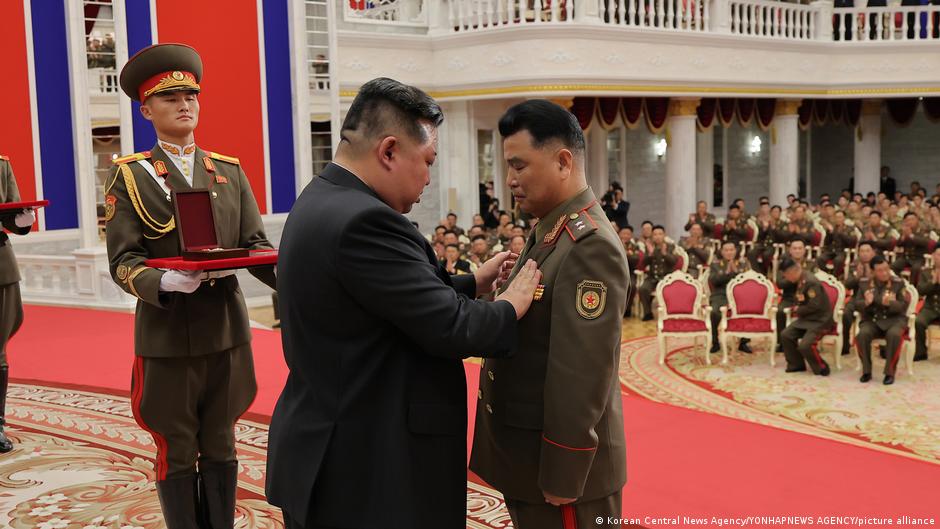
North Korea is thought to have sent about 15,000 soldiers to fight for RussiaImage: Korean Central News Agency/YONHAPNEWS AGENCY/picture allianceAdvertisementSkip next section What you need to knowWhat you need to know Chancellor Friedrich Merz is in South Korea at the end of his Asia tour Merz and South Korean President Lee Jae Myung deepen their countries' strategic partnership, including security and military ties Germany's president Steinmeier continues his trip to China, where he called for free global trade to be strengthened Volkswagen (VW) posts 3rd quarter losses of €5.8 billion ($6.46 bln) VW has been struggling to keep pace with competition from China and to transition to electric vehicles 8-year-old girl sustains serious injuries after wolf attack at a wildlife park in Brandenburg Here are the main headlines from and about Germany on Thursday, October 29, 2026:
Germany's President Frank-Walter Steinmeier on Thursday called on China to reduce economic imbalances between the two countries, as well as between China and Europe.
Steinmeier, who was speaking at the renowned Peking University, also urged China to work with Germany and other European nations to strengthen the international, rules-based order and "to advocate for peace and free global trade."
The German president, who holds a largely ceremonial role, spoke of his respect for China's rapid development in its economy, technology and politics, calling China a "defining world power."
But Steinmeier added, "With greatness and power comes great responsibility."
"We are not concerned about China's rise. We are watching how China rises," he said.
"We do not want to decouple from China; on the contrary, we want to structure trade in such a way that it continues to benefit both sides." This, he said, requires fair and uniform rules.
Steinmeier was referring to the high barriers European companies face when trying to operate in the Chinese market. Since China heavily subsidizes its exports to Europe, the European market comes under pressure too quickly.
This poses "the danger of one-sided vulnerability," Steinmeier said. Europeans cannot want this for their economy, just as "China does not want it for its economy."
He also called on China to exert more influence on Russia to bring the war in Ukraine to an end.
According to Steinmeier, China's interests are also at stake in this war, just as they are in the Middle East. As a major trading power, China also needs free sea lanes, intact supply chains, and a secure energy supply.
"The longer these conflicts persist, the weaker the global economy as a whole becomes — and with it, one of its largest economies: China," the president said.
Steinmeier addressed future issues in which China should take a particular interest: climate change and artificial intelligence. He appealed to his hosts, saying that when it comes to AI, "we should jointly establish international guidelines so that the technology remains under human control," he said.
On the final day of his state visit, Steinmeier will meet with China's leadership and hold talks with, among others, President Xi Jinping.
Steinmeier is making his first visit to China in eight years, as he seeks to boost bilateral ties.
German Chancellor Friedrich Merz on Thursday said North Korea was threatening "freedom throughout Europe" by sending soldiers to fight for Russia in its war against Ukraine.
After a meeting in Seoul with South Korean President Lee Jae Myung, Merz highlighted that Russia was supplying weapons to North Korea.
The chancellor said this arrangement therefore shows how "Korea's security affects Europe's security. And Europe's security also affects Korea's security."
North Korea has boosted its military ties with Russia since the start of the full-scale invasion of Ukraine in 2022.
Pyongyang has provided Moscow with artillery ammunition and missiles. It has also, according to South Korean intelligence services, sent about 15,000 soldiers to fight alongside Russian forces.
In exchange, Russia provides financial backing, military technology and security guarantees to North Korea.
Before Merz's arrival on Thursday, North Korea fired about 10 short-range ballistic missiles toward the Sea of Japan, according to the South Korean military.
At the start of his visit, Merz said he hoped that Korea would eventually be unified. The peninsula has been split along the 38th parallel since the end of hostilities in the Korean War in 1953.
Merz also agreed with Lee to deepen their two nations' strategic and security ties, which includes joint military exercises and exchange of intelligence.
The chancellor is expected to conclude his trip to South Korea with a visit to the Demilitarized Zone (DMZ) on Friday.
Germany is looking for new partners in Asia. As Chancellor Friedrich Merz travels to Singapore, Japan and South Korea, Berlin is trying to reduce its economic dependence on China while adapting to a changing global order. But can countries in the Indo-Pacific, besides China, help Germany diversify its trade and security partnerships?
This week on Berlin Briefing, DW's Giulia Saudelli speaks with DW Business Reporter Steven Beardsley and DW Chief Political Correspondent Nina Haase, who is traveling with the chancellor.
They discuss Germany's push to "de-risk" from China, growing security cooperation in the Indo-Pacific, and whether middle powers can work together to shape the future global order.
Germany and South Korea on Thursday pledged to work together on the economy, energy and security and high-tech industries, South Korean President Lee Jae Myung said.
The South Korean leader made the announcement after a meeting with German Chancellor Friedrich Merz in Seoul.
At a joint press conference, Lee told reporters that he had asked Merz for Germany's backing in securing favorable treatment for South Korea as part of the EU's Industrial Accelerator Act.
The two leaders also agreed to improve bilateral ties to an "enhanced strategic partnership," Lee said.
An eight-year-old girl sustained serious injuries after she was attacked by at least one wolf at a wildlife park in Brandenburg in east Germany.
The child was brought to hospital by a rescue helicopter on Wednesday.
Local officials said a zookeeper had helped prevent other children from being attacked.
Police are investigating how and why the attack occurred, which took place during a special program for children.
Police on Thursday said their investigation was centered on a staff member who was in the enclosure with the children, a spokeswoman said.
The Teltow-Fläming district administration said the incident happened before the wildlife park's regular opening hours as part of an "Animal Keeper Day" for children.
The administration also said the attack had taken place in the polar wolf enclosure.
"While the animals in the wildlife enclosure were being watered, the wolves kept there attacked a girl and seriously injured her," the district administration said.
The zookeeper's quick action prevented "further harm to two other girls" who were also at the scene, the district added.
The park will remain closed for the time being, officials said, as authorities launch a safety review at the wildlife park, which is about 60 kilometers (37 miles) south of Berlin.
Police are still probing the circumstances that led to the children being inside the enclosure.
The Johannismühle Wildlife Park said it was cooperating with authorities but could not provide further details due to the open investigation.
"We deeply regret the incident, and the affected family has our full support," the park said.
The wildlife park was closed until further notice "due to technical reasons," a sign at the entrance said on Thursday.
A wolf bit a woman in a busy shopping area in Hamburg this year, in what is thought to be the first such attack since wolves were reintroduced to the country in 1998.
German Chancellor Friedrich Merz, who is visiting Seoul, said at the start of his visit that he hopes North and South Korea will eventually be reunited.
The Korean Peninsula has been divided into two states since the Korean War ended in 1953.
Merz pointed to his own country's division between West and East Germany for much of the second half of the 20th century.
"Korea and Germany are united by the painful experience of division," he wrote in the guest book during his meeting with South Korean President Lee Jae Myung.
"I also wish for the people of Korea what we are fortunate to experience in Germany: unity in freedom."
North Korea is a largely isolated dictatorship ruled by Kim Jong Un, while the South is a democracy that has close ties with the West.
The two Koreas technically remain at war since a truce ended hostilities.
Merz is set to visit the demilitarized zone (DMZ), which divides the two countries, on Friday.
The German chancellor's visit to South Korea is the last stop on his tour of Asia this week, which has also seen him visit Japan and Singapore.
Bayern Munich head coach Vincent Kompany has just returned home from the hospital, admitting that he hadn't listened to his body, "and then at some point, my body just said, 'Enough is enough!'"
Read our full report on Kompany's health and the need for better support for coaches at the highest level of sport here.
They were once top sellers in China. Now the likes of Volkswagen, Toyota and Honda are losing ground to a new generation of Chinese carmakers. What happened?
Volkswagen (VW) reported third quarter losses of €5.8 billion ($6.5 billion) on Thursday, as it faces rising competition from China.
Germany's biggest car maker had reported a loss of just over €1.07 billion in the same period last year.
Volkswagen, like other car makers, has struggled to keep pace with fierce competition from China, the world's biggest car market. VW has also struggled with the transition to electric vehicles and with declining demand.
Volkswagen last month warned that its 10-brand group, which includes makers such as Audi, Seat and Skoda, was facing a 10-billion-euro hit to its annual profits.
The most significant hit came from Porsche, Volkswagen's luxury sports car and SUV subsidiary. Porsche, which was once a major driver of profits for the VW group, was also one of the main factors behind VW's quarterly losses in 2025.
The luxury brand has been hit by a sales slump in China, US tariff policy and its electric vehicle strategy.
VW announced this year that it plans to cut over 100,000 jobs across the group by the end of the decade as it tries to reduce costs. It announced on Thursday that its restructuring would cost the company 31 billion euros.
The company is considering or has decided to shut down multiple German factories — including plants in Zwickau, Emden, Hanover, and Neckarsulm.
"What matters now is swift and consistent implementation," Arno Antlitz, VW's chief financial officer said in a statement. "We cannot lose any time and need to act quickly and decisively."
Guten Morgen from the DW newsroom in Bonn on the banks of the Rhine, which is bathed in autumnal hues and fog as we near the end of October.
We open today's coverage of Germany with the news that Volkswagen's recent struggles have translated into huge losses.
The country's largest auto manufacturer, which has already announced job cuts of 100,000 by the end of the decade, reported third quarter losses of nearly 6 billion euro.
On the other side of the world, Chancellor Friedrich Merz is concluding his tour of East Asia with a visit to South Korea, while President Frank-Walter Steinmeier continues his visit to China.
Stay tuned as we bring you more on those and other stories making headlines in Germany on Thursday.