Germany news: COVID vaccine maker BioNTech to close 3 sites
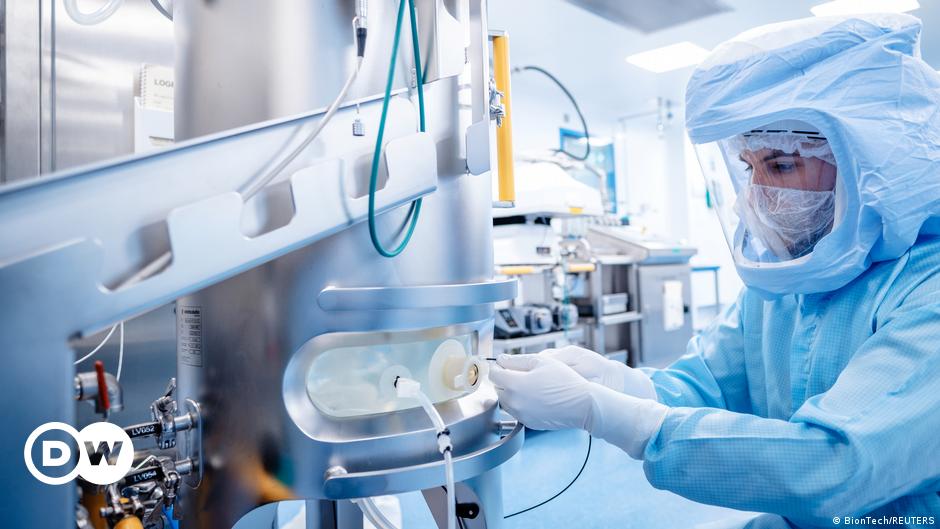
German biotech company BioNTech says it will close three sites in Germany after failing to find buyers.
The sites are in Marburg, Idar-Oberstein and Tübingen. BioNTech is also shutting down operations in Singapore.
The Mainz-based company had announced plans in May to sell the facilities as part of a restructuring of its manufacturing operations.
BioNTech said its efforts to find buyers had been unsuccessful, citing a difficult market and investment environment.
The company said it had reached agreements with its works council on additional redundancy terms for affected employees.
The three German closures affect around 1,800 employees. BioNTech had previously said its wider restructuring could affect up to 1,860 positions.
BioNTech rose to global prominence during the COVID-19 pandemic after developing an mRNA vaccine with US pharmaceutical company Pfizer. Demand for COVID vaccines has since fallen sharply, leaving the company with excess manufacturing capacity.
BioNTech is increasingly focusing its resources on its oncology pipeline and has said the restructuring could eventually generate annual savings of around €500 million ($587 million).
Recent state elections have been won by parties at the extreme ends of the political spectrum: in the eastern states of Mecklenburg-Western Pomerania and Saxony-Anhalt, the far-right Alternative for Germany (AfD), and in Berlin the far-left Left Party.
At the same time, parties in the political center are seeing their support increasingly drain away.
A ceremony attended by some 1,000 guests is to be held on Monday evening in the southwestern city of Karlsruhe to mark the 75th anniversary of the foundation of the Federal Constitutional Court.
Among those invited are Chancellor Friedrich Merz, Bundestag President Julia Klöckner and President Frank-Walter Steinmeier.
In a speech released to the press in advance, Steinmeier stressed the importance of the court at a time when liberal democracy in Germany was increasingly threatened by "forces at the political margins."
"A strong Constitutional Court is part of the resilience of our democracy," he said. "I am convinced that the Constitutional Court is a guarantee that, despite all challenges, the success story of our liberal democracy will continue."
Steinmeier highlighted the importance of the Constitutional Court in moving Germany "away from the traditional authoritarian state toward a modern civil society" after the Nazi era.
"The court succeeded in positioning itself ... against the Nazi tyranny and to use its jurisdiction to stress that the constitution was and is a deliberate counter-model to this tyranny," he said.
The Constitutional Court, which was founded on September 28, 1951, is the highest German court for constitutional issues and is tasked with ensuring the compliance of all governmental institutions with the German constitution, or Basic Law.
Up to the end of 2025, it dealt with almost 274,000 cases, more than 96% of which were judicial reviews following constitutional complaints, according to the Federal Agency for Civic Education (bpb).
Its rulings cannot be contested and all other state organs are obliged to follow them.
After defeat to Greece, Jürgen Klopp is confronted with the real challenge of his task as Germany head coach. Can his charisma alone push this group forward?
Hendrik Wüst, the conservative leader of the state of North-Rhine Westphalia (NRW), has kicked off a three-day trip to Turkey to mark the 65th anniversary of the 1961 agreement allowing "guest workers" from Turkey to work in West Germany.
Wüst, whom many see as a potential successor to beleaguered Chancellor Friedrich Merz, called for a "new chapter" in relations with Turkey as he began his visit, accompanied by a large delegation.
Wüst noted that one-third of the some 3 million people of Turkish origin or ancestry in Germany live in its most-populous state of NRW, saying: "They are naturally part of our state."
On Monday, Wüst is due to visit a plant in the Turkish capital, Ankara, that belongs to the company Henkel, which is based in Düsseldorf, the capital of NRW.
He then plans to visit the mausoleum of Mustafa Kemal Ataturk, the founder of modern Turkey, while a meeting with Turkish business figures is scheduled for the evening.
On Tuesday, Wüst will hold political talks in the capital before traveling on to Turkey's largest city, Istanbul, where a business conference is on the agenda.
Tuesday will also see the presentation of a prize for tolerance and reconciliation between cultures to former Germany football captain Ilkay Gundogan.
The 51-year-old Wüst is the first premier of the state to make an official visit to Turkey.
Even as October approaches, the water levels on the crucial River Rhine remain among the lowest on record.
After an unusually dry September, the reading in Cologne dipped to 40 centimeters (just under 16 inches) on Monday morning, monitoring data from the WSV agency showed.
"The 40 centimeters constitutes a low-water record," a Cologne city official, Markus Neumann, told the DPA news agency.
Prior to the series of new records in the past few months, the lowest measurement in Cologne had been a 2018 reading of 69 centimeters.
Several of the points along western Europe's busiest inland freight waterway were similarly shallow on Monday.
In Koblenz, Andernach, and Düsseldorf the readings even moved into negative territory, meaning that the gauging station was completely dry.
The levels at the measuring points do not indicate the absolute depth of the river for shipping, but rather the depth at a more accessible point, nearer the banks. The difference between the depth and the readings varies among the gauging stations but tends to be somewhere around 1 meter shallower than the navigable shipping channel.
Amid a hot and dry summer, the Rhine made headlines repeatedly and hit a series of record lows in August, severely impacting commercial shipping. A brief rainy period had brought some relief, but levels had been dropping again in the last few weeks.
The Rhine, linking the Netherlands and the vast port of Rotterdam to much of western Germany, is used for an array of freight transportation, including coal and fuel.
Germany's WSV river agency also had low water level warnings in place on stretches of most of the country's major rivers on Monday, including the Elbe, Danube, Weser, Ems and the Oder.
The far-right Alternative for Germany (AfD) has failed to secure its first senior municipal posts in the northern state of Lower Saxony.
In Salzgitter, incumbent Mayor Frank Klingebiel of the center-right Christian Democratic Union (CDU) won 74.7% against AfD candidate Patricia Mair, who received 25.3%.
In Munster, independent candidate Anna Adamczak secured around 80% against her AfD opponent.
In Bockenem, in the Hildesheim district, independent Jens Lüer defeated AfD candidate Felix Mull by 69.6% to 30.4%, a margin of 2,019 votes.
In the state capital, Hanover, incumbent Mayor Belit Onay of the Green Party defeated Axel von der Ohe of the center-left Social Democratic Party (SPD) by 61.5% to 38.5%.
The results are preliminary. Those elected will serve eight-year terms.
German Foreign Minister Johann Wadephul is visiting the Netherlands on Monday, where he is hold talks with his Dutch counterpart Tom Berendsen and meet with senior International Criminal Court (ICC) officials.
In The Hague, the two foreign ministers are expected to discuss the European Union's planned budget, military cooperation and support for Ukraine.
Their talks come as a group of EU member states, including Germany and the Netherlands, are resisting the European Commission's proposal for a €1.76 trillion ($2 trillion) budget for 2028-2034.
Wadephul also intends to meet with ICC President Tomoko Akane and deputy chief prosecutor, Nazhat Shameem Khan, in the city, which is where the court is based.
The ICC is currently under growing pressure from the US, with President Donald Trump last week calling on the international community to withdraw en masse from the court in a speech at the UN General Debate.
Germany's domestic intelligence agency (BfV) has warned that cooperation between German research institutes and Chinese universities could open the door for Chinese espionage.
China has been building up a "comprehensive system of technology and know-how transfer" for years to gain the edge politically, economically, technologically and militarily, the BfV told the daily Handelsblatt.
"This acquisition of technology and know-how can also occur by means of scientific cooperations with universities and top research bodies in Germany," it said.
The BfV said Chinese scientists visiting Germany could be instrumentalized to advance Beijing's "strategic ambitions."
It named quantum technologies, AI and hypersonic technology and biological and surveillance technologies as being particularly sensitive, as they can be used both for civilian and military purposes.
According to the BfV, "legal grey zones" and a "lack of risk awareness" on the part of German research institutions were potential vulnerabilities.
It said the Chinese state could also exploit Germany's constitutionally guaranteed freedom of scientific research and teaching.
Left Party politician Elif Eralp, who could become Berlin's next mayor after an election win last week, has filed a criminal complaint against conservative Interior Minister Alexander Dobrindt over a remark referring to her as an "antisemite."
Lawyer Jasper Prigge told the DPA news agency the complaint by Eralp and the Berlin branch of the Left Party argues that Dobrindt endorsed a statement describing Eralp as an "antisemite" in what amounted to a criminal act of defamation and insult.
The incident occurred in a talkshow on German television on Thursday.
The moderator of the show, Maybrit Illner, said, "Elif Eralp says she is an antisemite," quickly correcting her slip-up to "... [that] she is not an antisemite."
Dobrindt then said: "Oh, yes, she is."
Dobrindt had said on an earlier occasion that the Berlin branch of the Left Party was "quite obviously tolerating antisemites and extremists in its orbit."
Eralp herself has repeatedly condemned all forms of antisemitism and reaffirmed Israel's right to exist.
The legal action comes as many conservative politicians have reacted with outrage to the victory of the socialist party in the elections on September 20.
Some observers, however, see the accusations of antisemitism levelled at the party as overblown and politically motivated.
The DW newsroom in Bonn says guten Tag and willkommen to all its readers!
We will be looking at the antisemitism accusations targeting the Left Party in Berlin after it won state elections there a week ago.
The state chapter of the party has now filed a criminal complaint against Interior Minister Alexander Dobrindt after he seemed to say its mayoral candidate, Elif Eralp, was an antisemite, which she strongly denies.
Meanwhile, the domestic intelligence agency BfV has warned that German know-how could be siphoned off by China during cooperations between universities and research institutes.
Read on for more on these and other stories!