Germany: Voting underway in two key state elections
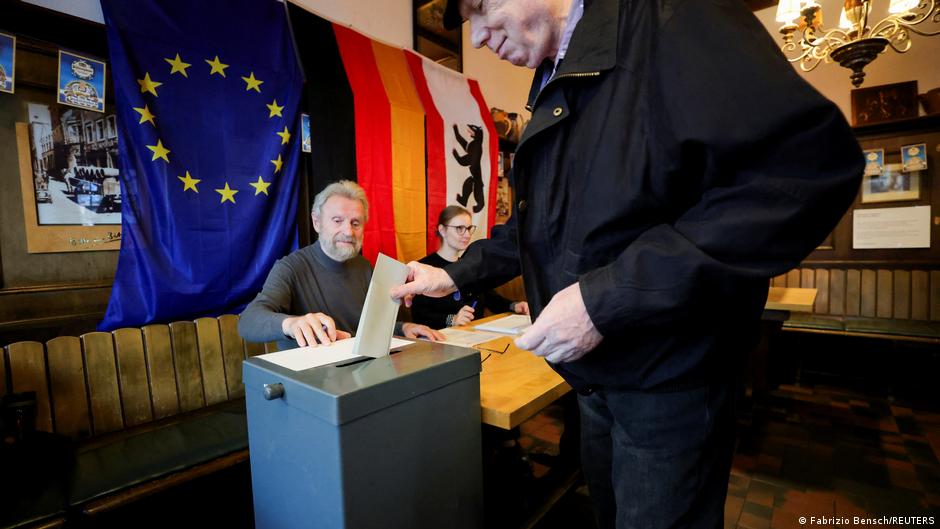
A voter casts their ballot at a Berlin Bierhaus ('beer house') that will serve as a polling stationImage: Fabrizio Bensch/REUTERSAdvertisementSkip next section What you need to knowWhat you need to know Regional elections are taking place in the eastern state of Mecklenburg-Western Pomerania and the city-state Berlin Voters are also electing members of district assemblies in Berlin The outcome of the elections could determine the political future of Chancellor Friedrich Merz, whose approval rating is at a record low The far-right Alternative for Germany (AfD) is expected to gain ground in both states but is unlikely to be part of government For the first time, 16- and 17-year-olds are eligible to vote in both states We're expecting exit polls at around 16.00 GMT. Follow along here for all the highs and lows today:
Tired of missing our real-time updates? Click here to add us as a Preferred Source on Google. Then tap the "Star" or "Preferred" to keep DW News at the top of your feed.
Voters have been lining up at polling stations to cast their ballots, as have the candidates (presumably to vote for themselves) in Berlin and in the northeastern state of Mecklenburg-Western Pomerania.
In the German capital, Werner Graf (Green Party) and Steffen Krach (center-left Social Democrats) cast their votes in the Tempelhof-Schöneberg constituency.
Further north, Leif-Erik Holm (far-right AfD) cast his vote in Schwerin, the capital of Mecklenburg-Western Pomerania.
Holm told local public broadcaster NDR outside the polling station that he was "optimistic" about his party's chances.
"The clouds have parted and the sky is turning blue," he said, referring to the color of his party.
His rival, the incumbent state premier Manuela Schwesig of the Social Democrats (SPD), cast her vote a short time later.
A quarter of Berlin residents will have no say in the German capital's city-state election because they lack citizenship. That's the highest proportion of residents excluded from the election yet, and many are unhappy.
Find out more about how foreigners are not included in Berlin's elections in this report.
In the run-up to Berlin's election, Elif Eralp's socialist Left Party is narrowly ahead in major polls — setting up a close race with the conservative CDU. But her party faces controversy over antisemitic rhetoric.
Voters in the eastern state of Mecklenburg-Western Pomerania head to the polls on Sunday, with the Social Democrats and far-right AfD neck and neck.
Here's a look at key economic issues that could influence the election.
The elections in Berlin and Mecklenburg-Western Pomerania are taking place two weeks after the far-right Alternative for Germany (AfD) surged to first place in Saxony-Anhalt, securing nearly 44% of the vote in the state.
The Left Party is hoping to secure its candidate Elif Eralp as mayor of the capital city if the party finishes in the first place in state elections. Here's what you need to know about her:
In Mecklenburg-Western Pomerania, the fight is between the Social Democrats (SPD) led by the popular Manuela Schwesig and the far-right Altnerative for Germany (AfD).
The 52-year-old Schwesig has made it her mission to beat back the advance of the AfD, which is polling at around 37%, ahead of the SPD at 33%.
"The situation is serious," Schwesig told DW recently. "The AfD would harm our economy; they would harm our social cohesion. Their crude way of speaking, their hate and incitement, is tearing our society apart; there's a renewed propensity for violence, and that will affect us women in particular."
Besides keeping tabs on whether the AfD comes out on top, all eyes are also on how the CDU performs in the state.
CDU is the conservative Christian Democratic Union party that is chaired by the chancellor of the country, Friedrich Merz.
His party is polling at around 7% in the state, which is slightly above the 5% threshold required by a party to enter state parliament.
In the 2021 elections, the CDU had just 13.3% of the vote.
If the CDU fails to achieve the 5% threshold, there's going to be immense pressure on Merz to fight for his job.
SPD: Manuela Schwesig, also the incumbent state premier.
AfD: Leif-Erik Holm is the AfD's candidate for state premier, whom the party would put forward to head the state government if it can form one, while Enrico Schult is the AfD's candidate leading the party's election campaign in the state. Holm is the better-known candidate out of the two.
CDU: Daniel Peters, who has been the chair of the CDU parliamentary group in the state parliament.
The Left (Die Linke): Simon Oldenburg, who is the current minister for education in the state.
Even if the AfD comes out on top in Mecklenburg-Western Pomerania, that's not a guarantee that it will govern the state.
In Germany's parliamentary system, a party needs a majority in the state parliament or coalition partners to elect a state premier.
That means that the AfD could be pushed to the sidelines if other parties reject cooperation with it under the so-called "firewall" policy.
Both parties are neck and neck, according to polling in recent weeks.
If Merz's party wins the elections, that'll be good news for the chancellor, whose popularity has taken a big hit, especially following state elections in Saxony-Anhalt two weeks ago, where the far-right Alternative for Germany (AfD) trounced the CDU.
Seventeen parties are contesting the election in Berlin, including the Left Party and the CDU. The four other major parties are the AfD — which has consistently polled in third place —, the environmentalist Green Party, the center-left Social Democratic Party (SPD) and the left-wing, populist Sahra Wagenknecht Alliance (BSW).
With the German capital struggling with a severe housing shortage in a city where 85% rent their homes, housing and rental costs are voters' top concerns.
Advertised rents have doubled since 2014, and the city needs 211,000 more homes by 2040.
So far, the Left Party has been the only major party that has promised to act on a 2021 referendum when 59% of Berliners voted to have the government take control of apartments from the biggest landlords to protect rents.
For the AfD, Berlin's housing crisis has fed into its argument for restricting immigration that has driven support for the party.
Chancellor Friedrich Merz made a rare campaign appearance for his Christian Democratic Union (CDU) at an event in Berlin on Thursday but has largely stayed away from the campaign trail.
In Mecklenburg-Western Pomerania, the CDU might even fail to make the 5% threshold required to enter parliament.
At the national level, Merz's own approval ratings fell to as low as 14% earlier in the week , while the far-right AfD has surged to first place with 27-29%, according to opinion polls released earlier this week.
Merz's CDU was polling nationally at 18-20%.
The chancellor has been under mounting pressure over whether he's the right person for the job, amid frustration over the slow pace of his promised reforms and the rise of the AfD.
Merz insisted this week that he's still committed to leading the nation and his governing coalition with the center-left Social Democratic Party (SPD).
"I was elected for four years and I want to use this time to solve problems," he said on Tuesday, insisting: "We have to prove that this can be achieved with this coalition."
However, a YouGov survey released on Friday showed that around half of Germans don't expect Merz to still be chancellor by the end of the year.
Guten Morgen and welcome to our coverage of elections in Berlin and the eastern state of Mecklenburg-Western Pomerania.
Polling stations are open for voters to elect members of the state parliaments. There's also a third vote open to EU citizens for electing members of one of Berlin's 12 district or borough assemblies.
While the elections are regional, they are set to have a national impact, with German Chancellor Friedrich Merz, whose popularity has severely dipped in recent weeks, struggling to keep his job.
That's due to a host of reasons, including the rise of the far-right Alternative for Germany (AfD) that secured a historic result with nearly 44% of the vote in elections two weeks ago in the eastern state of Saxony-Anhalt.
In Berlin, the race is tied between the Christian Democratic Party (CDU) and the Left Party (Die Linke). The AfD has consistently been polling third in Berlin, which is both the capital city and one of the country's 16 states.
In the northeastern state of Mecklenburg-Western Pomerania, the race is tied between the Social Democratic Party (SPD) and the AfD.
Stay tuned for the latest developments in these two crucial elections throughout the day.