
Germany's oldest party, the center-left SPD, is in a difficult position following its success in the Mecklenburg-Western Pomerania state election
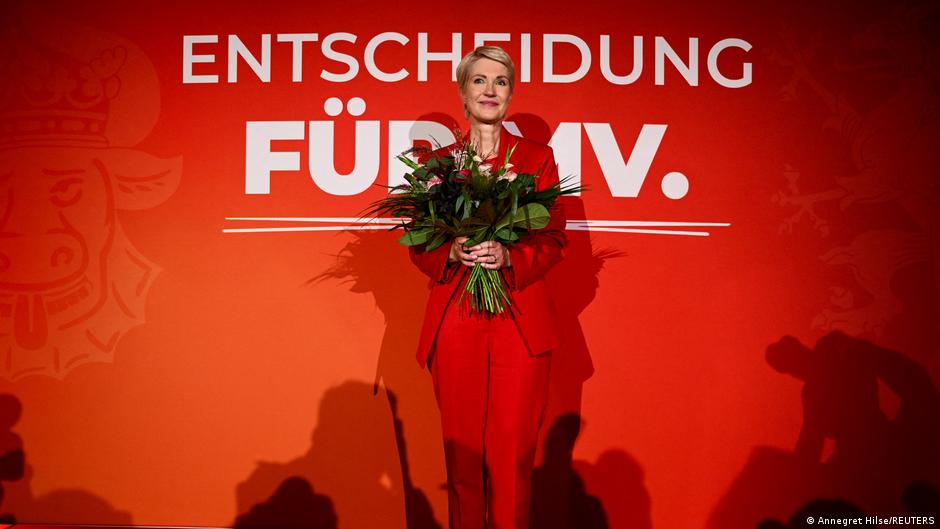
Manuela Schwesig is the new center of power in the SPDImage: Annegret Hilse/REUTERSAdvertisementFollowing state elections in Mecklenburg-Western Pomerania and Berlin, two of Germany's 16 federal states, the mood within the center-left Social Democratic Party (SPD) is oscillating between relief and frustration, confidence and bewilderment.
"The SPD is clearly capable of winning more than 30% of the vote," party co-leader Lars Klingbeil said jubilantly in Berlin. "This result in Mecklenburg-Western Pomerania is an encouragement for the entire Social Democratic movement."
As Klingbeil put it, Manuela Schwesig, the SPD state premier of Mecklenburg-Western Pomerania and her party had shown "how to make up ground, how to fight, and how, with the right issues and the right approach, to stage a comeback and ultimately win people over through that effort."
What Klingbeil conveniently omits is that Schwesig's success was also because she distanced herself as much as possible from the federal government's policies, and by extension from the SPD at the national level, which it governs in coalition with the center-right CDU/CSU alliance of the Christian Democratic Union and its Bavarian sister party, the Christian Social Union under Chancellor Friedrich Merz.
Meanwhile, the national government has become more unpopular than any of its predecessors.
Schwesig scored points above all with her opposition to parts of the federal government's pension reform plans. At the post-election review meeting in Berlin, she intensified her criticism, launching a pointed attack on the chancellor. She argued that 81% of people in her state consider the reforms unfair and that Merz is misjudging the situation.
On election night, Friedrich Merz made clear that he was all the more determined to stay the course. "The reforms must go ahead," the chancellor said. "Of course, this puts all of us in a difficult position. What needs to be done now requires courage, resilience, and patience. I will demonstrate those qualities as leader of the CDU and, above all, as chancellor of our country."
Schwesig had a clear response. "My advice to the chancellor, if he wants to regain people's trust, though I'm not sure that's still possible, is that he needs to engage with the reality on the ground." She argued that Merz must ask himself what needs to change. "There can be no business as usual."
The SPD, and above all its leaders, Lars Klingbeil and Bärbel Bas, now find themselves in a dilemma. Both serve as cabinet ministers in Merz's government and therefore help implement policies that many SPD members are increasingly questioning.
At the same time, they are accountable to their party and must ensure that SPD priorities are reflected in government policy. The success Schwesig achieved with her unequivocally critical stance is now putting them under considerable pressure.
Following her electoral victory, Schwesig has emerged as one of the most influential figures within the SPD. Many party members would like to see Schwesig become the party's next leader.
She already appeared to be embracing that role as she stood before the microphone at the post-election review, dressed head-to-toe in red and exuding confidence. By contrast, Bas and Klingbeil appeared almost defensive, seeking to strike a balance between criticizing the coalition and supporting it.
"If people in our country perceive reforms as something that threatens their way of life and leads only to things getting worse, then it is not just our communication that needs to improve. In some areas, the substance of the reforms themselves needs to change as well," said Klingbeil.
Bas called for both a "reality check" and a "fairness check" on the reforms, arguing that they must be workable in practice and socially equitable.
Will that be enough? Calls for the SPD to be "more like Schwesig", in other words, to assert its own positions with greater confidence, are growing ever louder within the party. The only question is how much dissent a governing party can afford to show. "Nothing would be more damaging than allowing this coalition to collapse over a policy dispute at this point," Bas warned. Solutions, she argued, "are possible within this coalition as well."
At a leadership committee meeting on the morning after the state elections, the SPD leadership adopted a strategy paper. Across nine key points, it sets out the priorities the party intends to champion in government. One section is headed "Real Change Instead of Simply Cutting Spending," while another is titled "An Affordable Life for All."
The SPD wants inheritance tax reform to ensure that the resulting revenue can fund a "genuine education initiative." On pension reform, the paper states that important questions remain unresolved regarding phased retirement and the right to retire without pension reductions after 45 years of contributions.
The SPD leaves no doubt about its stance: "The lifetime achievements of people who have paid into the system for many years must continue to make a difference."
It remains unclear whether the CDU/CSU will respond to these demands. The same is true of the simmering debate over whether Bas and Klingbeil should be replaced at the helm of the party. Pressure continues to come from Philipp Türmer, leader of Jusos, the SPD's youth wing. "I'm not saying that the two of them are the problem, but at the moment they're not part of the solution either," he told German broadcaster RTL and its news channel ntv.
Türmer and others had called for a special party conference that could have paved the way for replacing Bas and Klingbeil. Instead, the party will hold a convention in December, a smaller party gathering that cannot elect or remove party leaders.
From now on, however, SPD members are likely to judge their leaders even more by how effectively they defend the SPD's positions in government and whether they can restore the party's appeal among voters.
This article was originally published in German.
