Going too far in televised debates can backfire - Valor International
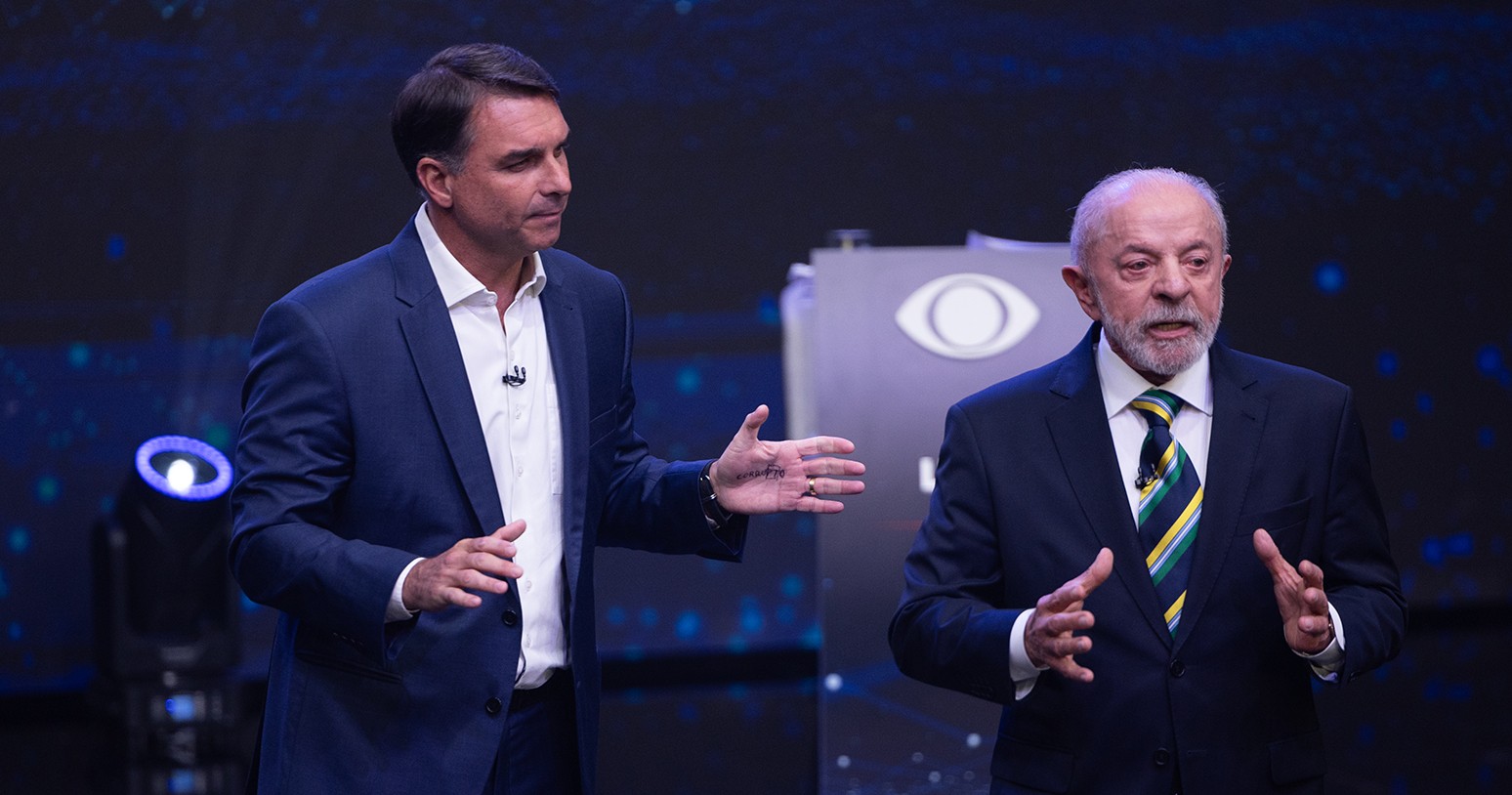
Preparing a candidate to behave hyperaggressively in a live televised election debate can be a winning tactic. Or it can backfire. It worked for Donald Trump in 2016 against Hillary Clinton, in the three-round contest that changed the history of American political campaigns. It failed for Pablo Marçal (Brazilian Party of Labor Reconstruction, PRTB) in 2024, during the São Paulo mayoral race, when the then-outsider provoked his opponents until José Luiz Datena (then with the Brazilian Social Democracy Party, PSDB) threw a chair at him, but still failed to secure a place in the runoff.
The performance of Flávio Bolsonaro, the Liberal Party’s (PL) presidential candidate, in Sunday’s (18) debate on Band did not surprise those who follow electoral politics in the U.S. Everything in Trump’s playbook from ten years ago was there: invading an opponent’s personal space to make them uncomfortable; bringing people whose presence would unsettle the opponent into the front row as guests of honor; conspicuous, even disrespectful, gestures; and accusations that are difficult to substantiate.
The final details of the TV Globo debate, scheduled to begin at 9:20 pm this Friday (23), have not yet been officially announced. Contacted on Wednesday (21), the broadcaster’s press office said information about the format and rules would be released once they had been finalized.
Flávio’s and Lula’s campaigns are preparing for a debate expected to be “more substantive,” with mandatory questions on specific issues and regions of the country, following the model of debates among governor candidates during the first round. The expectation is that the presidential candidates will devote more time to presenting and discussing their proposals, although time will also be set aside for them to address topics of their own choosing.
The number-one goal of today’s debate playbook is to produce footage for clips—short scenes that can go viral on social media. In a word: to “own” the moment.
“There is a great deal of political unpreparedness, with politicians falling in love with social media,” said Paulo Vasconcelos, the political strategist responsible for the winning campaign strategy of Douglas Ruas (PL), the governor-elect of Rio de Janeiro. “They have the feeling that social media is life, that it is reality. And it isn’t,” he added.
Political marketing specialist Lula Guimarães, who handled communications for Guilherme Boulos (Socialism and Liberty Party, PSOL) in his 2024 São Paulo mayoral campaign, says Flávio replicated against President Luiz Inácio Lula da Silva (Workers’ Party, PT) Marçal’s style in the mayoral race. But it is a risky bet, because an excessively aggressive or arrogant tone can end up driving voters away. “I think he [Flávio] went too far,” says Guimarães, who has worked with candidates on both the right and the left.
The strategist, who had access to qualitative research involving groups of viewers, says Flávio followed the playbook of right-wing leaders around the world, such as Trump. Guimarães says it is common for candidates’ coaching teams to advise them to use their allotted time not only to answer questions, but also to weave in speeches about their proposals or criticisms of their opponents. According to him, however, the Trump-aligned right takes this “diversionary strategy” to another level, potentially making the debate itself unworkable.
For Vasconcelos, 66, who has extensive experience in political marketing dating back to Itamar Franco’s 1986 campaign for governor of Minas Gerais, political communication is not a soap opera: if viewers cannot follow the storyline, they will get lost in a sea of accusations and acronyms they do not recognize.
“In this case, both candidates failed on Sunday,” the strategist says. “They spoke to their own bases when they needed to win over undecided voters,” Vasconcelos says.
Boulos was Marçal’s main target during the campaign two years ago. During one of the early debates in that race, the influencer provoked his opponent by waving a replica of an employment record booklet, drawing a reaction from Boulos, who slapped the object. The PRTB candidate at the time also made gestures and facial expressions while his opponent was speaking, in addition to repeatedly alluding to alleged drug use. On the eve of the election, he even presented a fake medical report targeting Boulos.
According to Guimarães, it is surprising that Flávio resorted to a strategy that had already been rejected at the municipal level, while abandoning a style of communication that could have helped him attract undecided voters. “He seemed more interested in landing punchy, ‘own-the-moment’ sound bites that could later be cut into clips for social media,” he says. Lula, in turn, appeared “not to have come prepared for this kind of confrontation, just as Boulos was caught off guard by the employment-record-book incident and ended up playing a role that left him frustrated.”
The problem for Flávio, in the strategist’s assessment, is that while the approach may have been well received by Bolsonaro supporters, it is unlikely to resonate with voters who have not already been won over.
“Neither of them managed to carry out effectively the task of winning over voters who still need to be persuaded, but Flávio managed to be more disastrous than Lula,” Guimarães says, adding that the image the senator projected ran counter to the softer persona he had sought to establish at the start of the campaign by calling himself “the moderate Bolsonaro.”
Besides Marçal, two politicians with large social media followings—the reelected Federal Deputy Nikolas Ferreira (Liberal Party, PL, Minas Gerais) and São Paulo city councilman Lucas Pavanato (PL), who was recently elected to the federal Chamber of Deputies with a record vote total—gave Flávio advice during the Band TV broadcast. Nikolas and Pavanato, who are allies, also acted as provocateurs behind the scenes at the broadcaster, recording videos and trying to irritate members of Lula’s campaign team.
According to Guimarães’s analysis, the logic of political marketing would suggest that Flávio adopt a more restrained stance in the TV Globo debate, where candidates typically take a cautious tone. “The winner of a debate is the one who makes fewer mistakes,” he sums up. “Much more than the content or the proposals, what sticks is the attitude.”
For Vasconcelos, a political strategist’s advice always comes down to survival. “You don’t go into a debate to win. You go in to come out alive,” he concludes.
This article was translated from Valor Econômico using an artificial intelligence tool under the supervision of the Valor International editorial team to ensure accuracy, clarity, and adherence to our editorial standards. Read our Editorial Principles.