Google reveals shocking price of building AI data centres in space
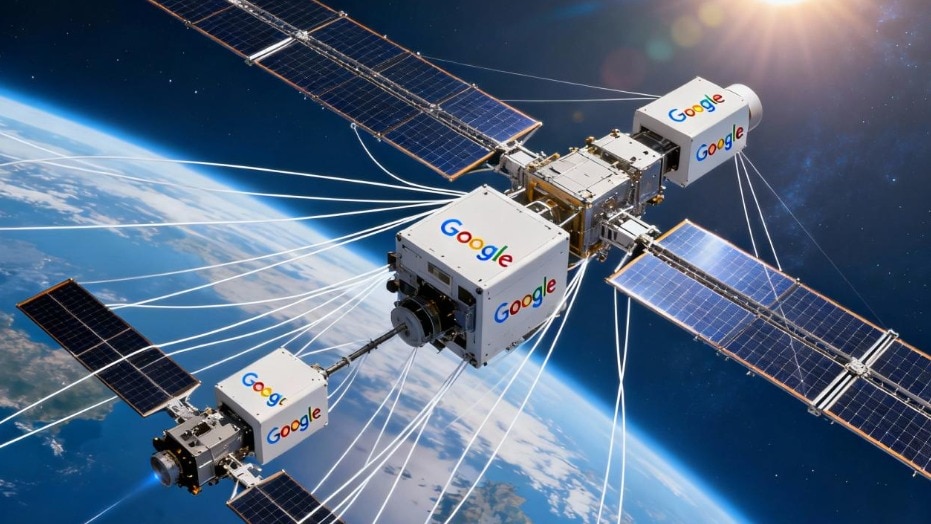
Tech companies are pouring billions of dollars into expanding their AI infrastructure, but finding enough land, electricity and resources to build new data centres is becoming a challenge. Space may seem like an interesting alternative, particularly because satellites could use solar power to run these facilities. But there is one big problem: the cost. Taking AI data centres into orbit could be far more expensive than building them on Earth. In fact, according to Google, the cost could be up to 100 times higher.
Amanda Peterson Corio, Google's head of data centre energy, believes companies should first make better use of the options available on Earth before looking towards space. "Let's explore all the terrestrial options before we go extraterrestrial," she told The Information. She also notes that while the US has enough power to build more infra for AI, delays in getting permits are slowing down the construction of new data centres.
Her comments around the cost of Space data centres come at a time, when Google is itself exploring the possibility of running AI workloads in space through its Project Suncatcher research programme. The company is looking at whether a network of satellites equipped with its AI chips could eventually work together as data centres in orbit.What is Google's Project Suncatcher?
So as part of this project, Google wants to see if it can build data centres in space using satellites instead of large buildings on Earth. The idea is to equip these satellites with Google's AI chips, allowing them to process information while orbiting the planet. They would also use solar panels to generate the electricity needed to run these chips. If the experiment works, Google hopes to connect several such satellites to create a network of AI data centres in space.
Google's first Project Suncatcher satellite, roughly the size of a refrigerator, reached orbit on October 1. The idea behind this initial mission is to see whether Google's Tensor Processing Unit (TPU) chips can survive and work in space, where they have to deal with radiation, extreme temperatures and other challenges.
On October 30, Google announced its satellite had successfully completed its first AI test, which it called the "Hello World" milestone. In a simple test, Google asked its Gemma 4 AI model to write a haiku about being in space. The satellite processed the request using its onboard AI chips and sent the response back to Earth.
The satellite has four TPUs (Google's AI chips) and can generate up to 1 kilowatt of power. However, these chips use a lot of electricity, so only one can run for about 20 minutes at a time. Google plans to take things a step further in 2027 by testing two satellites that can communicate with each other.
Meanwhile, Google is not the only company exploring this idea. Elon Musk's SpaceX is planning to test its own orbital AI computing infrastructure by late 2027, with a wider deployment targeted for as early as 2028. Meanwhile, Jeff Bezos' Blue Origin has also outlined plans for Project Sunrise, a proposed network of satellites that would work as data centres in space.
China is also getting into the race. Its state-owned space contractor, China Aerospace Science and Technology Corporation (CASC), has outlined plans to build gigawatt-scale space-based computing infrastructure over the next five years. Chinese companies are also working on their own projects. Startup ADA Space, for instance, has already launched satellites under its Three-Body Computing Constellation project, while other companies are exploring larger networks of computing satellites.- EndsAlso Read | From Egypt to Malaysia, hackers hijack billboards to show porn, mock security saying anyone can do itAlso Read | People deserve it: Elon Musk after Sam Altman claims PC users are hogging all RAMAlso Read | $6.3 billion gone in 20 minutes: Binance back online after hack, says it will cover 95% of stolen assets
Divya enjoys making sense of the ever-evolving worlds of tech and AI. From decoding specifications and testing the latest gadgets to exploring how technology shapes the way we live, work and connect, she believes there is always more to a story than what meets the eye. Away from the screen, she is probably brewing her next cup of coffee, thinking about her next meal or overthinking just about everything else.