
GOP Faces Devastating North Carolina Poll from Republican Pollster
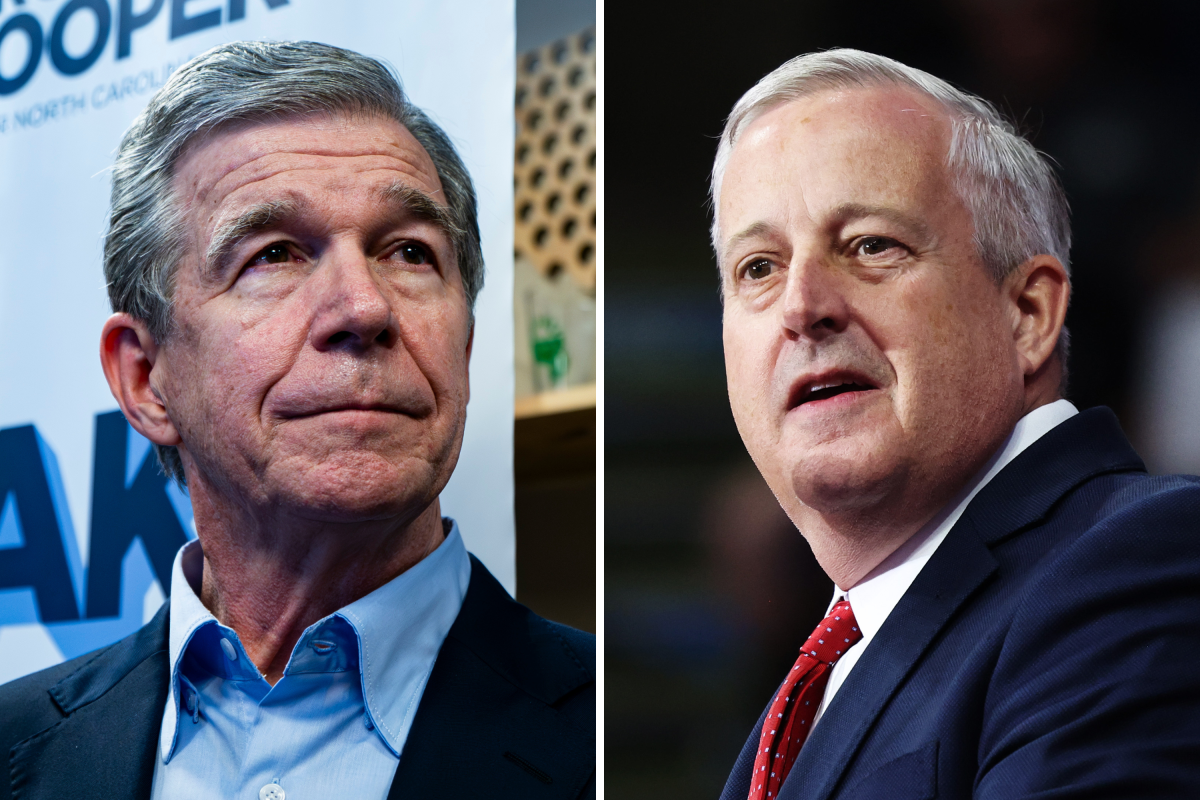
Former Governor Roy Cooper, a Democrat, held a 15-point lead over Republican Michael Whatley in the latest poll of the North Carolina Senate race from a GOP-affiliated pollster, a major warning sign ahead of the November 3 midterms.
Cooper is running to flip the Senate seat held by Republican Senator Thom Tillis, who is not running for reelection this year, and has established a polling lead over Whatley, the former chair of the Republican National Committee (RNC). The new Harper Polling survey published Thursday gave Cooper one of his largest leads yet among North Carolina voters, with fewer than 50 days until Election Day.
The poll is notable because Harper Polling is affiliated with Republicans and was founded by Brock McCleary, who served as the National Republican Congressional Committee’s polling director.
Still, a significant number of voters were undecided and up for grabs, the poll found, and neither candidate received an outright majority of support. Cooper is viewed as the favorite by forecasters like the Cook Political Report, and Democrats believe he will benefit from a favorable national environment. But North Carolina did vote for President Donald Trump in each of his three runs, so it’s a close state.
Cooper’s support stood at 49 percent, while 34 percent of respondents said they planned to cast their ballots for Whatley, the survey from Harper Polling, first reported by The Carolina Journal, found.
Five percent said they would vote for other candidates, and the rest were undecided as Election Day approaches.
It surveyed 608 likely voters from September 13 to 15, 2026, and had a margin of error of plus or minus 3.97 percentage points.
It’s Cooper’s largest lead yet in a Harper Polling survey.
He led by 13 points in the pollster’s survey from August, 52 percent to 39 percent, and 11 points in May, 50 percent to 39 percent. Cooper led by 8 points in March, 9 points in November 2025 and 4 points in September 2024.
Cooper is viewed more favorably than Whatley, and North Carolina voters are generally less familiar with Whatley, according to the poll.
Favorable views of Cooper stood at 47 percent, while 43 percent viewed him negatively, the poll found. Meanwhile, 26 percent of voters viewed Whatley favorably, while 42 percent viewed the Republican unfavorably.
The poll comes after Trump campaigned with Whatley in North Carolina this week. He held a rally for Whatley in Gastonia, a city of more than 80,000 people about 20 miles west of Charlotte. The president urged his supporters to "go out and pretend I'm on the ticket."
Jeff Allen, Cooper’s campaign manager, told Newsweek that the campaign anticipates a competitive race.
“A Democrat has not won statewide federal office in North Carolina in nearly two decades and we know this race will be very close, which is why we’re building a campaign to earn every vote and make sure North Carolinians know that Roy Cooper will fight for them in the Senate,” Allen said.
Newsweek also reached out to Whatley’s campaign for comment via email.
Other recent polls have given Cooper a lead.
The Democratic candidate led an Eastern Carolina University poll by 8 points, 52 percent to 44 percent. It surveyed 675 likely voters from August 31 to September 3 and had a margin of error of plus or minus 4.4 percentage points.
An Elon University/YouGov poll showed Cooper up 11 points, 49 percent to 38 percent. It surveyed 565 likely voters from August 21 to 31 with a margin of error of plus or minus 5.6 percentage points.
A High Point University poll showed a slightly closer race, giving Cooper a lead of five points, 50 percent to 45 percent. It surveyed 660 likely voters from August 3-12.
Forecasters also give Cooper an advantage. The Cook Political Report and Sabato’s Crystal Ball both classify the race as Lean Democrat, favoring him to flip the seat.
Prediction markets also give Cooper an advantage. He had a 92 percent chance of winning on both Kalshi and Polymarket on Thursday.
Prediction markets allow traders to buy and sell contracts tied to current events, aggregating real‑money wagers into probability estimates.
Prices fluctuate as traders react to polling, fundraising, candidate developments and broader political trends. They measure trader sentiment at any given moment but do not always accurately predict the future.
North Carolina is one of the most closely divided swing states in the country, having voted for both Democrats and Republicans in recent elections. However, in Senate races, Republicans have been performing well in the past few election cycles. The late Senator Kay Hagan was the last to win a Senate race in 2008, when former President Barack Obama also won the state.
In 2022, Democrat Cheri Beasley lost to Republican Ted Budd, then a member of the House, by about 3 points. Tillis defeated Democrat Cal Cunningham by less than 2 points in 2020. In 2016, former GOP Senator Richard Burr defeated Democrat Deborah Ross, now a member of Congress, by nearly 6 points.
Democrats believe that trend will end this year. Cooper is viewed as one of the party’s strongest recruits across all Senate races, as he’s been able to win statewide before and was fairly popular during his run as governor. The national environment will also play a role as President Trump’s declining approval rating and concerns around the cost of living and economy threaten to weigh down Republicans.
Democrats have held a grip on the governor's mansion. Democrat Josh Stein, who succeeded Cooper, won November's race by nearly 15 points after Republican Mark Robinson faced a series of scandals on the campaign trail.
Coalitions have shifted in the Tar Heel State. Democrats have gained ground in suburban areas near Charlotte and Raleigh, but Republicans have done well in the rural areas that used to be more competitive.
Trump also carried the state in each of his three runs, albeit by narrow margins—about 3.6 points in 2016, 1.3 points in 2020 and 3.2 points in 2024.
As of June 20, there were 2,320,605 registered Democrats in North Carolina, and 2,328,930 registered Republicans. However, 3,145,417 North Carolina voters were registered as unaffiliated, according to the North Carolina State Board of Elections.
North Carolina’s race has major national implications as Democrats hope to win control of the Senate this year. Currently, Republicans have a 53-47 majority. Democrats must flip four seats in November to win control of the chamber, as Vice President JD Vance would serve as the tiebreaker.
North Carolina is viewed as one of Democrats’ top flip opportunities due to Trump’s slim margins in the state. The other is Maine, where GOP Senator Susan Collins is up for reelection in a state Trump lost in each of his three presidential runs.
Democrats are also defending seats in two states Trump won in 2024—Georgia and Michigan.
But no other Republican-held seats are up for grabs in states Trump won by single digits or lost in 2024, meaning Democrats must turn to more conservative states to win a majority. Their targets are Alaska, Iowa, Ohio and Texas, and polls do show close races in those areas. They would have to win two of those seats for a majority.
But if Democrats fail to flip North Carolina, their Senate math becomes even more difficult. They would need to win three of those seats to win a majority in that scenario, underscoring the importance of this race for both parties.
North Carolina will be closely watched over the coming weeks as the battle for Senate control heats up. The two candidates have not agreed to a debate but will be making their cases to voters about why they should succeed Tillis in the Senate.
Newsweek’s reporters and editors used Martyn, our AI assistant, to produce this story. Learn more about Martyn here. Contact Newsweek editors on this story: Jason Lemon and Gray R. Thomas

