GOP in Striking Distance of Flipping 7 States Despite Trump’s Low Approval - Newsweek
Republicans are close to flipping seven Democratic-held Senate and gubernatorial seats in the 2026 midterms, despite President Donald Trump’s falling approval rating creating a challenging national environment for the GOP.
Historically, the party of the president loses seats in the midterms when he is unpopular, and Trump’s approval has fallen to record lows in recent polls, fueling Democrats’ optimism about their chances of having a strong night on November 3. But Republicans are still competitive in several Democratic-held seats that could buck the national trend and flip into GOP hands.
Four Senate races and three gubernatorial races present flip opportunities for Republicans in this year's midterms. Those include the Senate races in Georgia, Michigan, Minnesota, and New Hampshire, as well as the governor’s races in Kansas, Oregon and Wisconsin.
The national environment is currently favoring Democrats for the midterms, according to recent polling data. A recent survey from YouGov and The Economist found that Democrats have a 15-point advantage on the generic ballot, 53 percent to 38 percent, among likely voters. It surveyed 1,003 likely voters from September 25 to 28.
Democrats had an 8.3-point generic ballot lead in RealClearPolitics’ polling average as of Friday. That is approaching Democrats’ generic ballot win of 8.6 points in the 2018 election, the last time there was a "blue wave" election in the popular vote. If that lead holds, Democrats would be well-positioned to take control of the House and compete for Senate control.
That is being driven by Trump’s poor approval rating, as well as ongoing frustration with the economy and cost of living.
Momentum has shifted toward Democrats not just because Trump’s approval is low—but because it is low on issues that matter to voters such as the cost of living, Shawn Donahue, professor of political science at the University at Buffalo, told Newsweek.
“It’s not necessarily that Democrats are doing a great job. It’s just that a strong undertow for Republicans that’s led by Trump,” he said. “A lot of it is that Trump gets elected on the promises of lowering prices and getting us out of wars, and prices have not gone down.”
In the YouGov poll, Trump’s approval stood at -26 points, 62 percent disapproving and 36 percent approving of his job performance. Meanwhile, only 27 percent of respondents said the country is heading in the right direction, while 23 percent described the economy as being excellent or good.
Affordability has become a major theme of the midterms, and that conversation has become dominated by soaring gas prices, which have become a sore spot for Republicans.
Gas prices surged amid the Iran war, which has seen disruptions to the Strait of Hormuz, a critical passageway for the global oil supply. Gas prices averaged $4.396 per gallon on Friday, adding pressure to Americans’ wallets as they weigh whether to support Democrats and Republicans.
The national environment can be a powerful force in midterm elections, but there are other factors that can shape an outcome as well. Local issues and dynamics, as well as candidate quality, can keep seats competitive, defying the broader political environment.
Many of these seats are in states that are roughly divided between Democrats and Republicans who only narrowly backed either Trump or former Vice President Kamala Harris in the 2024 election, meaning there is still a significant GOP voter base in those states.
Gubernatorial races are generally more likely to defy national headwinds because they are less polarized, according to Donahue.
“Often there’s more of a focus on local issues in gubernatorial races, especially when you might have a party that’s been in power for eight years or so, and their policies are not seen as particularly popular,” he said.
Kansas is more conservative, so any Democratic victory requires candidates to win more conservative voters, even in a strong year for Democrats.
Meanwhile, Oregon is more Democratic, and that race could come down to local issues like the economy or educational issues.
Four Democratic-held Senate races have been competitive in recent polls.
Republicans currently hold a 53-47 majority in the Senate, so Democrats need to flip four seats to win a majority.
But if Republicans manage to flip one of these four seats, Democrats’ already-difficult path to the Senate would become even more narrow, as they would have to win seats in more conservative states to make up for those losses.
A key challenge for Republicans in these races is going to be turnout, Donahue said.
“It looks like Democratic turnout is going to be really, really good, and it doesn’t look like Republicans are nearly as enthusiastic to get out and vote,” he said. “The weird dynamics that they’re in is that Donald Trump is really unpopular across the country, and it’s going to energize Democrats even more. Plus, most independents don’t really care for Trump anymore.”
The Michigan and Minnesota races may appear more competitive because Democrats nominated more progressive-leaning candidates over moderates in the primary, according to Donahue.
Newsweek reached out to the campaigns in Michigan, Minnesota and New Hampshire for comment via email.
Georgia is a swing state that narrowly backed Trump in 2024, so Republicans have sought to make its Senate race competitive this year. It's part of the battleground, but Senator Jon Ossoff, a Democrat, has still established a polling lead over Republican Representative Mike Collins. The Cook Political Report has shifted the race to Likely Democratic status.
While Georgia was viewed as being more Republican for much of the 2000s, growth in the metro Atlanta area, as well as its suburbs shifting leftward, has turned it more purple. Some of its suburbs were some of the only places in the country that shifted left from 2020 to 2024.
Ossoff is viewed as a strong incumbent in Georgia, and given that it only narrowly backed Trump in 2024, Democrats are hopeful a blue-wave environment would keep the seat in their hands.
An InsiderAdvantage poll showed him leading by 8 points, 50 percent to 42 percent. It surveyed 1,200 likely voters from September 22 to 23.
The latest YouGov poll gave Ossoff a 10-point advantage, 52 percent to 42 percent. It surveyed 3,301 likely voters from September 15 to 18, and had a margin of error of plus or minus 2.7 percentage points.
The Michigan Senate race has emerged as one of the most competitive Senate races of the 2026 midterm elections. The state backed Trump by about 1.4 points in 2024 after narrowly backing former President Joe Biden in 2020, so it is one of the most closely divided battlegrounds.
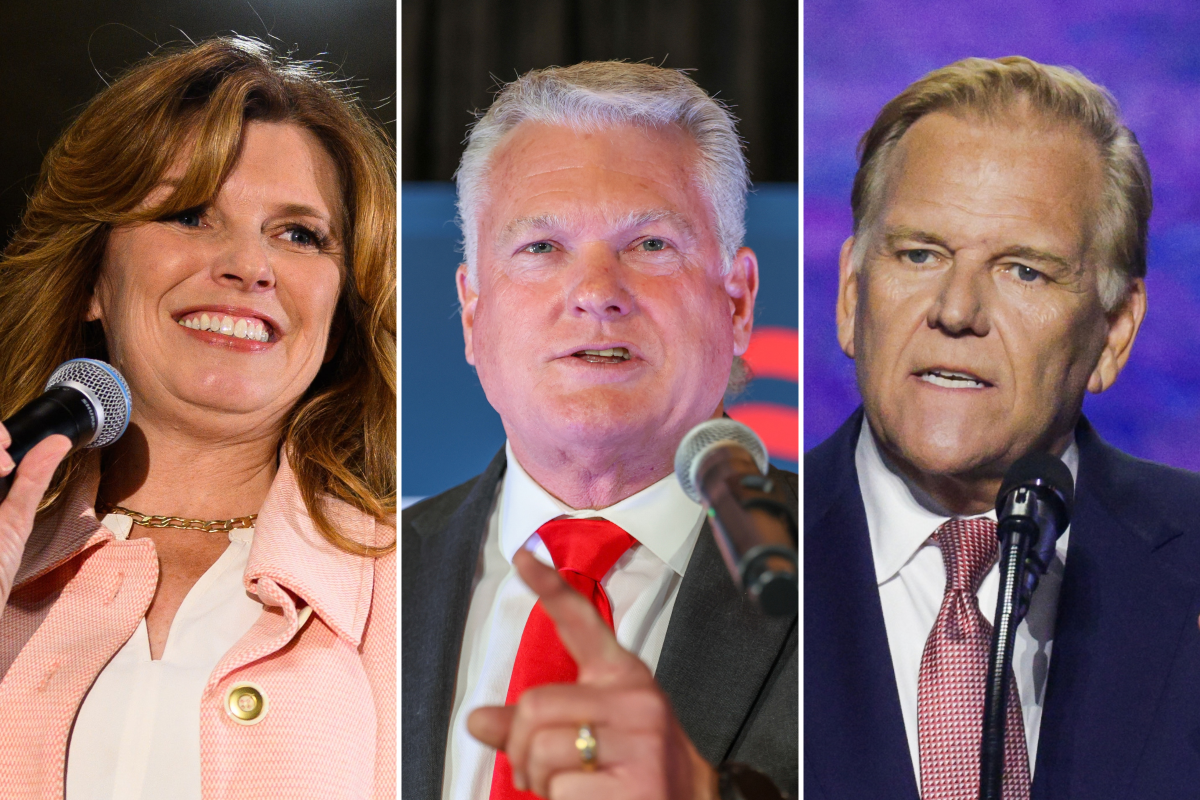
Democrat Abdul El-Sayed, a progressive public health official, is running against Republican former Representative Mike Rogers to succeed retiring Democratic Senator Gary Peters.
Democrats have hoped the national environment would keep swing states like Michigan in their hands, but polls continue to suggest a close race. Republicans are hoping to flip the race, and have argued El-Sayed is too progressive for a swing state.
The latest Fox News poll showed El-Sayed up a single point, 50 percent to 49 percent, while a Marist University survey showed him up 7 points, 51 percent to 44 percent.
The Fox News poll, conducted by Beacon Research and Shaw & Company Research, surveyed 1,028 likely voters from September 24 to 28 with a margin of error of plus or minus 4 percentage points. The Marist poll surveyed 1,235 registered voters from September 24 to 27 and had a margin of error of plus or minus 3.8 percentage points.
The Cook Political Report rates the race as a toss-up.
Minnesota is more of a Democratic-leaning state, backing Harris by just over 4 points in 2024. It’s another state where Democrats believe the national environment should benefit them, but Republicans still are hoping to make a play for the race to succeed retiring Democratic Senator Tina Smith.
Polls have suggested a closer-than-expected race between Democratic Lieutenant Governor Peggy Flanagan and Republican Michele Tafoya, though polling has generally been a bit more limited on the race.
Flanagan held a single-point lead in a recent InsiderAdvantage poll, 46 percent to 45 percent, which surveyed 1,200 likely voters from September 28 to 29, with a margin of error of plus or minus 2.95 percentage points.
Meanwhile, the two candidates were tied in a SurveyUSA poll sponsored by KSTP-TV, each receiving 42 percent of the vote. It surveyed 654 likely voters from September 9 to 14, with a margin of error of plus or minus 4.4 percentage points.
Republicans have sought to tie Flanagan to a fraud scandal that brought scrutiny toward Governor Tim Walz’s administration. The scandal centered around the Feeding Our Future nonprofit, which was implicated in a $250 million COVID-era scheme involving fraudulent claims for child nutrition programs. The Justice Department’s probe, which began under the Biden administration, has led to dozens of indictments.
In light of the scandal, Minnesota became the epicenter of the Trump administration’s ramped-up immigration enforcement earlier this year. Two American citizens, Renee Nicole Good and Alex Pretti, were fatally shot by federal immigration officers in January amid protests in Minneapolis, fueling anger over the White House's hard-line approach to immigration and border security.
These are two of the most critical issues facing Minnesota voters in November.
Maddie Heinz, a Flanagan spokesperson, told Newsweek that Tafoya is "just another MAGA Republican who will do Trump’s bidding."
"Minnesotans showed the world how to stand up to Donald Trump and we’re going to do it again in November," Heinz said.
The Cook Political Report classifies it as Likely Democratic.
The Senate race in New Hampshire, which backed Harris by fewer than 3 points in 2024, presents another opportunity for Republicans to chip away at a Democratic-held Senate seat.
Democratic Senator Jeanne Shaheen is retiring, and Democratic Representative Chris Pappas and former Senator John Sununu are running to succeed her.
Although the state leans toward Democrats, polling of the race is close, and the Cook Political Report recently moved the race into its toss-up category. Sununu, who is part of a well-known and popular political family in the Granite State, is seen as a top recruit for Republicans who can turn a race that should favor Democrats into a true toss-up.
Pappas led Sununu by 5 points in a recent poll from The New York Times and Siena University, 50 percent to 45 percent. It surveyed 613 likely voters from September 15 to 22, with a margin of error of plus or minus 2.8 percentage points.
A poll from the University of New Hampshire gave Pappas an 8-point lead, 50 percent to 42 percent, among likely voters. It was conducted from September 17 to 21 among 1,392 likely voters.
Three gubernatorial races could also flip in November. Generally speaking, governor races are seen as being less defined by traditional partisanship than federal races. This is why solidly Democratic states like Vermont have a Republican governor, while conservative states like Kentucky are more willing to elect a Republican governor.
This year, there are three Democratic-held governor seats that appear competitive in the polls.
Kansas, where Governor Laura Kelly cannot run again due to term limits, presents Republicans a clear pickup opportunity. The Sunflower State backed Trump by 16 points in 2024 and is typically seen as a fairly conservative state, though some polling suggests it looks more competitive this year.
Republican Ty Masterson is running against Democrat Cindy Holscher to succeed Kelly, and the Cook Political Report classifies the race as Lean Republican, meaning Masterson is seen as having a slight, but not definitive, advantage.
An Emerson College poll showed him up 7 points, 51 percent to 44 percent. It surveyed 750 Kansans from September 15 to 16, and had a margin of error of plus or minus 3.6 percentage points.
Garrett Henson, Masterson campaign spokesman, told Newsweek that Holscher is "wrong for Kansas," pointing to her position on income taxes, property taxes and transgender athletes. Henson also touted Masterson’s endorsement from labor union SMART-TD, local businessowners, agribusiness and "Kansans of every party in every corner of the state."
"It's why Ty is leading in every independent poll," Henson said. "Kansans want a governor who will lower their costs, and that's exactly what Ty will do."
The Oregon gubernatorial race has also become competitive in the polls, despite the fact that Harris carried the state by 14 points in 2024. Governor Tina Kotek is running for reelection and is facing a challenge from Republican Christine Drazan, who lost to Kotek by fewer than 4 points in the 2022 gubernatorial race.
A poll from DHM Research gave Drazan a single-point lead, 47 percent to 46 percent. It surveyed 915 likely voters from September 17 to 27, with a margin of error of plus or minus 3.24 percentage points, reported Oregon Public Broadcasting.
It found that most voters—58 percent—view the state as being on the wrong track, with only 29 percent saying it’s moving in the right direction.
A GOP victory in Oregon would be one of the most unexpected midterm results due to its status as a solidly Democratic state, driven by progressive strongholds like Portland. Republicans have not won a gubernatorial race in Oregon since 1982, when the state reelected GOP Governor Victor Atiyeh.
Kotek's approval has been low, signaling that voters are not happy with the state government, Donahue said. But the state might be "too blue" to elect a Republican, he added.
A DHM Research survey for the business-backed group Grow Oregon in early September had Drazan ahead 45 percent to 43 percent. It surveyed 600 likely voters from September 3 to 9.
The Cook Political Report has shifted the race from Likely Democrat to Lean Democrat, a sign that they view it as becoming more competitive for Republicans.
Republicans also see an opportunity in Wisconsin, a swing state that backed Trump by 0.9 points in 2024, the closest state for either party in the 2024 election.
Democratic Governor Tony Evers is not running for another term. Republican Representative Tom Tiffany won his party’s nomination, while Milwaukee County Executive David Crowley emerged victorious from the Democratic primary after exiting, and later reentering the race, amid concerns about the then-frontrunner state legislator Francesca Hong, a Democratic Socialist.
Wisconsin is generally a closely divided state that is competitive in most cycles, and Republicans are investing in the race. According to a report from Wisconsin Public Radio, Tiffany raised $26 million in the last quarter, the majority of the haul coming from three billionaire Republican megadonors.
The latest Marquette University Law School poll showed a tight race between the two candidates, with Crowley leading by 3 points, 49 percent to 46 percent. It surveyed 692 likely voters from September 16 to 23, with a margin of error of plus or minus 4.8 percentage points.
The race is classified as a toss-up by the Cook Political Report.
There have been outliers in recent midterms, where some states have defied the national headwinds to flip against the party benefiting from the national environment.
The 2022 midterms were generally a good year for Republicans, but Democrats still managed to flip several seats. Democrat John Fetterman flipped a Senate seat in Pennsylvania, a key battleground, while Democrats also flipped three governorships.
That includes Massachusetts and Maryland, two Democratic-leaning states where voters previously split their tickets for moderate Republican governors, and the swing state Arizona.
In 2018, Republicans flipped four Senate seats in Florida, Indiana, Missouri and North Dakota despite an environment favoring Democrats. Although Florida was close in 2016, the other three states voted for Trump by wide margins despite having Democratic incumbents and were seen as uphill battles at the time.
Cook’s latest outlook has the race for control in the Senate as a true toss-up, with Democrats projected to gain one to five seats; they need a net gain of 4 to take the majority.
Contact Newsweek editors on this story: Jason Lemon, James Debens, Gray R. Thomas.