Granite baron Veeramani: Inside child abuse case Chennai cops tried to close - The Indian Express
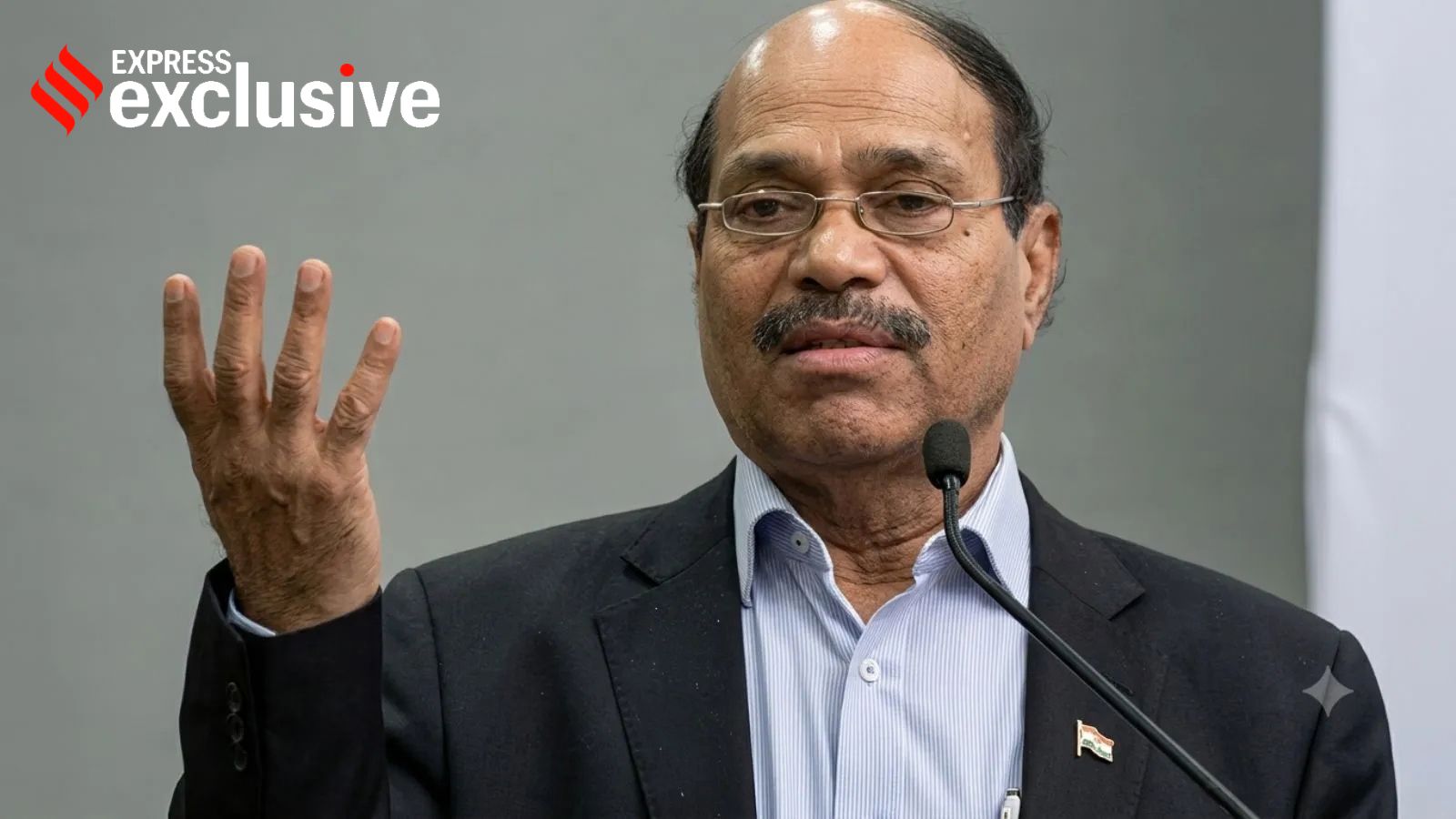
When Chennai Police decided in February to drop further action in a POCSO case against granite businessman R Veeramani, investigators had a video purportedly showing the sexual assault of a minor girl, had searched the house where it was alleged to have happened, and had questioned Veeramani and the woman associated with the property. They had also spoken to domestic workers, a puncture shop operator and an employee of a nearby hospital. The accounts recorded by police had one thing in common: outsiders were allegedly not allowed into the house.
The girl in the video, police said, could not be found, and the original recording could not be retrieved from a DVR. Veeramani denied he was the man in the video. Shanthi, his longtime associate, said the room shown in it was not part of her house. Concluding that there was “presently no basis for proceeding further with the investigation”, the Anti-Vice Squad had classified the case as “Further Action Dropped” on February 18 this year.
Seven months later, that conclusion stands in stark contrast to where the case is now. The girl has been traced and has identified herself and Veeramani in the video in a statement recorded before a Judicial Magistrate. Police have identified other alleged victims, and Veeramani, Shanthi and her husband Mahendra Simhan have been arrested.
A copy of the February closure report submitted by the Assistant Commissioner of Police, Anti-Vice Squad, to the Special POCSO Court provides a detailed account of how an investigation that began with a video of an alleged sexual offence against a child reached what police considered a dead end, The Indian Express has learnt.
It began with a stranger and an envelope.
On October 6, 2025, a 42-year-old child rights worker was at her office when an unidentified man arrived, handed her an envelope and left. Inside were a white sheet of paper and a pen drive.
The note named Veeramani and alleged that he had sexually assaulted a minor girl in the bedroom of his “female friend” Shanthi’s house. It said a recording of the alleged assault was in the pen drive.
The child rights worker inserted the drive into her laptop. According to her complaint to the police, she saw footage of a man touching a girl who appeared to be a minor in a private room. She went to the Anti-Vice Squad the same day with the envelope, note and pen drive. The complaint travelled through the police hierarchy to the Central Crime Branch, and at 1 pm on October 7, a case was registered under Sections 7 and 8 of the POCSO Act.
Two days later, the investigation was entrusted to the Assistant Commissioner of Police, Anti-Vice Squad. Police first examined the complainant and later had her statement recorded before the IV Metropolitan Magistrate Court in Saidapet.
Investigators then tried to find the unidentified man who had delivered the material. There was no CCTV camera at the complainant’s office. Cameras from the area were checked, the closure report says, but they were not functioning. That trail ended there.
Police next turned to the suspected crime scene.
After informing the Special POCSO Court, a police team searched the house referred to in the complaint. Investigators explained the case to the owner and examined the premises to determine whether the alleged offence had occurred there. According to the report, they found nothing.
The footage indicated that the incident had occurred in 2019.
Police brought in an authorised cyber expert to examine the DVR at the property, but since six years had passed, nothing could be recovered.
Police then summoned Veeramani and Shanthi.
Veeramani denied being the man in the recording. He also said he did not know the girl in the video.
Shanthi acknowledged knowing Veeramani but told investigators that she did not know the girl. More significantly, she said the place visible in the recording was her house. She also told police that she would not permit outsiders into her house “under any circumstances”.
Investigators sought details of people who had worked at the property around the period of the alleged offence. Shanthi provided the names of four former domestic workers but said she did not know where they were currently living. The closure report says they therefore could not be examined; it does not record further details of attempts to locate them.
Police did examine two people then working at the house. Both supported the account that outsiders were not allowed inside. Investigators also questioned people in the vicinity.
A man running a roadside business nearby told them that outsiders were not permitted into the house. An employee of a nearby hospital, who said he knew Shanthi and her husband, gave a similar statement: people from outside, whether known or unknown, were not allowed in.
Meanwhile, police said they conducted “confidential inquiries” to identify the girl. The closure report records that “every possible effort” was made to trace her, but investigators could obtain no information about her identity. They were also unable to establish her age.
Police made one more check. They searched the Crime and Criminal Tracking Network and Systems, or CCTNS, to determine whether Veeramani or Shanthi had previously been involved in criminal cases. The search found none.
The closure report then brought these strands together: the unidentified messenger could not be traced; the search of the house had yielded no evidence; the old DVR produced no original recording; the girl could neither be identified nor her age established; the suspects denied the allegation; and the CCTNS check revealed no previous cases against them. Police decided there was no basis to continue.
The complainant was served notice on February 18 that the case had been treated as “Further Action Dropped”, and the final report was submitted to the Special POCSO Court. Even that report, however, contained a qualification. Citing a November 2025 Madras High Court order, the investigating officer said that if evidence or witnesses became available in future, action would be taken in accordance with law. The accompanying endorsement also directed the investigating officer to “pursue the matter with due diligence”.
The Special POCSO Court subsequently refused to accept the closure report and ordered further investigation. What followed has altered the case substantially.
As reported earlier by The Indian Express, the renewed investigation eventually led to the arrest on August 29 of Veeramani, Shanthi and Mahendra Simhan. Investigators subsequently traced the girl purportedly seen in the 2019 video.
Her statement was recorded before a Judicial Magistrate, and police have invoked provisions of the SC/ST (Prevention of Atrocities) Act against the accused.
The investigation has since expanded beyond the original video. In the latest development, the Central Crime Branch has arrested Ganesan, a former employee of Veeramani’s Gem Granites, after investigators claimed they had found on his mobile phone a video allegedly featuring Veeramani and a minor girl. Ganesan, who had worked at Gem Granites for 23 years and is currently employed with Balaji Global Enterprises, was arrested for allegedly failing to report the matter to the authorities. He has been remanded in judicial custody and lodged in Puzhal Central Prison.
Investigators are now trying to establish how Ganesan obtained the video, who sent it to him and the circumstances in which he retained it without informing the police. The Central Crime Branch is questioning people connected with the case and examining digital evidence to trace the source and circulation of the footage.
Police have identified other alleged victims, some of whom are believed to have been minors at the time of the alleged offences.
On Monday, Chief Minister C Joseph Vijay discussed the case with Chennai Police Commissioner A Amalraj and sought stringent action against anyone found to have suppressed or delayed the investigation, police sources said. Following the meeting, Additional Commissioner and IGP Narenthiran Nayar was assigned to examine the case, including possible links between Veeramani and police officers and allegations of financial transactions involving police personnel. Investigators are examining financial records and communications to determine whether money changed hands or anyone attempted to influence the earlier investigation.
Arun Janardhanan is an experienced and authoritative Tamil Nadu correspondent for The Indian Express. Based in the state, his reporting combines ground-level access with long-form clarity, offering readers a nuanced understanding of South India’s political, judicial, and cultural life - work that reflects both depth of expertise and sustained authority. Expertise Geographic Focus: As Tamil Nadu Correspondent focused on politics, crime, faith and disputes, Janardhanan has been also reporting extensively on Sri Lanka, producing a decade-long body of work on its elections, governance, and the aftermath of the Easter Sunday bombings through detailed stories and interviews. Key Coverage Areas: State Politics and Governance: Close reporting on the DMK and AIADMK, the emergence of new political actors such as actor Vijay’s TVK, internal party churn, Centre–State tensions, and the role of the Governor. Legal and Judicial Affairs: Consistent coverage of the Madras High Court, including religion-linked disputes and cases involving state authority and civil liberties. Investigations: Deep-dive series on landmark cases and unresolved questions, including the Tirupati encounter and the Rajiv Gandhi assassination, alongside multiple investigative series from Tamil Nadu. Culture, Society, and Crisis: Reporting on cultural organisations, language debates, and disaster coverage—from cyclones to prolonged monsoon emergencies—anchored in on-the-ground detail. His reporting has been recognised with the Ramnath Goenka Award for Excellence in Journalism. Beyond journalism, Janardhanan is also a screenwriter; his Malayalam feature film Aarkkariyam was released in 2021. ... Read More