
Greece returns remains of Czar Samuel to Bulgaria
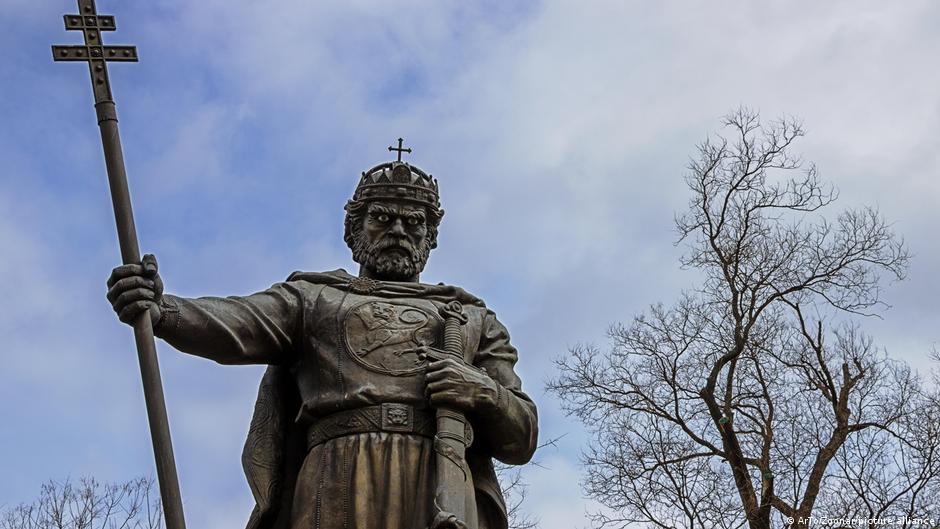
A warrior emperor who ruled the Bulgarian Empire in the Middle Ages, Czar Samuel is a symbol of Bulgarian national identityImage: ArTo/Zoonar/picture allianceAdvertisementThe remains of one of Bulgaria's most important medieval rulers were set to arrive in the Bulgarian capital, Sofia, on Saturday after decades of negotiations with neighboring Greece.
Czar Samuel ruled the First Bulgarian Empire from 997 to 1014, gradually extending his authority over a swathe of the Balkans as far south as Lake Ohrid, now in North Macedonia on the border with Albania.
But Samuel's rule was also characterized by conflict with the Byzantine Empire which ultimately defeated his army at the Battle of Kleidion in 1014.
Samuel is said to have died of shock when thousands of his defeated soldiers returned home having been blinded by order of Byzantine Emperor Basil II, known as Boulgaroktonos – the "Bulgar Slayer."
The Bulgarian lands fell under Byzantine rule four years later but Czar Samuel is still considered a symbol of Bulgarian national identity today, and his remains – discovered in a Greek border area 60 years ago – are set to be received with full state honors.
They are set to be flown to Sofia aboard a military aircraft accompanied by a fighter jet escort before a 21-gun salute and a procession to the Church of St. Sophia, where the public will be able to pay respects.
Free trains to the capital are being provided for the occasion, with some 750 police on duty during the handover ceremony.
"These are items that belong to both our peoples; they constitute our memory and our bond, and our compatriots and future generations deserve and must have the opportunity to pay tribute to their ancestors," said Bulgarian Prime Minister Rumen Radev at a ceremony held at Museum of Byzantine Civilization in Thessaloniki, Greece, ahead of the handover.
Bulgaria officially opened talks on the return of the remains in 2007, and they became a major issue in relations with their southern neighbor.
"If, in the past, Czar Samuel divided us, I can say that today he unites us," said Radev. "He strengthens our strategic cooperation and makes the historical relations between our states and peoples even stronger."
Greek Prime Minister Kyriakos Mitsotakis, speaking alongside Radev, acknowledged that the remains of Czar Samuel have "incalculable cultural and spiritual but also emotional value" for Bulgaria, adding: "The global community is re-evaluating its long-standing stance on protecting cultural heritage."
In return, Greece is set to receive 48 sentimental objects pillaged by Bulgarian troops from churches and monasteries in northern Greece during the First World War.
Some prominent Greek academics and religious leaders have criticized the exchange as inadequate on the Bulgarian side, but Mitsotakis said he hoped Saturday's ceremony would bolster Greece's international campaign to return the Parthenon Marbles, a collection of 2,500-year-old marble sculptures taken from the Acropolis in Athens and later displayed in the British Museum.
"This shift is embodied by today's initiative, which rests on the obvious principle that monuments and historical heirlooms cannot be treated as spoils of war, nor as the result of circumstances subsequent to their creation."
However, Bulgaria is not the only country to claim Czar Samuel, who is also celebrated with a huge statue in Skopje, the capital of North Macedonia.
"The bones return, the conflict remains! Samuel once again [contested] between Skopje and Sofia!" declared the Albanian-language newspaper Koha, while Skopje daily Sloboden Pechat called the handover another "battle over history."
In 2022, a bilateral commission recommended that Samuel be presented as the head of a state that "most contemporary historiographers consider to be the Bulgarian Empire" – territory which is now North Macedonia.
"Samuel occupies an important place in the historical narrative both in Bulgaria and in North Macedonia," Dimitar Bechev, a researcher at the Carnegie Europe think tank, told the AFP news agency.
Indeed, history has been playing a major role in the run-up to this month's Bulgarian presidential election, with incumbent President Iliana Iotova, backed by Prime Minister Radev, promoting a more neutral position between the European Union and NATO – both of which Bulgaria belongs to – and Russia.
"Radev is looking to attract the patriotic electorate," said analyst Bechev, adding that the return of the remains to Sofia "aims to underline the Bulgarian character of the Slavic population of Macedonia."


