Growth, stability divide cabinet
Direct Source Verification:
This story is aggregated from The Express Tribune (tribune.com.pk). Full reporting rights and copyright belong to the primary publisher.
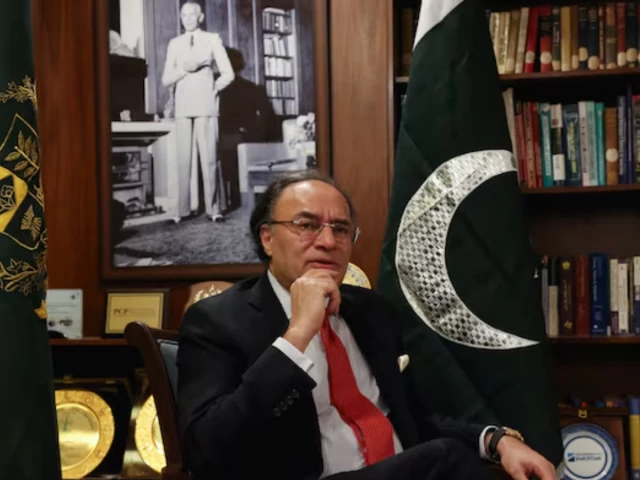
Members strike different notes on growth strategy, macro stabilisation
Pakistan's two important cabinet members on Thursday struck different notes about economic growth, as the privatisation adviser linked improvement in poor governance with higher growth but the finance minister again emphasised the continuation of fiscal stabilisation policies.
Diverse views about the timing and pace of economic growth were expressed by Finance Minister Muhammad Aurangzeb and Privatisation Adviser Muhammad Ali during the 9th edition of the Leaders in Islamabad Business Summit 2026.
"Unless we grow, we cannot improve governance," said Adviser to the PM on Privatisation Muhammad Ali, while emphasising the need for having a higher growth rate. He spoke in the opening session of the summit minutes after the finance minister reiterated his old stance of continuing the fiscal stabilisation policies that have held back growth, and the country has been growing at less than 4% pace since 2022.
Improving governance has also remained an important part of the International Monetary Fund (IMF) programme and is one of the priorities of the government of Prime Minister Shehbaz Sharif.
The system needs to deliver better as people have to come to open public administrative offices and wait for hours in the hope of resolution of their small genuine issues, said Bilal Azhar Kayani, Minister of State for Finance. Without transferring power and resources to the local level, people's problems could not be fully addressed, he added.
Bringing permanence to macroeconomic stability remains central to Pakistan's economic future, with strong fiscal and external buffers necessary to manage domestic and external pressures, said Aurangzeb while virtually addressing the session before Ali spoke at the forum.
Ali said "stability is not the destination; growth is". He said that the economic growth rate has to be much higher than the population growth rate. In the last fiscal year, Pakistan's economy grew at a rate of 3.7% whereas the population growth rate is estimated at 2.6%, causing higher unemployment and poverty.
The privatisation adviser further said that for too long Pakistan's growth model has heavily relied on consumption, external and public financing. Both the adviser and the minister had similar views about the country's economic growth model, which they said should not be consumption-led.
Ali said that to achieve growth, there was a need to give confidence to investors, emphasising predictable and consistent policy direction before hoping for any investment. The finance minister said Pakistan's growth trajectory must increasingly be driven by exports, investment and productive capacity.
Muhammad Ali said that Pakistan's future infrastructure and development needs could not be met by public spending alone and that the private sector must play a much larger role in financing, building and managing infrastructure and economic assets.
Economic stability has been achieved, but it is not sustainable, and the government is effectively managing the decline, said Azfar Ahsan, Chairman of Nutshell Group. He said that there was an elite capture of the country, which was not just limited to politicians and generals but bureaucrats are also part of it.
The finance minister emphasised that Pakistan must make full use of the opportunities available within the country while maintaining a clear and consistent economic direction: permanent macroeconomic stability, sustainable and responsible growth, continued structural reforms, greater trade and investment flows, and participation in the New Economy.
He said Pakistan's economic direction is anchored around five clear priorities: bringing permanence to macroeconomic stability while continuing to build shock-absorbing capacity on both the fiscal and external sides; transitioning from stabilisation to sustainable and responsible growth driven increasingly by investment, productivity and exports; staying the course on key structural reforms to strengthen the foundations of the economy; moving decisively from aid towards trade and investment flows; and positioning Pakistan to participate more effectively in the New Economy.
Aurangzeb said Pakistan's economy is now in a better position, with the improvement continuing into the current fiscal year. He said the objective is to build on this stability and move towards a more sustainable and productive growth model, shifting from consumption-driven cycles towards export-led and investment-driven growth.
He said that the government remains focused on protecting the gains achieved while continuing the structural reforms necessary to strengthen productivity, competitiveness and private-sector-led growth. However, a few days ago, Aurangzeb, as Chairman of the Cabinet Committee on State-Owned Enterprises, allowed the exemption of the international financial reporting standards that will camouflage the fiscal risks faced particularly by the energy-sector companies.
The finance minister noted that the State Bank of Pakistan has projected GDP growth in the range of 3.5% to 4.5% for the current fiscal year. He said that Pakistan's foreign exchange reserves have grown to an all-time high of $21.3 billion on the back of $3 billion Eurobonds. Aurangzeb said that last time the highest level for reserves was $20.2 billion. However, the $21.3 billion peak may prove temporary as the government is going to repay $3 billion of short-term Saudi debt next month.
The finance minister feared that the recent escalation in the Middle East conflict could have implications for economic growth and inflation. He said that the country has fuel reserves cover till the end of October and the National Coordination and Management Council was working to secure fuel supplies for November. Because of the possible second- and third-round impact of war, it is more important to maintain fiscal discipline, said the finance minister.
Original Source
https://tribune.com.pk/story/2629929/growth-stability-divide-cabinet