
Hakeem Jeffries Easily Wins Caucus Vote to Be Next Speaker of the House - Time Magazine
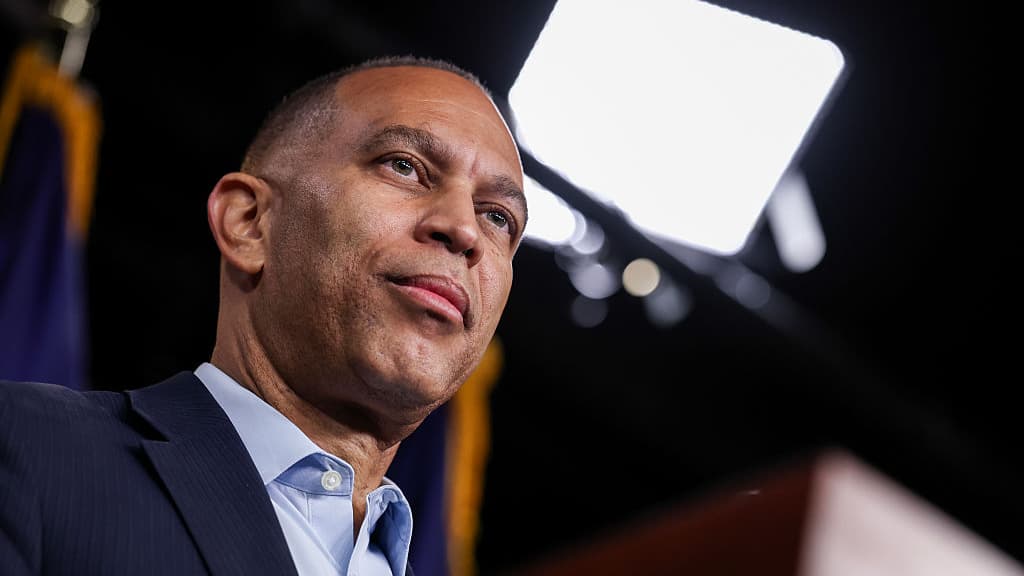
House Democrats nominated Representative Hakeem Jeffries of New York for Speaker on Wednesday, putting him one step closer to becoming the first Black American to lead the chamber after steering his party to a sweeping victory in this month's midterm elections.
Jeffries, 56, faced no challenger in the closed-door election and secured the nomination in a 251-11 vote. The ballots were cast secretly through an application on lawmakers' phones, leaving the identities of those who opposed him undisclosed, though several members have publicly acknowledged withholding their support.
Jeffries’ nomination was put forward by Representatives Teresa Leger Fernández of New Mexico, Mark Pocan of Wisconsin, Derek Tran of California, Rebecca Bennett of New Jersey, and Jim Clyburn of South Carolina.
The vote marked a milestone in Jeffries's political career, four years after he succeeded Nancy Pelosi as the top House Democrat and more than a decade after he entered Congress. Now, he is preparing to take charge of a chamber where Democrats are projected to hold 259 seats, a commanding majority that would give him considerably more room to maneuver than the narrow Republican majority that preceded it.
Jeffries will serve alongside Representatives Ted Lieu of California as Democratic caucus chair, Katherine Clark of Massachusetts as majority leader, and Pete Aguilar of California as majority whip. The full House will vote to formally elect its leaders when the new Congress convenes on Jan. 3.
The outcome was widely anticipated. Jeffries had secured broad support from his colleagues, and the absence of a challenger left little prospect that dissent from the party's left flank could derail his ascent. But the objections surrounding his nomination have offered an early glimpse of the competing expectations confronting Democrats as they prepare to wield considerable power during the final two years of President Trump's term.
The transition from minority leader to Speaker would put Jeffries at the center of the political battles during the final two years of President Trump's term, giving Democrats control over the House's legislative agenda and investigative committees. His party has promised to use that authority to scrutinize the Trump Administration and demonstrate to voters that Democrats can govern ahead of the 2028 presidential election.
But the breadth of the Democratic victory has also produced competing expectations about what the party should accomplish with its newfound power. Progressives, many of whom are not publicly backing Jeffries, are pressing for more ambitious legislation on health care, corporate power and military assistance to Israel, while moderates are emphasizing affordability and policies that could attract bipartisan support. The divisions are unlikely to threaten Jeffries's speakership, given the size of his majority, but they could shape the agenda he pursues and the political compromises he is willing to make.
Wednesday's vote was conducted by secret ballot, a decision Jeffries announced Tuesday after some of his allies had favored nominating him by acclamation, without a formal tally. The recorded vote was intended to allow lawmakers to register their views privately, with the results revealing the level of support for Jeffries but not how individual members voted.
For some of the party's most senior members, the proceedings were an occasion to reflect on the historical significance of Jeffries's ascent. "This is a very surreal moment for me," Clyburn, a longtime South Carolina Democrat and former member of the House leadership, told reporters before entering the room. "And when it comes my turn to second his nomination, I'm going to be thinking about John, Lillian, and Emily,” he said, referring to the late John Lewis, an influential civil rights activist and congressman.
Representative Steny Hoyer of Maryland, who served for years alongside Pelosi and Clyburn in the party's previous leadership team, recalled witnessing the election of the first woman to become speaker. "It's a historic time," Hoyer said as he entered the room. "I've now served here for the first woman who was elected speaker of the House, and now we're going to see the first African American. I think it's a testimony to the progress that we've made in America."
The nomination followed an extensive effort by Jeffries and his allies to consolidate support in the days since the election. They solicited endorsements from major Democratic factions, contacted lawmakers who had expressed reservations and sought to meet with members of the large incoming class before Wednesday's vote. Jeffries personally met with leaders of the Congressional Progressive Caucus, the New Democrat Coalition, and the Blue Dog Coalition.
The push came amid a campaign by progressive activists to persuade Democrats to reject Jeffries, whom some critics regard as too closely aligned with corporate interests and insufficiently willing to challenge the party's establishment. Congressional offices were inundated with calls and emails, and an online petition seeking an alternative candidate attracted more than a million signatures.
At a Democratic conference in Denver over the weekend, protesters repeatedly interrupted Jeffries with demands for Medicare for All, a Green New Deal, and an embargo on American weapons transfers to Israel. Some protesters also gathered Wednesday outside the room where Democrats were voting on leadership.
Progressive lawmakers have pressed Jeffries to promise a committee markup next year on Medicare for All legislation and bring forward the Block the Bombs Act, which would restrict certain offensive weapons transfers to Israel. Jeffries has not publicly committed to any such moves, and had appeared largely untroubled by the prospect of defections.
But the public pressure did not translate into an organized challenge inside the House Democratic caucus as it did in the upper chamber, where Senator Chris Van Hollen of Maryland has launched a bid to replace Senator Chuck Schumer of New York, the current Democratic leader, over similar frustrations with the party's leadership. Though Schumer appears likely to retain his leadership post, Senate Democrats aren’t expected to settle that contest until next month.
Taking the Speaker’s gavel would mark the culmination of a political rise centered in Brooklyn, where Jeffries grew up as the son of an Air Force veteran and a social worker. He often talks about how the devastation of the crack epidemic during the 1980s shaped his interest in public service and his desire to improve conditions for working-class families who remained in struggling neighborhoods.
After attending the State University of New York at Binghamton, Georgetown University and New York University School of Law, Jeffries worked as a corporate lawyer before turning to politics. He lost his first two campaigns for the New York State Assembly, but he eventually won a seat in the Legislature. In 2012, he challenged a longtime Democratic congressman who withdrew from the race, clearing a path for his election to the House.
In Congress, Jeffries has developed a reputation as a disciplined political communicator and coalition builder, cultivating relationships across the party's ideological spectrum as he rose through its leadership ranks. When Pelosi stepped aside after the 2022 elections, he succeeded her as the top House Democrat, becoming the first Black lawmaker to lead either party in Congress.
His election as speaker would carry a historic significance beyond his own career, placing a Black American for the first time in an office second in the line of presidential succession, after the Vice President. It would also come more than 150 years after Joseph Rainey of South Carolina became the first Black member of the House during Reconstruction.
Democrats have promised to use their control of Congress to pursue an ambitious legislative agenda and subject the Trump Administration to the kind of scrutiny that Republican leaders have largely resisted. The House's investigative committees would be able to examine allegations of corruption and abuses of executive authority, as well as the administration's handling of the war in Iran. Some Democrats are openly discussing impeachment proceedings against senior administration officials, including Defense Secretary Pete Hegseth.
But their ability to enact legislation will remain constrained by Trump's veto power and the Senate's 60-vote threshold for advancing most bills. Those obstacles have helped fuel a debate over whether the party should concentrate on legislation that might attract Republican support or pursue more ambitious measures that could establish its priorities for the 2028 election.
Jeffries has sought to leave room for both approaches, outlining an agenda organized around affordability and accountability. His immediate priorities include restoring enhanced Affordable Care Act tax credits that expired earlier this year, reversing Republican Medicaid spending cuts, and repealing tariffs imposed by the Trump Administration.
In recent weeks, progressives have flooded congressional offices with calls and emails urging lawmakers to oppose Jeffries. Some regard him as an embodiment of a Democratic establishment they believe has been too cautious in confronting Trump and too accommodating of corporate interests. At a Democratic conference in Denver last weekend, protesters repeatedly interrupted Jeffries with demands for Medicaid for All, a Green New Deal, and an embargo on American weapons transfers to Israel.
Unlike in the Senate, opposition in the lower chamber never coalesced around another candidate. Representative Jamie Raskin of Maryland, whose name has circulated as a possible alternative, has ruled out a bid as he’s in line to chair the powerful House Judiciary Committee. Representative Ayanna Pressley of Massachusetts, the subject of an online effort to draft her, has also made clear that she did not intend to run. "I do not need to be the speaker of the House to speak for the people," Pressley told constituents at a town hall on Monday.
Less than 24 hours before the nomination vote, Jeffries held a news conference and laid out more of his legislative vision. He embraced proposals to lower the Medicare eligibility age, expand coverage to include dental, vision and hearing benefits, and guarantee health coverage for children. "Those are bold actions, meaningful actions, important actions that can be taken on our march toward universal health coverage," Jeffries told reporters.
The proposals drew praise from Senator Bernie Sanders of Vermont, the leading proponent of Medicare for All, who said they resembled the first stage of his plan to move the country toward a single-payer system. But Jeffries has stopped short of endorsing Medicare for All itself, a distinction that illustrates the policy disagreements he will encounter even on an issue that Democrats have identified as a central priority.
The Congressional Progressive Caucus is expected to grow to more than 100 members in the next Congress, while the New Democrat Coalition, the largest ideological faction in the House Democratic Caucus, will number more than 140. Both groups support expanding access to health care and reversing Republican cuts, but they differ over whether Democrats should seek to replace the existing insurance system. The New Democrats have expressed skepticism about Medicare for All, arguing that competition among private insurers can help control costs.
Progressives are also seeking more aggressive action on corporate power, campaign finance, and American military assistance to Israel, among other issues. Their growing ranks could give them substantial influence over the House agenda, even if their efforts to challenge Jeffries's leadership have gained little traction.
The political circumstances are almost the reverse of those confronting Pelosi when Democrats last reclaimed the House during a Trump presidency. In 2018, it was moderate Democrats who objected to her return as speaker, arguing that the party needed new leadership after years under her command. Pelosi ultimately overcame the resistance and went on to wield considerable authority over Trump's first term, overseeing major investigations and two impeachments of the President. Jeffries now faces skepticism primarily from the left, though he approaches the speakership with a larger majority and without the organized challenge that confronted his predecessor.
His political strength will likely make Wednesday's election a relatively straightforward affair, but it remains uncertain how he will exercise that authority.
Representative-elect Don Leonard of Ohio said in a video posted to social media last week that senior Democrats had warned him they would make his life a "living hell" if he refused to support Jeffries. Leonard later met with the Democratic leader to discuss his concerns.
At Tuesday’s news conference, Jeffries adopted a welcoming tone toward the incoming lawmakers. "It's a great class, and they have a lot of wonderful ideas—fresh ideas, new ideas—about how to advance the ball in a bold way for the American people," Jeffries said. "I embrace those conversations."


