HBO’s Billionaire Divorce Drama 'War' Doesn’t Know What It’s Trying to Say - Time Magazine
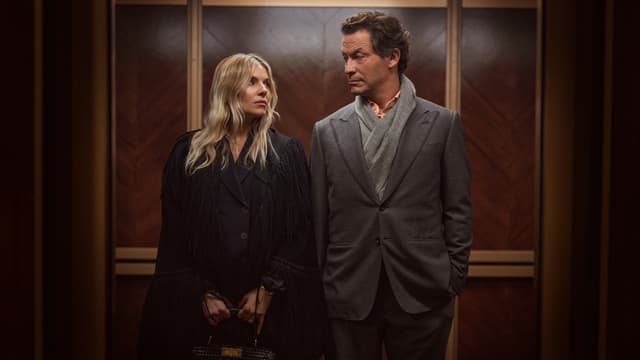
In the third episode of War, a legal drama from HBO and Britain’s Sky TV, a tech billionaire played by Dominic West makes a generous and degrading offer. He’ll give Steven (Robert Daws), one of many hirelings advising him in a nasty divorce, a wristwatch worth a million dollars if he disrobes “down to your socks, right now.” Steven’s initial response is a nervous giggle. Then he’s frantically unbuttoning his shirt. His point duly made, West’s character, Morgan Henderson, quickly stops the striptease. “For people like me, the word trust loses all meaning,” Morgan says. “There are no lengths to which people won’t go, there’s nothing they won’t do to debase themselves, to humiliate themselves, and you, if they think they can get a slice.”
This is as close as the first season of War, premiering Oct. 1 on HBO, gets to a thesis statement. Created by Lupin and Hijack hitmaker George Kay, this planned anthology series set within the high-rent hallways of London’s elite law firms takes, as its debut subject, the protracted uncoupling of Morgan and his actress wife, Carla Duval (Sienna Miller). The show is everything you’d expect from a prestige-branded drama: persuasively acted, aesthetically polished, intricately plotted, and, with a few baffling exceptions, subtly scripted. It can be quite exciting. But as the season progresses, sparse character development and minimal insight into the absurdity of possessing—let alone fighting over—sums of money that could sustain hundreds of upper-middle-class Steven types add up to a frustrating lack of perspective.
From the very beginning, the Henderson-Duval split is sordid. After accepting an award with a high-minded speech, Morgan—the entrepreneur behind a socially responsible social media platform called Zephyr—allows himself to be seduced by a beautiful young woman, Flora (Rose Williams). It’s a honeytrap, set by Carla in a desperate scheme to investigate rumors of her husband’s infidelity. On a junket promoting a dire-sounding period drama called The Milliner (her declining film career fuels some of War’s wittiest moments), she wastes no time forwarding Flora’s selfie with a sleeping Morgan to her lawyers. And so the gears of the divorce machine shudder into motion, working to formalize a gradual estrangement that had been masquerading as the unavoidable byproduct of two demanding, international careers. We don’t learn much about either spouse as people; Carla’s personality is especially tough to pin down. At times, it’s implied that she’s cold or cutthroat. Her son from a previous relationship (Aran Murphy, in his second HBO troubled-teen role this fall) is barely mentioned before he pops up in Episode 3.
The show’s failure to flesh out these characters could have worked. The anthology’s overarching concept implies that it’s the lawyers, not the clients, that we’re supposed to be getting to know. In Morgan’s corner is Cathcarts & Sons, a venerable, old-school firm whose patrician pomp is telegraphed by stuffy, dark-wood interiors. Carla hires upstarts Taylor & Byrne, whose glassy, modern office space, by contrast, underscores a mission of operating on the light side of the legal arts—avoiding dirty tactics and putting clients first. (Flora’s photo, which is proof of Carla’s entrapment as well as of Morgan’s cheating, is an early ethical test.) The adversaries have history that goes beyond the prep-school-to-white-shoe-firm pipeline, and it gives both sides further ammunition for a fight they’re incentivized to draw out for as long as possible.
There are a few compelling characters among the attorneys. Married Taylor & Byrne partners Nick Taylor (James McArdle) and Serena Byrne (Phoebe Fox) are about to have their first child, and the question of whether she—the tougher but somewhat less senior and, of course, female of the two—will step back from work to focus on family meshes well with the show’s depiction of Carla as a mostly absent mother. Pip Torrens could make your skin crawl (complimentary) as St. John Smallwood, a cruel, sardonic leader of the opposite team, a constant reminder of how much ground there is between compromised and sociopathic on the moral spectrum.
But even these standouts feel underdeveloped. And most of the dozen or so colleagues of theirs we meet are either cyphers or types. Smallwood’s underling David Schill (Miles Jupp) is flop sweat personified. Shadow and Bone star Archie Renaux is very good at conveying the quiet calculations of Johnny Warren, a working-class junior lawyer who is basically the straight Tom Ripley, Esq., but the fact that his character can be summed up so concisely speaks to its limitations. Farther down the call sheet, for every inspired casting choice (Celia Imrie as a sprightly barrister), there are a couple of name actors wasted in roles that serve expository purposes (Patrick Fabian as a Morgan minion, Nick Mohammed as a Taylor & Byrne staffer).
There are so many characters, and Kay does so little to identify a protagonist within this cynical milieu, that—as the case progresses inevitably from a pantomime of mediation to a courtroom spectacle with the potential to make careers and ruin lives—it’s hard to know where to look. Ideas surface and either stall out, like the nihilism of Gabe’s superrich teen cohort in an era whose apocalyptic mood is a direct result of their parents’ actions, or linger redundantly. Well before the midpoint of the season, viewers will be trained to see lawyers as 24/7 performers, manipulating everyone around them through false sincerity and empathy, if not full fabrication. Glib flourishes like an episode that ends with both spouses saying "I do" to escalating their conflict and the occasional insertion of misplaced crime-drama clichés ("It's done," Flora tells Carla after sleeping with Morgan) undermine otherwise solid scripts.
The point may be that money destroys families and debases everyone who seeks it. But even if Succession hadn’t already eloquently made it (Morgan’s watch stunt is a milder version of Logan Roy’s viscerally disturbing Boar on the Floor), that’s not what War’s ultimate framing of Morgan and Carla suggests. While all the scheming and jockeying and betrayal can be thrilling, the resolution feels like a shrug. Kay invokes big, timely issues—extreme wealth, gender roles, the horrors of social media—without finding much to say about them. An anthology is supposed to be a collection of complete stories. War’s slick but shallow first outing is anything but.