
HC judge who summoned SC judges to his Kolkata home, ordered their arrest, dies
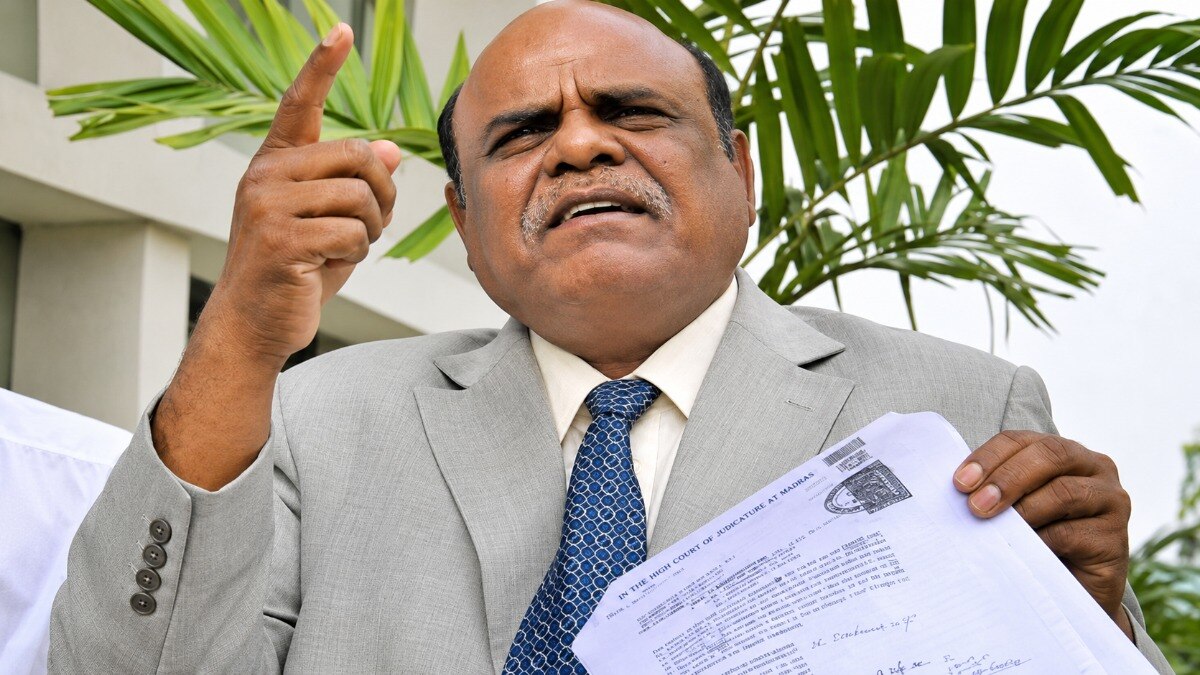
Justice CS Karnan, the High Court judge who in 2017 turned his Kolkata residence into a makeshift courtroom and summoned Supreme Court judges for a hearing, died in Chennai on Friday, according to reports. He subsequently spent six months in prison on contempt charges, a first for any sitting High Court judge in India.
The former Calcutta High Court judge had issued non-bailable arrest warrants against seven Supreme Court judges, including then Chief Justice of India JS Khehar, in May 2017. He went on to sentence eight judges of the Supreme Court to five years of rigorous imprisonment. The orders were issued from his residence, even though the Supreme Court had already withdrawn his judicial and administrative work.
Karnan, 71, died at Apollo Hospitals in Chennai on Friday (November 13) after undergoing treatment for health complications, according to reports. His confrontation with the Supreme Court had made him the first sitting High Court judge in India to be sentenced to imprisonment for contempt of court.
Karnan, who had accused fellow judges of corruption and caste discrimination, claimed that the Supreme Court judges had humiliated him because he was a Dalit. He also attempted to prevent them from travelling abroad and directed them to surrender their passports.
The confrontation began in January 2017, when Karnan wrote to Prime Minister Narendra Modi, accusing 20 sitting and retired judges of corruption and seeking an investigation.
On February 8, a seven-judge Supreme Court bench headed by CJI Khehar initiated contempt proceedings against him and withdrew his judicial and administrative work.
On March 31, Karnan appeared before the Supreme Court but demanded restoration of his powers. The Supreme Court bench refused.
On April 13, Karnan issued an order summoning Khehar and six other Supreme Court judges to his residence at Rosedale in New Town of Kolkata on April 28.
According to an April 14, 2017, report in The Indian Express, Karnan told journalists that his residence had become his "make-shift court".
He accused the seven judges of violating the Scheduled Castes and Scheduled Tribes (Prevention of Atrocities) Act and sought their response on punishment. Several charges under the Act are non-bailable.KARNAN EVEN ORDERED ARREST OF SC JUDGES
After Karnan summoned the Supreme Court judges, he did not appear before Karnan on April 28.
That day, Karnan issued another order seeking to prevent the judges from travelling abroad, citing alleged caste discrimination.
On May 2, he issued non-bailable warrants against Khehar and six other Supreme Court judges.
India Today TV reported that Karnan directed the Calcutta High Court Registrar General to get the warrants executed through Delhi Police.
On May 8, he went further. From his Kolkata residence, Karnan purported to sentence eight Supreme Court judges, including Khehar, to five years of rigorous imprisonment and fined them Rs 1 lakh each.
The judges included Dipak Misra, J Chelameswar, Ranjan Gogoi, Madan B Lokur, Pinaki Chandra Ghose, Kurian Joseph and R Banumathi.THEN, SUPREME COURT SENT KARNAN TO JAIL
A day later, on May 9, 2017, the Supreme Court found Karnan guilty of contempt and sentenced him to six months in prison.
The court rejected his unsubstantiated allegations against fellow judges and found that his conduct had undermined the judiciary.
He evaded arrest for more than a month. Police finally arrested him in Coimbatore on June 20, after which he was lodged in Kolkata's Presidency Jail.
Karnan was released in December 2017 after serving his six-month sentence.
Years later, Karnan was arrested again in December 2020 by Chennai Police over videos in which he allegedly made obscene remarks and threatened sexual violence against judges and their families. He was lodged in Chennai's Puzhal prison before the Madras High Court granted him conditional bail in March 2021.
Karnan, who served as a judge of the Madras High Court before being transferred to the Calcutta High Court in 2016, remained one of the most controversial figures in India's judicial history. His unprecedented confrontation with the Supreme Court raised questions about judicial accountability, the limits of judicial authority and contempt of court.- Ends

