
He lost his father in 2018. On Thursday, he won India sailing silver - The Indian Express
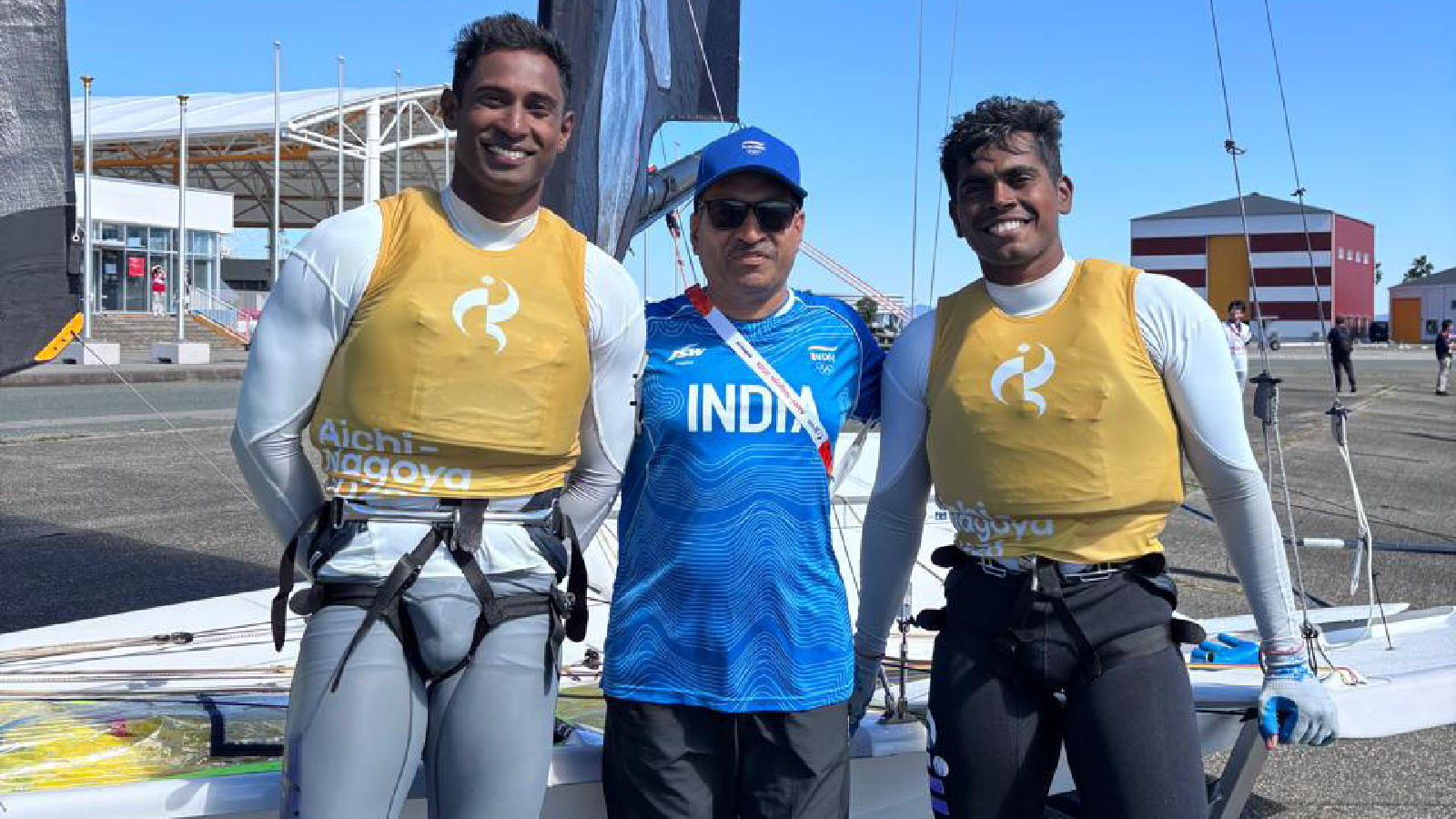
Prince Noble was at a sailing regatta in Germany with his crew and cousin, Manu Francis, when he learned his father, Noble KG, had died snatched by the ferocious waters of the 2018 Kerala floods. The sky had crashed down on him and his family of a mother, two brothers and a sister, that day.
Prince leaned on his oldest friend, Manu.
On Thursday, Prince and Manu of the Army Yachting Node sailed their last four races of the Skiff 49er Dinghy event into suddenly gusting winds. In calmer conditions on Wednesday, they had led the fleet in five races and were looking at gold. On Thursday, gusts of 14-15 knots sent them to the edge of the 49er’s trapeze. In the final race, they went from fourth place to second. It went to the wire, but they gave India its first sailing silver of these Games.
“I knew something bad had happened in the floods, but not that he…,” he trails off. “I wish I could’ve seen my father just once. Sometimes I wish I had never gone to Germany and was with him. He always encouraged me, whether I was winning or losing. And I didn’t win much back then. But his only thing was I should enjoy the sport. Result is in God’s hands,” Prince says.
𝐒𝐈𝐋𝐕𝐄𝐑 𝐎𝐍 𝐓𝐇𝐄 𝐖𝐀𝐓𝐄𝐑𝐒 𝐎𝐅 𝐀𝐈𝐂𝐇𝐈-𝐍𝐀𝐆𝐎𝐘𝐀! ⛵🥈
Prince Noble Kurisinkal and Manu Francis sail to Silver in the Men’s Skiff event, securing India’s first Sailing medal at this edition of the Asian Games! ✨
Watch the 20th Asian Games Aichi-Nagoya 2026… pic.twitter.com/HgTWunfahj
Prince reads the Bible every day, and believes he won’t win if he doesn’t pray. On a boat that flies on water, belief and trust matter. “When things get tough, and you are dropping down the scoreboard, it can feel like you are sinking, so you pray to the Lord. You don’t pray asking for a medal, but to give you strength to navigate the angry winds. That’s what my father used to say. It’s what we learnt in training in the Army. It’s what I trust Manu to do as teammate,” he says.
It was Prince’s fondest memory: countless days spent fishing with his father, who told him the sea was his friend, as they travelled out from inland Palakuzha in Ernakulam. They would also watch, fascinated, an uncle who repaired the powerboats that accompanied sailors. It was there his father first said he wanted to see Prince on boats with those soaring sails, calling it the most peaceful feeling he knew. His father’s death drew Prince even closer to the sea.
Manu, Prince’s cousin, a year older, was a sports-loving, cheerful influence on the quieter, more ruminative Prince. Wherever Manu went, Prince followed. He dragged him to cricket (“I was never any good at it,” Prince laughs), to football and badminton, and finally to watch the Volvo Ocean Race of 2008, where bright, massive sails docked at Kochi and raced like aeroplanes on water. “It was a festival. We couldn’t stop talking about it. We vowed to sail all our life,” Manu recalls.
They entered a talent hunt run by the Kerala Yachting Association without knowing it was for sailing. “We were tested for swimming. Only later did we know we would be on boats. It was a dream come true,” Prince recalls. At an Enterprise Nationals, an Army coach training in Bhopal approached Manu, who had been racing well on entry-level dinghies, and invited him to train. “He was a Malayali Army coach. So I was convinced immediately,” Manu recalls. But wherever Manu went, Prince needed to follow. “I told them I’m only coming if he is,” says Manu, whose family worked in fishing and woodcutting. Bhopal taught them fundamentals and resilience, but something felt missing.
Landlocked people may not understand it, but despite the yachting facilities on offer, a coach who spoke their language, and locals providing everything in Bhopal, Prince couldn’t adjust to inland water training. “I really missed the sea. It’s different, even the winds. There’s nothing like it,” Prince says.
Prince was on the verge of an engineering admission when Manu received a recruitment offer from the Army, training in Mumbai, back by the sea. “It was the best option,” Prince says. “They have legendary sailors, excellent coaches, knowledge, because this is a technically complex sport. Also, can you ever buy me a boat costing 45 lakh, like we sailed today?” he laughs. His engineering aptitude would have suited him well elsewhere, but sailing was always the pull. “They have the best facilities and maximum opportunities.”
Sailing was always an expensive sport. But such was the passion of recreational sailors Suresh Pillai and Navneet Mittal, founders of a now-defunct Kerala Yachting Association, that they built an entire sailing club for the Kochi-Ernakulam duo. “Two boats to start. But sails and masts break all the time. Wires snap. They built it for us anyway,” Manu recalls.
Prince is helm, Manu is crew, the engine on the main sail. He has a near-photographic memory, able to recall past conditions and how they negotiated the winds, to steer sails and strategy. “He is disciplined like an athlete,” Prince says. Prince leans out on the trapeze wire, reading the winds and bringing power to the boat.
“Our communication is very solid. He’s like my elder brother. Whenever we visited their home, he would get me to play with him. We don’t even have to blink to communicate. We just understand each other. Of course we are two different people, so we disagree. But on the boat, we can overcome everything,” Prince says. “There’s a moment in sailing when the crew, the helm and the boat become a single person. In sync, and the boat literally sings, flies on water. I love that feeling.”
Manu digs the speed. “Prince is passionate about sailing. I am good at it, but I love racing cars and farming,” he says. He will head home and eat kuzhimandi, the Yemeni biryani. For Prince, it will be a visit to the Velankanni church.
It’s a silver by the sea. “My father was always proud of me. He would’ve asked, did you enjoy it? I loved it.”
Shivani Naik is a senior sports journalist and Assistant Editor at The Indian Express. She is widely considered one of the leading voices in Indian Olympic sports journalism, particularly known for her deep expertise in badminton, wrestling, and basketball. Professional Profile Role: Assistant Editor and Columnist at The Indian Express. Specialization: While she covers a variety of sports, she is the primary authority on badminton for the publication. She also writes extensively about tennis, track and field, wrestling, and gymnastics. Writing Style: Her work is characterized by "technical storytelling"—breaking down the biomechanics, tactics, and psychological grit of athletes. She often provides "long reads" that explore the personal journeys of athletes beyond the podium. Key Topics & Recent Coverage (Late 2025) Shivani Naik’s recent articles (as of December 2025) focus on the evolving landscape of Indian sports as athletes prepare for the 2026 Asian Games and beyond: Indian Badminton's "Hulks": She has recently written about a new generation of Indian shuttlers characterized by power and physicality, such as Ayush Shetty and Sathish Karunakaran, marking a shift from the traditionally finesse-based Indian style. PV Sindhu’s Resurgence: A significant portion of her late-2025 work tracks PV Sindhu’s tactical shifts under new coaching, focusing on her "sparkle" and technical tweaks to break out of career slumps. The "Group of Death": In December 2025, she provided detailed tactical previews for Satwiksairaj Rankireddy and Chirag Shetty’s campaign in the BWF World Tour Finals. Tactical Deep Dives: She frequently explores technical trends, such as the rise of "backhand deception" in modern badminton and the importance of court drift management in international arenas. Legacy and History: She often revisits the careers of legends like Saina Nehwal and Syed Modi, providing historical context to current Indian successes. Notable Recent Articles BWF World Tour Finals: Satwik-Chirag have it all to do to get through proverbial Group of Death. (Dec 2025) The age of Hulks in Indian badminton is here. (Dec 2025) Treadmill, Yoganidra and building endurance: The themes that defined the resurgence of Gayatri and Treesa. (Dec 2025) Ayush Shetty beats Kodai Naraoka: Will 20-year-old be the headline act in 2026? (Nov 2025) Modern Cinderella tale – featuring An Se-young and a shoe that fits snugly. (Nov 2025) Other Sports Interests Beyond the court, Shivani is a passionate follower of South African cricket, sometimes writing emotional columns about her irrational support for the Proteas, which started because of love for Graeme Smith's dour and doughty Test playing style despite being a left-hander, and sustained over curiosity over their heartbreaking habit of losing ICC knockouts. You can follow her detailed analysis and columns on her official Indian Express profile page. ... Read More
