Healthy sense of paranoia good for S'pore: Tan See Leng on S'pore's energy security - Mothership
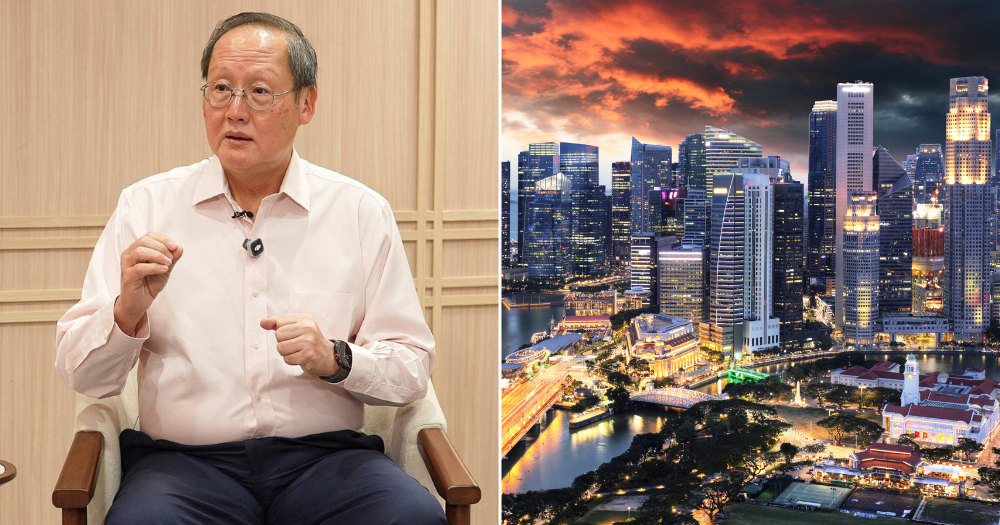
Commenting on the recent Indonesian gas cuts, Tan said that regional collaboration is not a "zero-sum" game.
When Iran strikes knocked out the world's largest liquefied natural gas (LNG) export plan in Qatar in March 2026, Singapore had a problem.
Singapore relies on natural gas to generate 95 per cent of its electricity.
In 2025, as much as 45 per cent of Singapore's liquefied natural gas (LNG) imports came from Qatar.
Seven months later, Indonesia announced in October 2026 it would trim gas exports to Singapore.
To borrow the words of Tan See Leng, Minister for Energy, Trade and Industry (Energy and Industry), Singapore kept calm and carried on.
This steady calm amid turbulence did not happen by chance.
Rather, it was the product of a “healthy sense of paranoia”, Tan told the media during an interview on Nov. 13.
The minister was speaking about the challenges and opportunities in Singapore's quest for a more resilient and decarbonised energy supply amid an increasingly turbulent geopolitical backdrop.
When Tan spoke of paranoia, he was responding to a question from Mothership on his reflections about the past year, which saw repeated disruptions to Singapore's energy supply.
Recalling an interview he gave to The Straits Times when he first joined politics back in 2020, Tan said that he shared with ST's reporter then that he was a "very paranoid person".
But this has come to serve him, and Singapore, well.
"I think that a healthy sense of paranoia is good for us because we are a very small country," Tan said.
For example, in 2025, Singapore established GasCo, a centralised national gas buyer to procure and supply gas to all power generators in the country.
When bombs fell in the Middle East in March, GasCo, set up just a year earlier, went shopping.
By June, GasCo secured enough supplies by June to offset those lost from Qatar.
It did so by diversifying its sources, buying from sellers in places like the U.S., Australia and Africa.
"The satisfying thing is that the paranoia that drives the setting up of GasCo, standby facilities, building the networks all over, diversifying, requiring the [electrical generation companies] to be able to switch from gas to diesel to hydrogen... with all these things, people look back and say, 'Wow, luckily we have all this'."
But surviving one crisis is not the same as being ready for the next.
Local electricity demand is expected to rise, from 8.6GW at peak today to between 9.9GW and 13GW by 2031.
Then there's decarbonisation. Singapore aims to reach net-zero emissions by 2050.
This confluence of different needs makes for "exhilarating times", the minister said.
To meet all these goals, Singapore is casting its net wide, developing several energy sources, or "switches", as it did for water with the four national taps.
Singapore's four "switches" are natural gas, solar, regional power grids and low-carbon alternatives.
During the interview, Tan addressed Indonesia's recent cuts to its gas exports to Singapore.
The cuts amounted to about 8 to 9 per cent of the pipeline gas exports to Singapore.
Indonesian officials explained that the gas would be diverted to meet local demand in Batam, Bintan and Sumatra.
Its energy minister, Bahlil Lahadalia, also said that Indonesia would sell gas to Singapore as long as the "price is right".
"This trend of resource nationalism is particularly concerning, especially if it undermines established contractual agreements," Tan had said during his Singapore Energy Lecture at the Singapore International Energy Week (SIEW) on Oct. 26.
Despite this, the minister shared during the interview that the momentum for regional collaboration has been "quite positive", particularly on the Asean Power Grid and cross-border renewable energy trade.
Tan emphasised that regional collaboration is not a "zero sum game".
"From time to time, I think the nature of where we are, different countries will have different needs, and we respect, first and foremost, the country prioritising their own domestic needs because every single country, I think they are accountable to their own people.
But at the same time, it really is not a zero-sum game. It doesn't mean that if you work with your neighbours, it means that your domestic needs will be compromised in any way."
Singapore's philosophy, Tan said, has always been "prosper thy neighbour".
"When we work with them, we actually allocate quite a fair bit of capacity. And how we work out our numbers with them is, how do they then allocate for their own domestic consumption before the export comes?"
Asean as a whole has huge natural resources in terms of renewable energy generation, Tan pointed out.
With more than 700 million people altogether, there is also much potential for economic growth.
He illustrated a win-win situation with regional projects like the Asean Power Grid, in which projects could lead to an influx of investment money, which could in turn uplift domestic economies.
The challenge is unlocking the political willpower to realise this vision, he said.
This vision is something he said he would try his best to articulate as Singapore takes over as Asean chair in 2027.
At this year’s Asean energy ministers’ meeting, the bloc agreed on an enhanced framework for the Asean Power Grid.
"Then next year, we can carry the work further to put in place the regulatory framework, the guidelines in terms of submarine, subsea cable laying, access, maintenance, repair, overhaul," Tan said.
Tan spoke at length, and in depth, about the possible energy sources that could be folded into Singapore’s energy mix in the future.
In the near term, Singapore will still depend on natural gas, the minister explained.
But going beyond and closer to 2050, this percentage would be lower.
"We think that hopefully it will be significantly less, maybe half, maybe slightly less than half," Tan said.
Solar could contribute 10 per cent or so, with significant investment going into research and deployment today.
That leaves about 40 per cent to be accounted for, which Tan said could come from several other clean energy sources, including green hydrogen and green ammonia.
Tan also announced at SIEW that Singapore's underground geothermal potential showed promise, and that the country would go on to study the feasibility of deploying geothermal power plants.
With natural gas expected to continue powering as much as half of Singapore's electricity demand, can Singapore still attain net zero by 2050?
"No country in the world can go 100 per cent green," Tan explained.
Energy sources like solar are intermittent and dependent on factors such as weather conditions.
The scale of their deployment is also limited by Singapore's land area and natural resources.
"Natural gas is one of those reservoir or buffer that gives you what we call base load. That means, come what may, you burn, there's still energy being generated. And hence you cannot completely diversify away from gas," the minister explained.
Among the clean energy sources, nuclear energy, Tan said, is exciting as it has the potential to substitute for natural gas.
Singapore is seriously considering nuclear power, but has yet to make a decision, he emphasised.
Next year, Singapore will undergo a review by the International Atomic Energy Agency, the global nuclear watchdog, to assess its readiness for the technology.
Nuclear energy has come a long way since its inception. On the market today are reactors that are smaller in size and scale, such as Small Modular Reactors (SMRs).
Unlike conventional reactors which require a considerable amount of land and an emergency planning zone that extends far beyond their perimeter, SMR facilities can be as small as four football fields.
These SMRs, Tan explained, use TRISO fuel, a new form of nuclear fuel each only as large as a matchstick head.
About 12,000 of these are packed into a single pellet.
"One tiny pellet of uranium is equivalent to 20 per cent of an Olympic-sized swimming pool in terms of gas," Tan said.
With these, the risk of a nuclear meltdown is also "very low", the minister shared.
"Today, thus far, for these new technologies, the technology is very, very safe. But [if] you can do it at scale, and it is commercially viable, then that would really help move the needle in bringing down the natural gas needs."
On where such a reactor might be sited in Singapore should the government decide to proceed with it in the future, Tan remarked that the obvious choice was "as far out as possible".
However, he said that there is no "straight answer" as new forms of nuclear technology are being developed and the size and scale of reactors are constantly changing.
"We haven't decided, because the technology is still evolving," Tan commented.
The Energy Market Authority (EMA) announced in October 2026 that it will study the feasibility of establishing energy infrastructure on Pulau Tekong.
During this year's National Day Rally, Prime Minister Lawrence Wong announced the government's plans to reclaim several islands off Singapore to form a larger Western Island, which could house power generation infrastructure.
Tan said: "It behoves every generation of Singaporeans to always build for successive generations."
"So what we're trying to do is really ensuring that with all of our different portfolios that we manage, the diversification of the different pathways, the different sources, to even investing significantly in R&D, in our research, innovation, enterprise ecosystem, to ensure that your generation, the generations that come after you, future generations of Singaporeans will always find Singapore energy self-sufficient, secure, reliable, [and] at the same time, affordable. And that is where we are today."
That said, flipping on the four "switches" will take some time.
Meanwhile, disruptions in the Middle East and recent gas cuts from Indonesia have highlighted the vulnerabilities arising from Singapore's dependence on gas imports.
Is energy self-sufficiency possible for resource-constrained Singapore?
"We certainly have that as our overarching ambition and vision. I think the key thing is how long we're going to take to get there," the minister remarked.
Diversification at multiple levels is crucial, Tan said.
The first level is diversification of import sources.
Singapore used to source natural gas via pipeline from just two countries. Today, it imports from the world over, including the U.S. and Mozambique.
Soon, Singapore may also source gas from Latin America, Tan shared.
The second level is diversification of power sources, which refers to the concept of the four "switches".
Singapore has also been stockpiling gas and diesel for rainy days since the Russia-Ukraine war broke out in 2022.
Tan said the stockpile has remained untouched.
"It seems that we are really at a confluence. You've got all of these AI developments, you've got the disruptions, you've got the tariff wars, and most recent, [U.S.] midterm elections," Tan observed.
Closer to home, Singapore's neighbours have also found it challenging to keep up with rising domestic needs, Tan said.
"So I think this has actually reached a particular point, in terms of all of our international relations, versus balancing it against growth, the requirements and so on, and I think that it's causing a fair bit of interest. It's causing a fair bit of tension," the minister remarked.
The challenge for a small country like Singapore is to figure out how to continue to thrive and remain relevant amid such developments.
"Just as how it was 30, 40 years ago when water itself was existential for us, today, energy is existential for us," Tan said.
This time, it's four switches, and a minister who is not afraid to admit he worries.