
His wife killed his 3 children. He defended her in court, then remarried - The Indian Express
“The voice, according to Lindsay, said that if she did not follow its command, neither she nor her children would be safe” – this is what Sheila Cavanaugh, a chaplain, told the court during the Lindsay Clancy murder trial, revealing details from one of roughly 200 interactions she had in the months after the Massachusetts mother strangled her three children and tried to take her own life.
The voice was male. And persistent. It was in January 2023, the murders.
Three years and one mistrial later, the ‘voice’ is still the least resolved question in this case. But there’s a second – not about the woman who did not dispute she killed her children, but about the man who left the house to pick up dinner, and came home to find them dead.
It was an ordinary morning. Possibly even a happy one.
‘(She) was playing with the kids… seemed in a good mood’, he told the court. The last image of his three-year-old son, Dawson, was the boy sitting on the couch eating chicken nuggets and green beans.
In the afternoon Lindsay texted Patrick – she was with the children, he was in his basement office. ‘Any chance you want to do takeout… I didn’t cook anything. It’s been a long day’. That was at 4.35 pm. A little after 5 pm Patrick Clancy left to buy dinner.
Phone records produced in court showed a call to Lindsay at 5.33; they spoke for 14 seconds to discuss which medicine to buy, a side errand Patrick was running.
Parents parenting. Even the prosecutors called it ‘a completely normal call’.
Patrick later testified Lindsay sounded subdued. ‘Maybe she’s giving the kids a bath’, he thought. He left for home at 5.37 pm. And sometime between then and 6.10 pm his life changed.
Three years later, in a Plymouth courtroom, one moment surfaced that had nothing to do with January 24 – and everything to do with Patrick Clancy potentially going from ‘grieving husband’ to ‘person of interest in a murder investigation’.
It was from August 2022 – five months before the killings. The prosecution had put a Massachusetts police officer on the stand to walk the jury through its argument – that Lindsay Clancy researched suicide for a year.
The evidence – Patrick’s laptop, a Microsoft Surface Pro in some reports, that was used to log in to Lindsay’s Facebook account and view a page on suicide methods. Pages connecting to the research on suicide were about a singer – Tom T Hall – who died by suicide. This pointed to premeditation by Lindsay, the prosecution argued.
But under cross-examination the officer admitted there was no way of knowing who visited the pages – could it have been Patrick Clancy? After all, he was the Tom Hall fan, not Lindsay, the court was told.
And Lindsay Clancy’s lawyer, Kevin Reddington pointed out that when the search was logged his client was not home; she was with their son at the pediatrician. “That’s it?” court records have Reddington asking the policeman, apparently, incredulous when realising this was the only digital evidence.
Reddington wasn’t accusing Patrick of anything.
But perhaps for the first time in the courtroom, a hint was supplied – ‘it could have been him, not her’. And it was perhaps the only time that the Patrick Clancy-as-suspect narrative wasn’t driven only by social media.
For his part, Patrick never wavered, at least in public. “She was very dedicated,” he said as the defense showed photos of the children’s artwork on the walls of their home. And in October 2024 he told The New Yorker: “I wasn’t married to a monster – I was married to someone who got sick.”
That real-but-almost impossible seed of doubt – a laptop search – was where the evidence stopped. It was not, however, where the internet stopped.
Before the trial began the defense and prosecution agreed to certain facts. But social media made no such agreement.
On TikTok (banned in India but popular in the US), self-declared ‘forensics’ experts held forth on the laptop story, and spun it into something much larger and unsubstantiated: – that Patrick Clancy was having an affair, or had somehow drugged Lindsay (the ‘voice’ in her head), and either killed his children himself (and staged his wife’s attempted suicide) or convinced her she did it.
But here’s the thing. His alibi for that evening is solid.
Surveillance cameras, phone records, eyewitness accounts, and a former New York City police chief who gave his story a clean chit. Patrick’s attorney, Howard Cooper, called the claims ‘patently false and defamatory’, and warned of real consequences for people who repeated them. But they claims continued spreading nonetheless.
Now here’s the part that makes this story so strange.
Patrick Clancy has been leading a double life, yes.
But it’s not the kind the internet’s ‘forensic scientists’ want to believe. He has been doing two things in public at once – navigating a murder trial involving his wife and, simultaneously, rebuilding his life with another woman some 400km away, in New York.
In April 2026, he married Dr Rachel Danis in a small ceremony in Central Park.
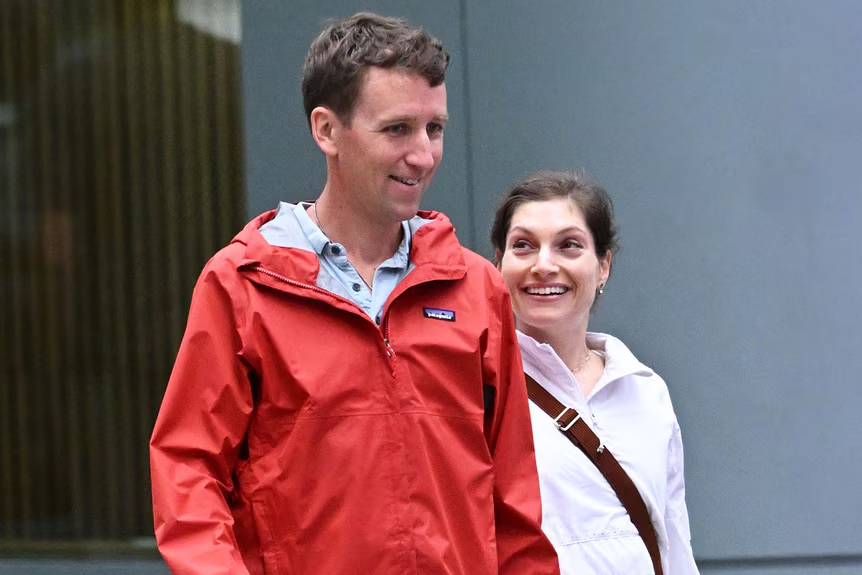
No one knew. Not till Reddington, Lindsay’s defense attorney, told the court in July, before Patrick took the stand. In August – with the trial in its final stages and whispers flying about – the couple were photographed outside their home in Manhattan; TMZ, a celebrity news website, ran that photograph.
And weeks on, after the mistrial was announced, they were snapped again, this time happy.
The world likes happy endings. The world also likes murky conclusions. This is both.
The wife who killed the children, the remarried husband and his new wife, the photographed tension while he goes through the murder trial. None of this evidence. But it is why, in some corners of the internet, Patrick Clancy is still on trial.
The trial was deadlocked; a lone juror held out against 11 who wanted to accept her plea of temporary insanity. A fresh hearing in end-September, scheduled for the 29th, will establish if the prosecution wants to start a fresh trial, to start this up all over again.
And it won’t just be for her. It will be for Patrick too. And this time Rachel also.
Chandrashekar is a senior editor with over 17 years of experience in reporting, writing, editing, and curating digital news content. He has worked with leading media organisations, including NDTV and Hindustan Times, handling high-impact coverage across politics, international affairs, conflict, and public policy. Over the years, he has written and edited news reports, explainers, analyses, profiles and opinion pieces for diverse audiences, focusing on breaking news, political forces shaping India and the world, economic policy, and global security. He has also helped shape editorial guidelines and train junior writers and editors. His expertise includes headline writing, search and audience optimisation, content packaging, and developing editorial standards for fast-changing news environments. His approach to journalism is rooted in accuracy, context and the belief good analysis should help readers what happened and why it matters. ... Read More

