Hollywoodbets Kingsmead: The remembrance of things present - IOL
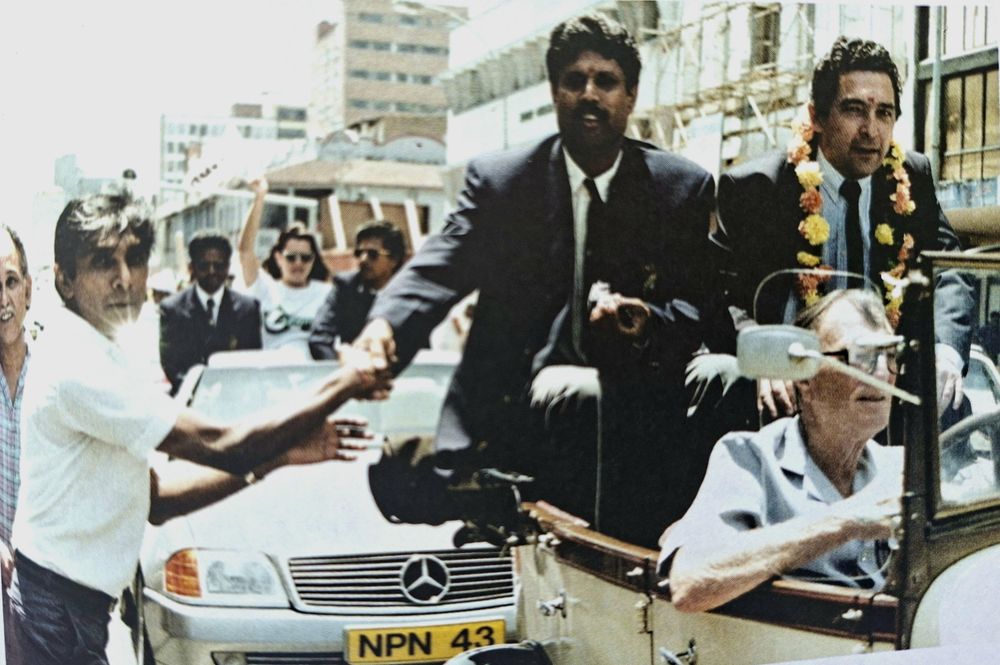
1992-Cavalcade through the city of Durban...Kapil Dev and Ali BACHER
‘Cricket is not a game. It is the truth of life.’ - J M Coetzee
1970. The Aussies were in town, and I was at the ground. My mother had packed a neat four-some cheese and tomato sandwiches.
By now, the shop opposite our one bedroomed flat had a slicing machine, and they were thinner than those churned out by my mother’s long blade.
We non-whites were granted an even narrower slice of turf to watch the game under the clock.
I was the tiniest and youngest, and thus lots of the banter flew over my head. With my back leaning on the green fence that cut off the white section from us, I munched my first two sandwiches and neatly re-wrapped the other two for lunchtime.
Barry Richards ambled onto the field and, with a lazy nod to the umpire, took guard. I had already watched him bat for Natal. He could pierce a packed cover-field with the precision of our neighbour Aunty Saras’ thrown slipper.
This was a man who had honed his reflexes at school, as Mike Procter would reveal, by throwing ‘a golf ball against a wall then hitting it back with a cricket bat.’
Test cricket is a staid affair. But, as Barry reached his 80s, a buzz began. Would he be crowned a centurion before lunch?
The last was Donald Bradman in 1930.Richards entered the nineties with a sensible shot.
Captain Bill Lawry, ‘theScrooge of cricket … held up play while he tied his bootlace and strung out the next over.’
Ali Bacher took the final over before lunch, desperately swung toleg, and was bowled.
Lunch was called and Barry was stuck on 94.This amazing innings is overshadowed by Graeme Pollock’s 274 which surpassed Jackie McGlew’s record of 225 not-out.
Still, in my eleven-year-old mind, Richards’ innings, with its twenty-four fours and a six, is arguably the greatest in the period of apartheid Kingsmead.
From Left: Basil D' Oliveira, Mike Procter, Barry Richards and Gopal Manickum.
We saw the cover drive, and dance down the wicket to the so-called mystery spinner Johnny Gleeson that was like a pirouette on a pin and a cut so late that I nearly peed.
I did. But in Durban’s humidity, everyone dribbled in the non-white patch between the press of armpits and thighs.
Where Richards caressed, Graeme Pollock, with his open stance, was all power, much like his namesake, the painter Jackson, who it is said, ‘hurled pigment at his canvas like pies.’
While Barry lunched, I reached for my sandwich. Ants as big as broad beans had got under the covers. The tea-room for non-whites was not open. I staggered around as if hit by a Mike Procter bouncer.
A pot-bellied cricket lover on the other side of the racial fence leaned over and gave me an overweight sausage with a sticky sauce. I was to learn later in life this was boerewors.
After lunch, Richards began swinging the sceptre. Did he have a Patel’s beans bunny for lunch?
Every shot leapt from the textbook or a family movie on the silver screen, clean, brief kisses between bat and ball. He went on to get 140 runs from 164 balls, a strike rate of over 85.
And before I had finished licking my fingers, he was gone. My father accompanied me on the third or fourth day. I so wanted to get Barry Richards’ autograph.
I could wander behind the clock and wend my way to the stand where Richards sat with his feet up. But my father placed a gentle hand on my shoulder and disarmed me of pen and paper.
How does a father tell a son who lectured him on the niceties of the gentleman’s game that, in cricket, there were boundaries which the likes of him and I could not cross?
And as I write this, I can still picture Richards, oh Richards of the late cut, in which the bat was at once stiletto and cleaver, ‘that fragile moment’ as Barthes would have it, ‘when the world is stilled, touching on both silence and applause.'
It was Richards last Test match at Kingsmead. It was my mine too. The boycott of ‘apartheid cricket’ began to gather.
My father and I retreated to Springfield on a Saturday afternoon and Sunday. At the grounds of Springfield, the setting and atmosphere were a world away from Kingsmead.
We would lay the mat on the pitch. The holes were huge. If you tried for a quick single, often you would get stuck, so you had to run alongside the pitch. This meant running in the direction of cover and then veering back to the pitch.
We were playing cricket but running like baseball players.It was impossible to play driving shots down the ground. The turf was too spotted with holes and mounds, and a square cut could bounce and scoot off to the wicket-keeper or simply just not carry beyond a yard or two.
To score, one had to loft the ball. This created its own problems. Once a big-hitter was in, the fielders in the adjacent ground had to have eyes in the back of their heads.
The fields were on top of each other with no sight screens, so as the sun descended, one sometimes saw two bowlers coming at you.
The highlight was a lunchtime a pot of breyani. My father would scoop a helping, ensuring I had a sliver of a potato. Like the Springfield wicket, the bit of starch dissolved with the slightest touch.1992.
When India toured we went to Old Kingsmead, my father and I. He was like a child; taking in everything, as we perched high up on the Umgeni end. After an absence of 22 years our first embrace was hesitant, but soon we took guard together, as if we had only returned from an extended lunch break.
The game ended. My dad spied other men on the stands with whom he had batt(l)ed through the 1960s and 1970s. They embraced. Spent a long time looking down at the empty pitch and then said goodbye.
Men who played the game with such dignity, under conditions that mocked them. As he reached his hands into mine, little did we know that he would never see Kingsmead again as Parkinson’s enveloped his body and eventually ended his life.
The game of cricket. No matter how well you may see the ball, no matter how well you are playing, your innings will come to an end for the lack of a reliable partner at the other end.
In the game of life, we think that partner may be a friend or even a lover. But what if it is our own dad, or a parent? The person we find already at the crease with a decent fifty under the belt when we, shiveringly, take guard?
Someone to steady our nerves with encouragement, with whispered advice on how the pitch is playing. Cricket tells the stories of remarkable father and son duos.
Stories of feats on the field, of honour beyond the boundary, that have made generations gasp and cheer. Stories also that spawned controversy and debate.
Bitterness and regret.For all of us, these stories should not be forgotten, lest we condemn ourselves to the solitude of having no history, no home, no batting partners.
October 9, 2026. The first day of the Test match against the Aussies. Full of child-like anticipation. How could it not be, given that its first seeds were planted in a son’s fond memories of trips to the ground with his father and nourished by a whole boyhood’s excitement and play?
Ashwin Desai is Professor of Sociology at the University of Johannesburg.