How a green economy could help reverse climate change
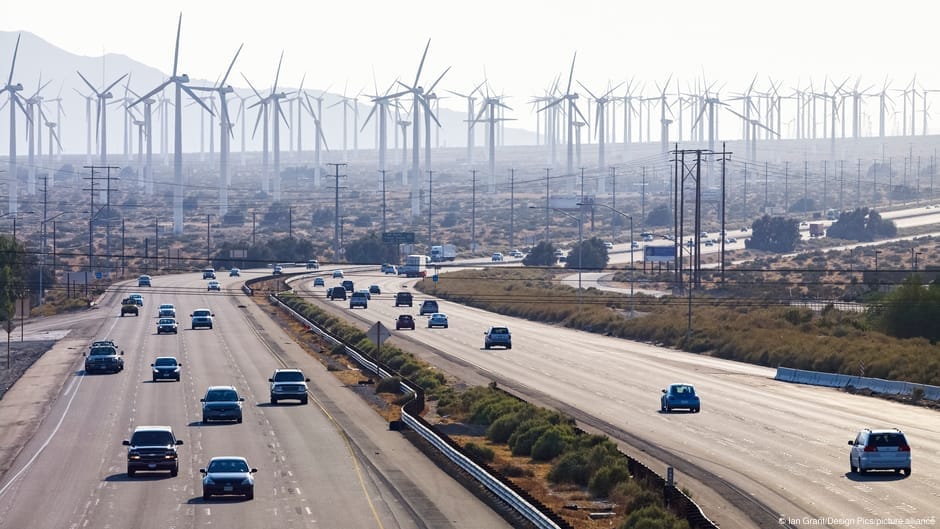
'Business as usual, but with more sustainable technologies': is this the way to a greener future?Image: Ian Grant/Design Pics/picture allianceAdvertisementHuman civilization is currently profoundly unsustainable. Earth has already crossed seven of the nine planetary boundaries critical for sustaining life, including climate change, ocean acidification and biosphere integrity.
If economies and societies keep to business as usual, the Earth's vital processes will continue to be thrown wildly out of balance, threatening the future of humanity.
It's now largely accepted that if humans are to have any chance of slowing global warming and nature loss, those social and economic models must change. That's where the idea of green growth comes in.
Its promise is to keep growing the economy while reducing emissions and resource use. That involves, for instance, running factories, businesses and homes on wind, solar and other green energy instead of coal and gas, replacing gas-fired furnaces with heat pumps and recycling and reusing resources and raw materials.
"Basically, the idea is: business as usual, but with more sustainable technologies," said Helmut Haberl, a social ecology professor at BOKU University in Vienna. Along with his colleagues in 2020, he published a major report evaluating more than 800 studies on green growth.
In principle, the world's economic output could continue to grow in the long term and generate significantly fewer emissions from the burning of fossil fuels like coal, oil and gas. That's been shown in scenarios modeled by researchers with the UN's Intergovernmental Panel on Climate Change, or IPCC.
Thanks to renewable energy and green technologies, those scenarios have already become reality in several countries and regions.
The economies of developed countries like the United Kingdom, the United States, Japan and Australia have experienced years of growth alongside sinking CO2 emissions. That's even when offshored production is included.
In the European Union, the bloc-wide economy has grown by more than 70% since 1990. Meanwhile, the EU's carbon emissions have dropped by around 40%.
But such a complete decoupling of growth and emissions is, according to Haberl and his fellow researchers, relatively rare.
In India, and in several countries in Africa and Southeast Asia, economies are becoming more efficient. But while economic performance is outpacing emissions growth, emissions are still rising in those countries and globally. This is not compatible with preventing the worst impacts of climate change.
"That doesn't mean, however, that it couldn't work in the future," said Haberl, referring to decoupling of growth and emissions.
And even though economic growth has been shown to be compatible with emissions reduction, eliminating all greenhouse gases from a polluting industry like steel or chemicals is complicated.
These sectors don't just release emissions by burning fossil fuels for energy; carbon is also a key part of the chemical processes used to create their products, notably in the steel industry.
Replacing it with greener substitutes, or an alternative energy source like green hydrogen, requires significant investment.
There's another hurdle: the world's high consumption of resources. A productive economy depends on many raw materials and other products: ores, chemicals, wood, cement, glass and agricultural products.
Many countries are now using green technologies to reduce the amount of resources needed to manufacture a product, for example, and are making their economies more efficient.
But that doesn't mean that overall fewer resources are being used, because falling costs can encourage businesses to produce more things and people to consume more. This can partially offset green savings and is called the rebound effect.
The British economy has been growing for years, emissions have been dropping and efficiency has increased — but the UK still used 7% more resources in 2023 than it did in 2001.
Global consumption of resources has tripled over the last 50 years. If the world continues on the current pathway, that could increase by another 60% by 2060. It remains unclear green growth can deliver the emissions and resource reductions needed to stop climate change and biodiversity loss rapidly enough.
"We really need to move beyond efficiency gains in our existing production practices to look more broadly at what we consume," said Catherine Ganzleben, a sustainability and fair transitions expert at the European Environment Agency.
She told DW that people also need to reconsider how they consume and whether they really need to own everything they use in their daily life — cars, for example.
"But we can shift towards models where we share cars, so we pool our resources and have significantly lower resources per person through sharing the goods that we need."
Some researchers have come to the conclusion that unrestricted economic growth is no longer possible in the long term, even if it's sustainable.
Instead, they've called for degrowth. This posits slower economic growth, no growth at all or even negative growth, so that the world's ecosystems and the climate have a chance to recover and stabilize.
That applies mainly to economies in richer countries, which would need to take targeted steps to reduce their energy and resource use. Poorer countries would continue to grow until their economies and quality of life are significantly improved.
Under the degrowth theory, a society's prosperity is not measured solely by the growth of its gross domestic product, but by values such as quality of life, education and community. The idea is that once countries develop to a certain point, additional growth doesn't translate into greater well-being.
Ultimately, the concept is based on the idea that human well-being and ecological sustainability is only possible in the long term with a planned, socially just reduction of material production and resource consumption. Degrowth advocates argue this would be preferable to an unplanned and potentially catastrophic economic contraction caused by escalating climate extremes.
A 2020 study by researchers from the universities of Leeds and Lausanne showed that the concept of degrowth supported the world's climate goals — and that a high quality of life didn't have to be sacrificed in exchange for a significantly lower consumption of energy and resources.
However, there is still no conclusive evidence that a entire modern economy could continue to function entirely on the degrowth principles in the long term.
Nevertheless, Haberl doesn't assume that an environmentally friendly economic model automatically goes hand in hand with sacrifice, arguing instead in favor of a needs-based economy.
"A society isn't necessarily better off when it's producing more goods and services," he said. It all depends on how prosperity and quality of life are measured in the future, and how states decide to do business.
Today, a successful economy is measured by the growth of a country's gross domestic product — put simply, the worth of all of its goods and services. This calculation doesn't take into account income distribution, unpaid work, quality of life and environmental damage.
"The highest possible real incomes for every individual would probably not be compatible with ecological goals in the long term," said Haberl. "On the other hand, an increase in prosperity — related to a higher quality of life — would be."
An analysis by the European Environment Agency (EEA) pointed out that the idea of steady growth is part of the world's economic cycle, and deeply anchored in our institutions, norms and societal discourse. The job market and tax system are also closely tied to the growth of the gross domestic product. A shrinking economy would therefore require a fundamental shift in our way of thinking.
Countries are faced with a dilemma: a steadily growing economy is not compatible with ecological goals, according to the EEA. On the other side, a sharp decline in growth could trigger enormous social upheaval.
And the correlation is much more complex than the idea of "less is more," as highlighted by an EEA study in November 2021. "The fact that GDP growth has been harmful for the environment does not necessarily mean that declining GDP would be good for the environment," noted the report.
Achieving green growth while respecting environmental limits would require an "unprecedented decoupling of economic activity from environmental and climate pressures. Whether this is feasible is currently uncertain."
This article was originally written in German.