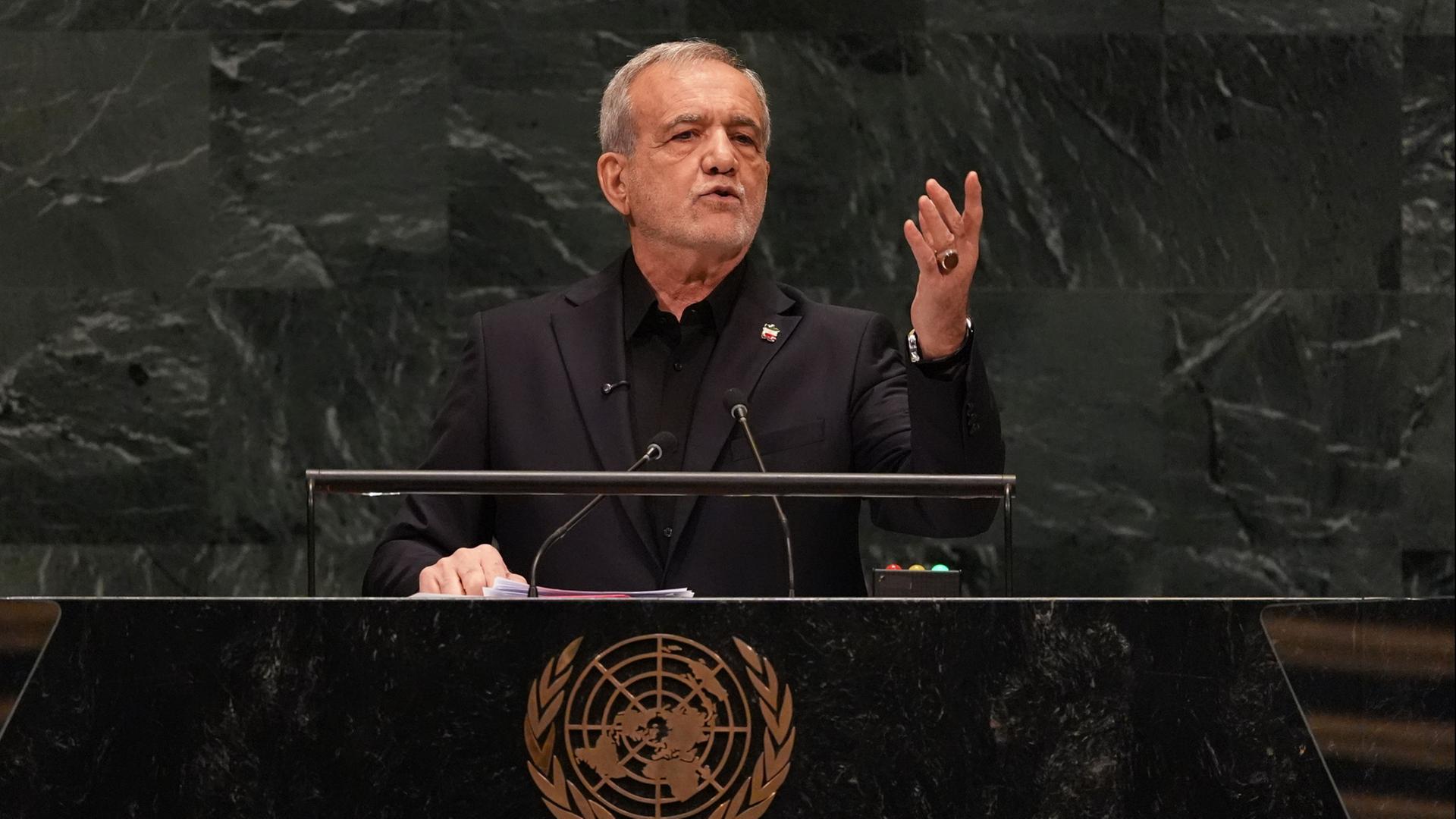
How and why the UN General Assembly is gaining prominence

As world leaders attend the 81st session of the United Nations General Assembly in New York this week, there is a chorus of criticisms about the organisation’s failures and limitations. From the inability to sanction Israel amid its genocidal campaign against the Palestinian people, to the failure to condemn the United States’ illegal bombing of Iran or to respond effectively to Russia’s aggression against Ukraine, the UN has appeared increasingly constrained in recent years.
The veto system of the UN Security Council, by which the five permanent members (China, France, the Russian Federation, the United Kingdom, and the United States) can effectively bypass any oversight of their activities, has meant that the Security Council has not intervened in world crises in any meaningful way since the end of the Cold War.
And yet, despite these limitations and external attacks, there are bodies of the UN that still play a significant role in world politics.
Given the paralysis of the Security Council and the shifting dynamics across the Global North and South, as small and middle powers gain more ground, the General Assembly is steadily rising in prominence as a place where politics doesn’t always trump policy.
The UNGA is comprised of 193 member states, each with an equal vote. This nominally even playing field means that lobbying for votes is intense and the horse-trading between states has shifted the dynamics on crucial questions at key moments.
Given its representative nature, the UNGA has traditionally played a very important, if overlooked, role in defining the UN’s work. Since 1960, Global South states have held a numerical majority in the assembly, which has allowed this group of states to set the agenda for issues that are discussed and to play a pivotal role in the political dynamics of the forum.
The collective agency of this disparate group of states – from small island members such as Jamaica to large states such as Brazil and India – has ebbed and flowed through various formations, from the Afro-Asian bloc to the Group of Seventy-Seven (G77). Their collective power has been considerable in moulding the economic and social development system and pushing forward a human rights agenda.
For example, the proposal to create the post of UN High Commissioner for Human Rights was led by Costa Rica in the General Assembly in 1965. Although the role was not officially created until 1993, the resolution provided the pathway towards institutional change, and importantly, put human rights at the centre of the agenda.
In this way, much of the General Assembly’s work has been gradually generated towards specific gains in the area of decolonisation, self-determination and inequality, reflective of the bonds of solidarity that hold different Global South states together, but also of the longer and wider arc of commitment to addressing global inequality and injustice.
It is in this light that the real potential of the General Assembly as a barometer that offers a reading of the position of the international community on various issues becomes clear. This is a dual-sided function, reflecting the general views of the majority of member states on a range of issues, as well as the global public opinion.
This was most evident recently in the resolutions passed condemning Israel’s military campaign in Gaza and its obstruction of aid delivery. The unprecedented number of votes in favour reflected not just the political will of the states involved to sanction the Israeli government, but the wider outrage among the general public at the appalling slaughter taking place.
And it is not just Gaza where the UNGA has taken initiative from the UNSC.
In the first weeks of Russia’s invasion of Ukraine in 2022, the General Assembly met under the “Uniting for Peace” mechanism outlined in Resolution 377. This was an initiative originally taken in November 1950 when the UN was embroiled in the Korean War, and the Security Council was paralysed.
The resolution put forward the most important constitutional changes to the UN. It outlined a route to bypass the Security Council when it is deadlocked and allowed a debate to be held in the UNGA. Under this resolution, the UNGA can make recommendations for action, including the imposition of sanctions and even the use of force to restore peace and security.
Between 2022 and 2023, the United for Peace resolution was invoked three times, moving the debate out of the Security Council, where Russia has a permanent veto, to the General Assembly, where three separate resolutions demonstrated support for Ukraine and criticism of the violation of sovereignty and territorial integrity by Russia.
Considering that the current dysfunction of the Security Council does not look set to change any time soon, the role of the General Assembly is becoming increasingly important to hold large states accountable and maximise the agency of smaller and middle powers.
The Liechtenstein Initiative is one such example. Introduced by the small, landlocked state in 2022, the initiative requires the General Assembly to meet automatically when one of the five permanent UNSC members uses their veto. Within 10 days, the assembly should convene and debate the issue that was vetoed. Crucially, the veto-wielding power must explain its position and justify its use of the veto to all UN members.
It is another way to create accountability for state behaviour, and allows the Security Council to be circumvented, especially when humanitarian catastrophes, atrocities and major conflicts occur that require an emergency response. Taken together, what these resolutions reflect is a growing trend towards moving debates about peace and security out of the Security Council and into the General Assembly.
This trend fits into the long history of initiatives by smaller states, often from the Global South, to defy the influence of great powers in the UN. Indeed, the General Assembly has been the place where the Global South has successfully shifted the needle on the world’s most pressing issues by flexing its collective agency over the last 80 years in ways that are not fully appreciated.
While the UNGA is not devoid of pressures from the great powers, it provides a space and a place for collective responses to the world’s biggest crises. Far more than being merely the bully pulpit for leaders like US President Donald Trump today, the UNGA chamber is the world’s leading forum for quiet diplomacy.
In the past, this forum has served as the measure of humanity’s greatest achievements in the areas of development and human rights. Looking ahead, the broken pathway towards a fairer world is most likely to be carved out of this space, as it is the General Assembly that has historically been the strongest reflection of this ambition.
The views expressed in this article are the author’s own and do not necessarily reflect Al Jazeera’s editorial stance.