How 'Ballari Chalo' strengthens BY Vijayendra's hold on Karnataka BJP
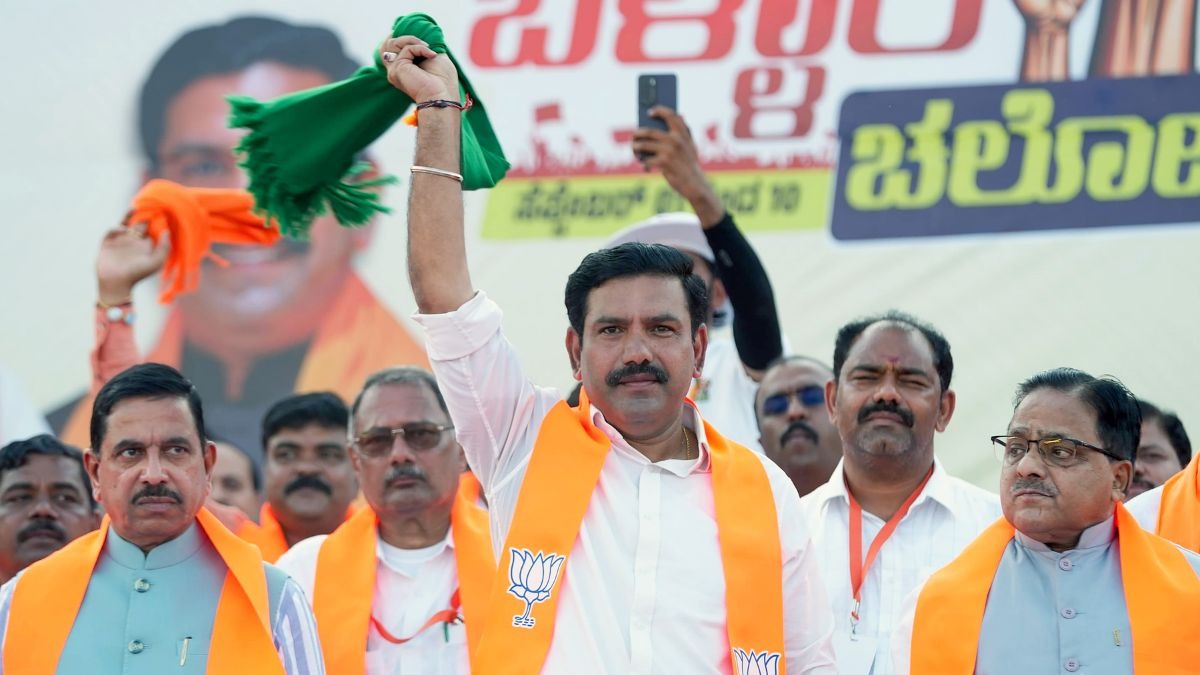
Chalo Ballari. It was BJP heavyweight B.S. Yediyurappa who blew the bugle at Lingasugur on the morning of September 1. His son and the party’s Karnataka president B.Y. Vijayendra did the walking. Ten days and roughly 175 km later, when the ‘Ballari Chalo’ padayatra wound up at the Municipal College Grounds there, nobody in the crowd needed the political choreography explained to them.
The march, led by Vijayendra, cut through nine assembly segments in Raichur, Koppal and Ballari. The BJP says more than 100,000 people turned up for the finale. While there can be no independent estimate of that, what can be counted is who all came. Former chief ministers Yediyurappa and Basavaraj Bommai, veteran Jagadish Shettar, Union ministers Pralhad Joshi and V. Somanna, state leader R. Ashoka, and the Ballari duo of G. Janardhana Reddy and B. Sriramulu were all on the stage.
Arguably, the odd thing about Ballari Chalo is that it should not have happened in the first place. It was announced to force the resignation of Karnataka minister B. Nagendra over the alleged Rs 187 crore irregularities in the Valmiki Corporation. Nagendra quit before the padayatra. The BJP did the walkathon anyway and Vijayendra widened the brief to what he called ‘at least 10 issues’, from drought in the state to some 250,000 vacant government posts.
The ruling Congress made the obvious jibe. State Congress chief B.K. Hariprasad asked why the BJP was marching for something it had already got. Chief minister D.K. Shivakumar was breezier, telling the BJP to go ahead and promising a yatra of his own once they were done.
More awkward for Vijayendra was Janata Dal (Secular) leader H.D. Kumaraswamy saying much the same thing, that there was no need for the march once the minister had resigned. That remark came days after BJP workers were nowhere to be seen at the JD(S) padayatra against the Bidadi township—a snub the ally had noticed.
Along the padayatra, the BJP’s pitch was farmers. Vijayendra accused the government of notifying only 101 taluks as drought-hit while distress ran far wider. He put the number of farmer suicides in three years of Congress rule at 3,655, with 937 of them in Kalyana Karnataka alone.
Vijayendra demanded a white paper on the diversion of Scheduled Caste (SC) and Scheduled Tribe (ST) sub-plan money into the government’s guarantee schemes. The Congress line is that the sub-plan reallocation was fiscal housekeeping. Neither side has moved an inch.
For Vijayendra, the yardstick, over and over, was his father. Flood affected people had received Rs 3.5 lakh for house reconstruction under Yediyurappa’s rule, he reminded his audiences. Milk producers got their incentives paid. The comparisons were neither subtle nor meant to be.
There is family precedent to Vijayendra’s method too. As leader of the Opposition in the legislative assembly, Yediyurappa had walked from Shikaripur to Bengaluru demanding title deeds for Bagair Hukum cultivators. That march and a decade of farmer agitations through the 1980s and 90s, with Ananth Kumar, built the rural Lingayat base that carried the BJP from two MLAs to power in Karnataka. It also forced the party to hand him leadership in the state.
But the parallel only goes so far. Yediyurappa walked to build a base he did not have. His son walked to hold one he was handed. The father’s march had a concrete demand. The son’s lost its demand before day one.
There is also a small irony in Vijayendra visiting Kuruba shepherd tents along the way. In 2021, it was Kuruba pontiffs who were leading padayatras for ST status, and that agitation was counted among the headaches of then chief minister Yediyurappa, who was trying to position his son for the top job.
That succession story has been a bruising one. Vijayendra took over the BJP state unit in November 2023 and is today the only state president of the party in office without a fresh organisational mandate. Karnataka’s organisational election was never completed. His term simply rolled on. Nobody in Bengaluru or Delhi pretends to know why.
A section of the state unit close to national general secretary (organisation) B.L. Santhosh has resisted Vijayendra from the day he was named, and through the past year, a procession of stalwarts have camped in Delhi to convey to the leadership: anybody but Vijayendra.
The leadership did not budge. Its reading, conveyed plainly to the dissenters, is that nobody except the Yediyurappa-Vijayendra duo can rally the party’s core base and get the organisation into working order before the 2028 elections in Karnataka.
However, the condition attached has been that Vijayendra must prove himself on the ground. Ballari Chalo, in that sense, was a test. The image of Bommai, Shettar, Ashoka and the Reddys sharing stage at the finish was precisely the result the BJP leadership had asked for.
So, the arithmetic of the past three years looks like this. Vijayendra has led two marches. Mysuru Chalo in 2024 was a BJP-JD(S) effort. Ballari Chalo was a BJP show, and ended with the party’s old guard (dissenters included) walking the last stretch behind him. Vijayendra has called it the first phase of an agitation that will run for the remaining tenure of the Congress government, and instructed the cadre to start preparing for 2028.
The message of Ballari Chalo is clear. Vijayendra holds the party in the state, and the narrative. The BJP’s agenda—from drought, farm distress and Dalit funds to ‘neglect’ of the state’s north—is now being written from his march rather than the legislative assembly floor. Whether voters buy it is a question for 2028. Whether the state BJP still contests it, at least in public, appears to have been settled at the padayatra’s finale.