
How can 'greater BRICS' achieve high-quality development?
By continuing to browse our site you agree to our use of cookies, revised Privacy Policy and Terms of Use. You can change your cookie settings through your browser.
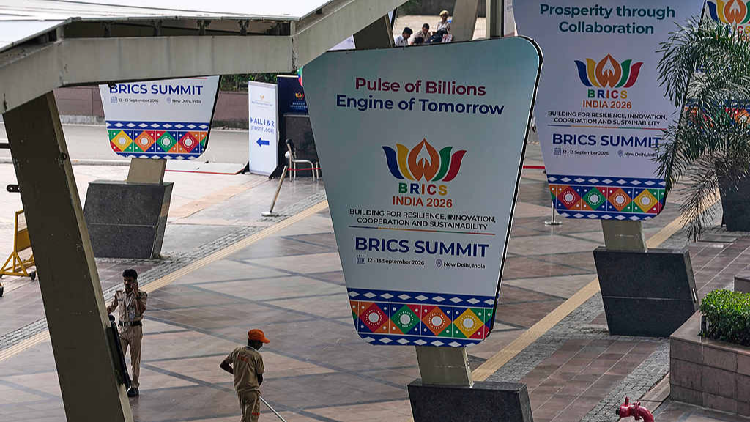
Workers clean the area around Bharat Mandapam, the venue for the 18th BRICS Summit, in New Delhi, India, September 12, 2026. /VCG
Editor's Notes: Cai Tongjuan is a research fellow at the Chongyang Institute for Financial Studies, Renmin University of China. The article reflects the author's opinions and not necessarily the views of CGTN.
As the 2026 BRICS Summit unfolds in India, cooperation among the "greater BRICS" is entering a new stage. The expansion of BRICS has added not only more members, but also larger markets, richer resources, deeper industrial complementarities and greater strategic depth.
The key question is not simply how to expand cooperation, but how to turn scale into quality and potential into sustainable growth.
From an open macroeconomic perspective, the top priority is to make trade and investment more convenient, stable and rules-based.
BRICS members differ in development stage and comparative advantage, which creates favorable conditions for building a more resilient regional production network. Tariff and non-tariff barriers should be further reduced, while customs procedures, inspection and quarantine standards, logistics and payment systems should be better coordinated. Greater use of local currencies and cross-border payment cooperation can also lower transaction costs.
At the same time, trade policy communication should be strengthened to reduce regulatory uncertainty and create stable expectations for businesses. Only when goods, capital, technology and people move smoothly can the benefits of the expansion be fully realized.
This is also why the initiatives proposed by Chinese President Xi Jinping at the summit matter. At the summit, Xi put forward a set of cooperation proposals, including the trade and investment facilitation initiative, which proposes to establish a BRICS special economic zone partnership, under which countries can set up an intelligent portal, coordinate policies, and build a new frontier for open development. Such proposals provide a practical pathway for turning the "greater BRICS" from an expanded platform into a more efficient engine of growth.
Second, industrial and supply chain cooperation should become a practical anchor. The global economy is facing slower growth, inflationary pressure, debt risks and geopolitical tensions. Rising unilateralism and protectionism have made developing countries more vulnerable to external shocks.
BRICS members should strengthen supply-demand cooperation in energy, minerals, agriculture, manufacturing, the digital economy and green industries. Long-term partnerships among upstream and downstream enterprises should be encouraged to build stable, transparent and predictable supply chains.
In new energy, critical minerals and digital infrastructure, the "greater BRICS" is well placed to form a cooperative structure based on complementary strengths and shared risks. More importantly, such cooperation should extend beyond governments to enterprises, industrial parks and local regions, creating more replicable and scalable models.
Third, higher-standard openness should promote deeper regional economic integration. BRICS cooperation is not a closed circle, but an open and inclusive platform for South-South cooperation.
Internally, members can explore more flexible arrangements for investment promotion, mutual recognition of standards, e-commerce and green trade. Externally, they should strengthen policy coordination with other emerging markets and developing countries, and help sustain an open, non-discriminatory and inclusive international economic environment.
Through better rules and institutional innovation, the "greater BRICS" can turn complementarity into stable growth expectations and extend the benefits of cooperation to the wider Global South. In this process, BRICS should also take a more active part in global economic governance, speaking with a more consistent and constructive voice on WTO reform, development financing, climate change and digital economy rules.
Building resilience also requires stronger financial cooperation and macroeconomic policy coordination.
BRICS countries should improve emergency reserve arrangements, enhance the financial safety net and strengthen monitoring and cooperation on cross-border capital flows, exchange rate volatility and debt risks.
Innovative development finance tools can be introduced for infrastructure, green development, digital transformation and small and medium-sized enterprises, improving access to funding and project sustainability.
For many developing economies, inadequate infrastructure and financing gaps remain major constraints on growth. If the BRICS mechanism can improve project assessment, risk sharing and long-term funding, it will provide stronger and more stable support for member countries. The closer the macroeconomic dialogue, the stronger the capacity to absorb external shocks.
Admittedly, deeper cooperation also faces challenges. Members differ in economic structure, institutional settings and policy priorities. As cooperation deepens, it must balance efficiency with inclusiveness, openness with security and collective interests with individual concerns.
The BRICS mechanism should therefore remain committed to extensive consultation, joint contribution and shared benefits, with a stronger focus on concrete projects and visible results. Priority should be given to areas where consensus is strong and spillovers are broad, such as infrastructure connectivity, green and low-carbon transition, the digital economy, agricultural poverty reduction and public health.
Meanwhile, more attention should be paid to cooperation with a human dimension, including support for small businesses, youth entrepreneurship and vocational training, so that the benefits of development reach ordinary people more widely and the social foundation of cooperation becomes stronger.
Looking ahead, the "greater BRICS" should be more than a larger economic presence. It should become a stronger force for high-quality development. The vision outlined at the summit offers an important guide: by staying committed to openness, practical cooperation and mutual benefit, BRICS countries can strengthen their resilience, expand shared growth opportunities and bring greater certainty to the global economy.


