How China is making manufacturing smarter and greener
By continuing to browse our site you agree to our use of cookies, revised Privacy Policy and Terms of Use. You can change your cookie settings through your browser.
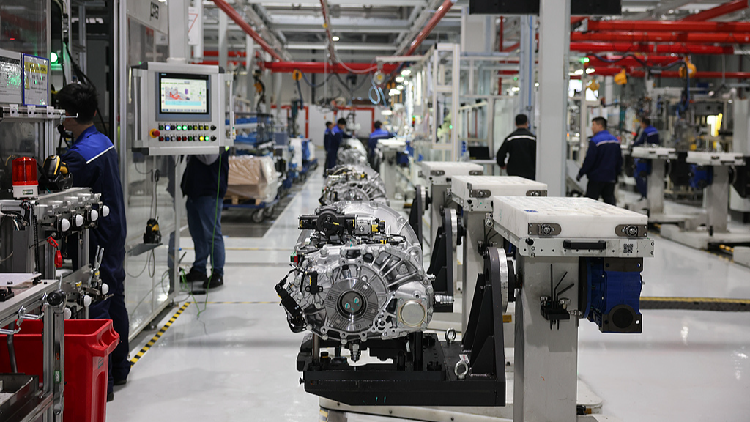
A factory workshop at an advanced manufacturing base in Jiaxing Economic and Technological Development Zone, east China's Zhejiang Province, April 3, 2026. /VCG
China is accelerating the transformation of its manufacturing sector, with smart technologies, green production and deeper industrial integration reshaping factories and supply chains.
Chinese President Xi Jinping has urged sustained efforts to expand and strengthen advanced manufacturing to provide strong support for advancing Chinese modernization. Xi made the remarks in a recent instruction, which was conveyed at a national conference on advanced manufacturing held in Beijing on Wednesday and Thursday.
China's smart manufacturing drive has already reached a significant scale.
By the end of 2025, the numerical control rate of key processes in major industries had reached 68.6%, according to the Ministry of Industry and Information Technology (MIIT). Large numbers of previously unconnected industrial machines have also been equipped with intelligent sensors, providing a foundation for collecting and applying industrial data.
According to MIIT, China has established a four-level intelligent factory system, with more than 35,000 basic-level, 8,200 advanced-level and 500 excellent-level intelligent factories built so far. Fifteen companies have also been included on a list for cultivation as leading-level intelligent factories.
Industrial robots are becoming increasingly common on production lines. According to the International Federation of Robotics, Chinese factories have more than 2 million industrial robots, the largest number in the world. Robot density has exceeded 500 units per 10,000 employees, higher than that of Germany and Japan.
Green manufacturing is another major part of the transformation.
China has built strong industrial chains around electric vehicles, lithium batteries and photovoltaic products. According to the General Administration of Customs, exports of the three categories approached 1.3 trillion yuan ($193.8 billion) in 2025, 3.5 times the level in 2020.
China's lithium battery industry has also expanded rapidly. Data from EVTank showed that China's lithium-ion battery shipments reached 1,888.6 GWh in 2025, accounting for 82.8% of global shipments.
Meanwhile, manufacturing is becoming more closely connected with digital technologies and modern services.
Intelligent factories are exploring new models such as shared manufacturing and agile customization, while industrial internet platforms are supporting flexible production, remote maintenance and coordination across the supply chain.
An industrial data initiative launched this year is also targeting bottlenecks in the collection, aggregation and application of industrial data, with a focus on using artificial intelligence to empower manufacturing.
From intelligent factories and industrial robots to green industrial chains and new digitally enabled business models, China's advanced manufacturing sector is advancing along three interconnected directions – smarter, greener and more integrated – as the country works to strengthen the foundation of its real economy.