How China is training Pakistani pilots to work and live in space
Two Pakistani pilots are undergoing intensive training in Beijing as China prepares to send its first foreign astronaut to its Tiangong space station, marking a new phase in the space cooperation between the two countries.
The pilots, Zeeshan Ali and Khurram Daud, are learning Mandarin, experiencing intense gravitational forces inside centrifuges and practising how to eat, sleep and repair equipment in weightlessness as they prepare for a historic journey into space.
A final decision on which of the two will fly is expected in mid-to-late October, Amer Gilani, who oversees human spaceflight cooperation at Pakistan's space agency, Suparco, told news agency Reuters.
The mission was conceived by China and Pakistan in 2019.
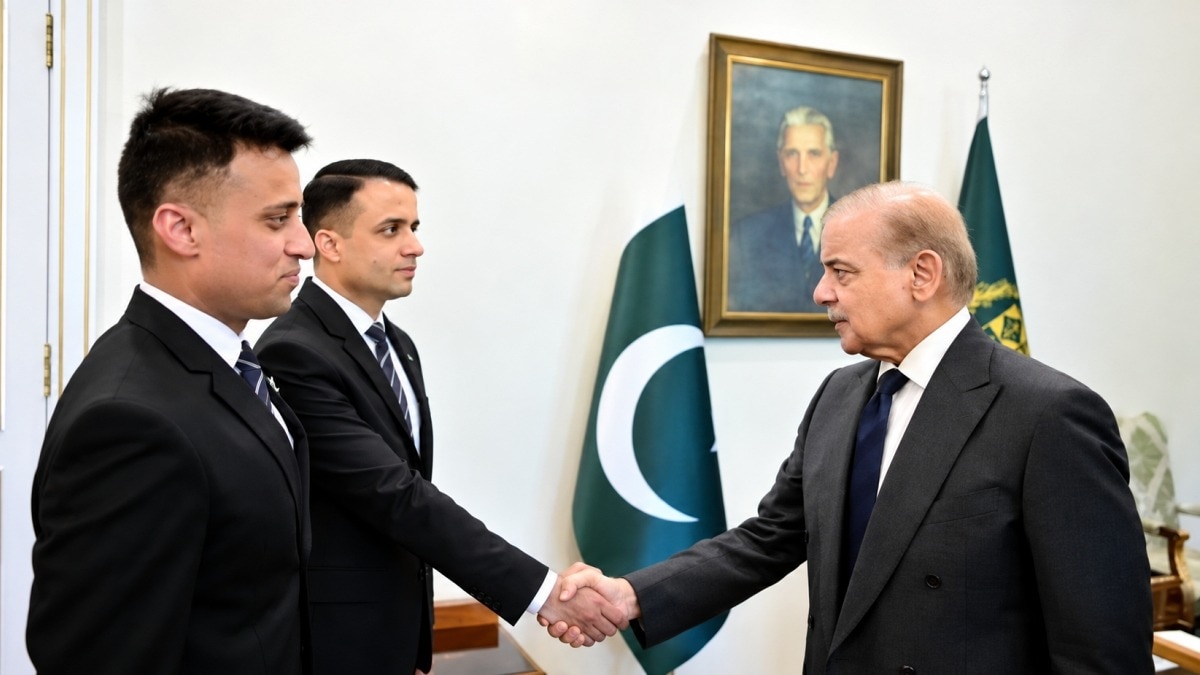
The selected pilot will become Pakistan's first astronaut and the first foreign national to travel to China's Tiangong space station. China has not announced a launch date. Pilots Zeeshan Ali and Khurram Daud were selected from approximately 20 finalists. (Photo: Reuters)
According to Reuters, the astronaut will fly directly from China after completing training and return to Pakistan only after recovering from the mission.
Ali and Daud were selected from approximately 20 finalists drawn from an initial pool of Pakistani pilots and scientists.
Their selection followed medical examinations, psychological assessments and tests of their ability to withstand the high gravitational forces experienced during rocket launches.
Training at the China Astronaut Research and Training Center in Beijing includes spacecraft systems, microgravity adaptation and intensive Chinese-language instruction.
The selected astronaut will serve as a payload specialist, responsible for conducting Pakistani scientific experiments aboard Tiangong rather than operating the spacecraft.
The mission is expected to last approximately one week.
Suparco received more than 300 proposals from universities in Karachi, Lahore and Islamabad for experiments to be conducted in orbit.
Chinese institutions selected four biotechnology experiments focused on addressing food insecurity and climate change.
The experiments will be developed and tested in Pakistan before Chinese engineers approve them for flight.
Tiangong comprises three modules — Tianhe, Wentian and Mengtian — with a combined mass of approximately 77 tonnes. The station supports research in life sciences, materials science, fluid physics and radiation exposure.
The mission highlights Pakistan's reliance on Beijing for human spaceflight. Pakistan has neither an independent orbital launch vehicle nor a crewed spacecraft.
The partnership also includes Chinese-launched Pakistani satellites, a joint satellite-navigation system and a Pakistani-built rover planned for China's Chang'e-8 lunar mission around 2028.
However, Suparco has said there is no official commitment or discussion about sending a Pakistani astronaut to the Moon.
For Pakistan, the upcoming mission represents a first step towards human spaceflight, while China gains an opportunity to demonstrate its space station's international capabilities.- Ends