
How does Xi Jinping’s ‘special plane’ compare with Air Force One? - Bangkok Post
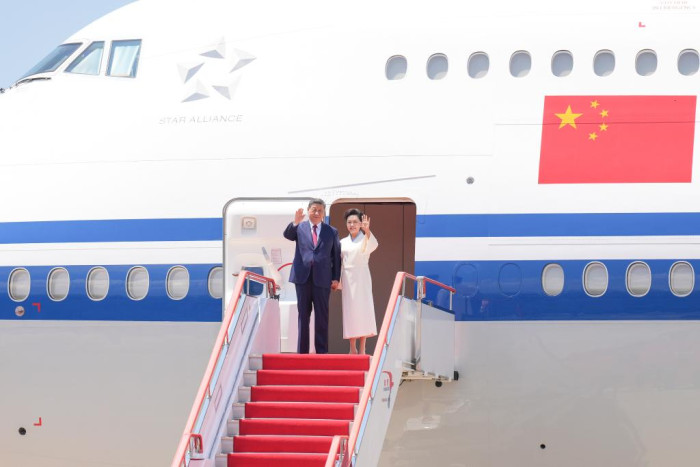
Xi Jinping, general secretary of the Communist Party of China Central Committee and Chinese president, left, and his wife, Peng Liyuan, step out of the airplane cabin upon arrival in Pyongyang, the Democratic People's Republic of Korea (DPRK), on June 8, 2026. (Photo: Xinhua) HONG KONG — Ahead of Chinese President Xi Jinping's visit to Washington this week, attention is already turning to the aircraft that will carry him and how it stacks up against America's famous presidential plane.
The aircraft carrying China's leader, often referred to in state media and official statements as a zhuan ji, or special plane, remains far less known to the world than Air Force One, despite both countries using Boeing 747s for presidential travel.
For a head of state, a presidential aircraft is more than a means of transport. Its range, on-board facilities and security systems reflect the practical demands of presidential travel and diplomatic missions, and the aircraft itself becomes part of the visual choreography of a state visit.
In a sense, it is one of the first symbols of a country to arrive in the host country, appearing in the sky before the president steps onto the tarmac.
But now the term is commonly used for the two highly customised Boeing 747-200Bs, designated VC-25A and bearing tail numbers 28000 and 29000, used to transport the US commander-in-chief.
Across the Pacific Ocean, China does not operate a dedicated presidential aircraft. Aircraft used for Xi's overseas trips have been drawn from Air China's fleet and specially prepared for presidential travel.
In 2013, when Xi had just taken office, his overseas trips were carried out on Air China Boeing 747-400s.
The Boeing 747 is a large, long-haul, twin-aisle aircraft with a spacious cabin and a distinctive upper deck.
In a 2013 state media report, Lu Peixin, a former acting director of the protocol department at China's foreign ministry, gave two reasons China did not maintain a dedicated presidential aircraft.
"One is to avoid waste and special treatment and increase aircraft utilisation," Lu said. "The other is to ensure flight safety because an aircraft has millions of components and cannot simply sit idle for long periods."
The arrangement has evolved with the aircraft used for Xi's long-haul travel. Just last weekend, Xi arrived in New Delhi aboard a Boeing 747-8 Intercontinental for the Brics summit, his first visit to India in seven years.
The 747-8I is the passenger version of the 747-8 and the last passenger variant of the 747 ever built.
Unlike the US, China has released relatively little public information about the aircraft used by its top leader. In official reports, Xi's plane is generally referred to simply as a "special plane", with few details of the aircraft itself.
Whether for domestic or international missions, the dispatch and deployment of special aircraft are subject to strict procedures and a high level of confidentiality.
By contrast, the White House maintains a dedicated web page on Air Force One that details its aircraft designation, tail numbers, on-board facilities and history.
A catering truck is parked on the other side of Air Force One, before US President Donald Trump's departure from Ankara en route to Washington after his participation in the North Atlantic Treaty Organisation (Nato) leaders' summit, at Ankara Esenboga Airport in Ankara, Turkey, July 8, 2026. (Photo: Reuters)
In China, for presidential flight missions, the Civil Aviation Administration receives the flight assignment and passes it to Air China through its office overseeing special flights, according to a rare media account in 2014.
The crew would be determined and security checks and modifications to the aircraft carried out. According to Lu in the 2013 report, some seats on board would be removed and replaced with sofas and beds.
Technicians from the PLA Air Force's 34th Division would help with inspections and the necessary modifications.
Lu said a refitted aircraft was generally divided into four sections.
At the front was an executive section for the national leader, comprising a living room, office and bedroom. This was followed by a section for ministers and other senior accompanying officials, then seating for officials at the bureau and department level. The rear section was reserved for accompanying media and staff.
By contrast, Air Force One is permanently configured for presidential travel.
Air Force One has 4,000 square feet (372 square metres) of floor space across three levels, including a presidential suite with an office, lavatory and conference room, and separate accommodation for senior advisers, Secret Service personnel and travelling press, according to the White House.
It includes a medical suite that can function as an operating room, and a doctor is permanently on board. In addition, there are two galleys capable of preparing up to 100 meals at a time.
The aircraft is also equipped with secure communications systems, front and rear air stairs, a self-contained baggage loader and in-flight refuelling capability, according to the US Air Force.
Beyond its on-board configuration, Air Force One carries a highly recognisable visual identity.
The words "United States of America", the American flag and the seal of the US president are emblazoned on its exterior, making the aircraft an immediately identifiable symbol of the American presidency wherever it flies.
At present, US President Donald Trump is travelling on a newer member of the 747 family.
The VC-25B Bridge, a customised Boeing 747-8I, entered presidential service earlier this year as an interim aircraft, bridging the gap between the two ageing VC-25A aircraft and Boeing's forthcoming VC-25B jets, which have faced delays.
Valued at an estimated US$400 million, the plane was gifted to the US government by the Qatari royal family and can fly faster and farther than the VC-25As.
In recent years, questions have swirled over why China's top leader does not travel on the domestically produced C919, which has entered commercial service with Chinese airlines.


