How 'greater BRICS' can cement its base to sustain Global South's rise
By continuing to browse our site you agree to our use of cookies, revised Privacy Policy and Terms of Use. You can change your cookie settings through your browser.
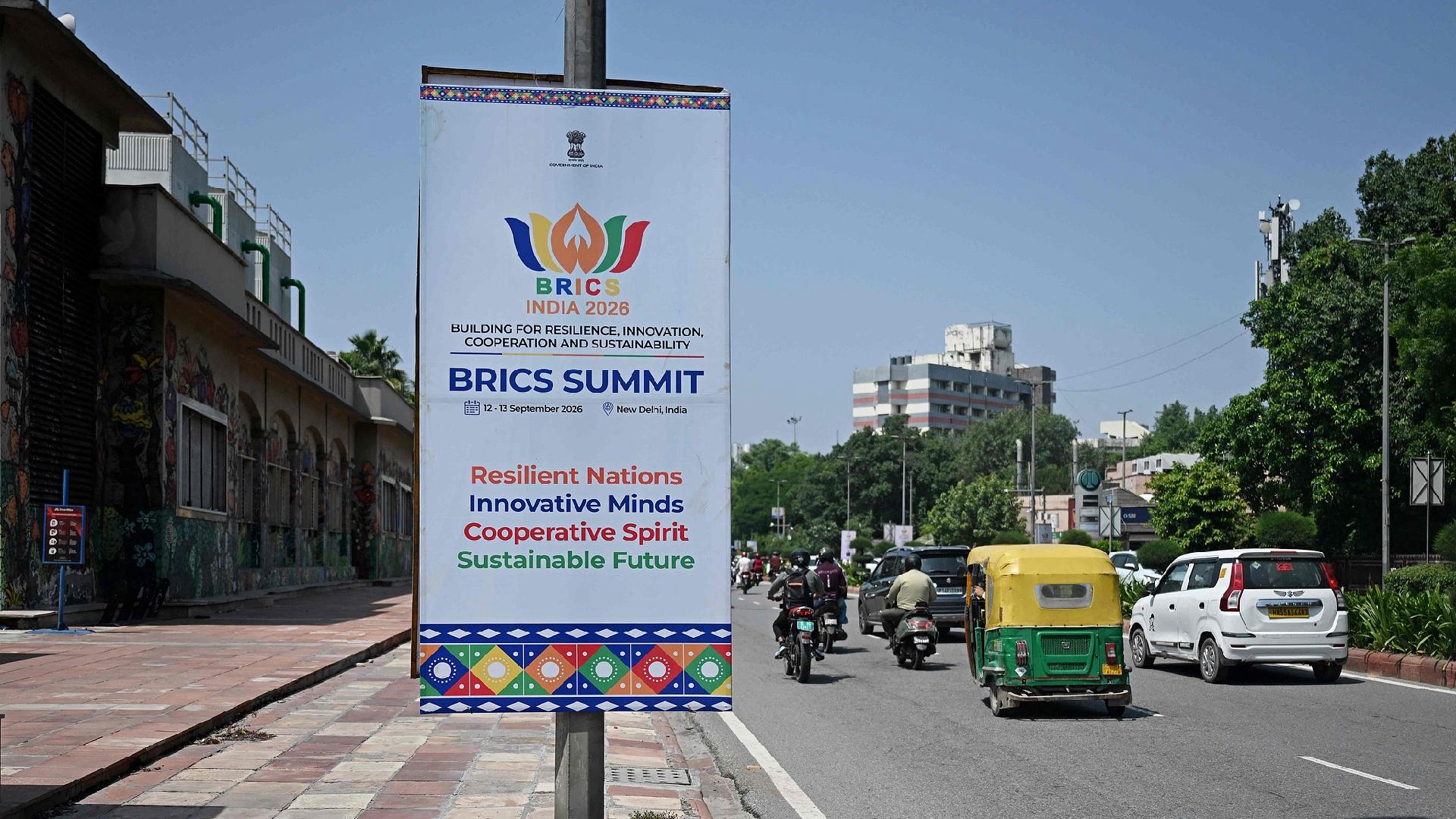
A sign put up for the 18th BRICS Summit in New Delhi, India, September 9, 2026. /CFP
Editor's note: Xin Ge, a special commentator for CGTN, is a research fellow at the Institute of Public Policy and Governance, Shanghai University of Finance and Economics (SUFE), and a chair associate professor at the School of Public Administration and Policy, SUFE. The article reflects the author's opinions and not necessarily the views of CGTN.
Political economy, like physics, distinguishes motion from momentum. The Global South has been in motion for two decades; the question is whether that motion can generate lasting momentum: productive capacity that withstands commodity cycles, technological shocks and the renewed pressures from unilateralism and protectionism.
That was, in essence, the question Chinese President Xi Jinping addressed in New Delhi on September 13 at the 18th BRICS Summit, speaking about cementing the foundation of BRICS cooperation and bolstering the strength of the Global South.
His central proposition was that "to accomplish great things and achieve major progress, the foundation of greater BRICS cooperation must be cemented." The sequence matters: Foundation comes before ambition. As BRICS cooperation expands beyond its original five members, the grouping is being called on to turn greater scale into practical cooperation and development outcomes.
Xi described the Global South’s collective rise as a key driver of world multipolarity, while acknowledging that technology gap and development gap persist and the existing international governance system has not kept pace with the times.
In other words, greater economic weight does not automatically translate into greater capacity. Economic growth alone cannot guarantee technological capability, industrial upgrading or a strong pool of talent. The challenge is to build the foundations that can turn economic potential into sustainable development.
The five initiatives proposed by Xi are an answer to that structural challenge. The first – the open source and inclusive artificial intelligence (AI) initiative – aims to build a BRICS AI open source community, support cooperation in developing and applying large language models, hold specialized AI seminars and training courses, and build an open ecosystem for AI.
At a time when access to advanced technologies is becoming an increasingly important factor in development, such cooperation can help BRICS countries strengthen their capacity to participate in the digital economy.
The other four initiatives form a broader chain of practical cooperation. Trade and investment facilitation would include a BRICS special economic zone partnership, an intelligent portal and policy coordination, as well as a BRICS Forum on Trade in Services next year.
Digital industry cooperation would promote a shared cloud platform, alongside digital skills training, technological exchanges and industrial alignment.
Intelligent manufacturing cooperation would support the development of smart factories and standards, while the science and technology talent development initiative would establish a BRICS engineer cultivation alliance and launch a youth exchange program for scientific and technological innovation. Together, these measures address markets, technology, production and talent – the practical building blocks of development.
Last-minute preparations ahead of the 18th BRICS Summit in New Delhi, India, September 12, 2026. /CFP
What distinguishes this approach is its emphasis on translating cooperation into capacity. Population, markets and resources provide important advantages, but development ultimately depends on the ability to convert those advantages into productive capabilities. The initiatives proposed by Xi are designed to do precisely that: Facilitate trade and investment, strengthen technological cooperation, upgrade industries and cultivate talent. That is what "cementing the foundation" means in practical terms.
Summit declarations alone do not produce development. Xi also pointed to a record of concrete cooperation. Since China launched the Global Development Initiative five years ago – an international cooperation plan for all countries to achieve the United Nations 2030 Sustainable Development Goals – more than 2,000 projects have been implemented in partnership with other countries, and training provided to over 200,000 professionals in more than 120 countries.
China has given zero-tariff treatment for 53 African countries with which it has diplomatic relations. These examples indicate that the emphasis on practical cooperation is accompanied by measures that seek to expand development opportunities and capacity-building.
The timing also matters. This year marks the launch of China’s 15th Five-Year Plan (2026-2030), which Xi described as both "a blueprint for China's development and a cooperation list for the rest of the world." China's own development is presented not in isolation, but as an opportunity for wider cooperation. Whether such opportunity can translate into lasting benefits will ultimately depend on implementation and the willingness of other countries to work together.
Xi also placed BRICS cooperation within a broader vision of global governance. He said, "A world without rules is like a crossroads without traffic lights, where chaos and disorder are all but guaranteed," and argued that "the logic of 'might makes right'" should have been discarded long ago. The message is that a stronger Global South requires not only greater economic and technological capacity, but also a more representative and inclusive international order.
That is ultimately why the foundation matters. A "greater BRICS" can provide greater economic weight, but its long-term influence will depend on whether that weight can be translated into stronger industries, technological capability, human capital and practical cooperation. By cementing these foundations, BRICS can give the growing voice of the Global South greater capacity to shape its own development and contribute to a more balanced and inclusive international order.
(If you want to contribute and have specific expertise, please contact us at opinions@cgtn.com. Follow @thouse_opinions on X to discover the latest commentaries in the CGTN Opinion Section.)