How India's shipbuilding ambitions are setting sail, a vessel at a time
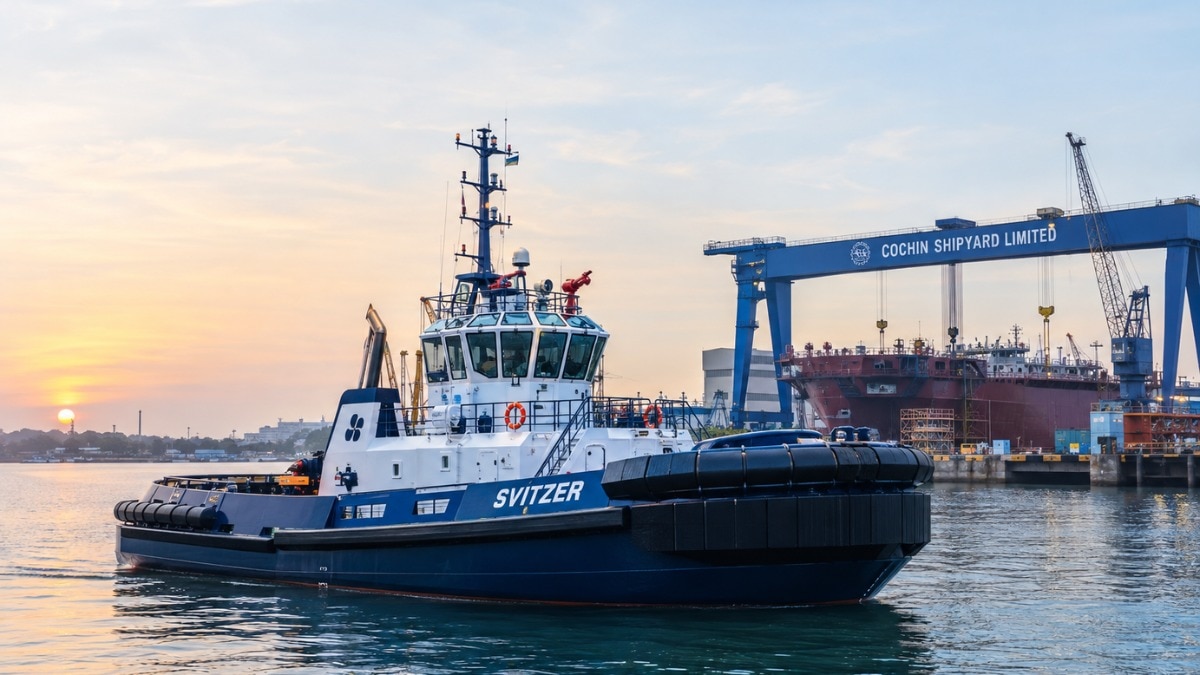
India’s shipbuilding ambitions are beginning to take shape, one piece at a time. One of the latest pieces is a fleet of small but technologically advanced vessels being built in Kochi.
Svitzer, one of the world’s largest towage operators, has begun construction of four battery-electric harbour tugs at the Cochin Shipyard Limited (CSL), with an option for four more. The 26-metre TRAnsverse 2600e tugs are being built for Svitzer’s fleet, bringing an international order for electric harbour craft to an Indian yard just as the country’s own ports have begun ordering electric tugs to replace conventional diesel-powered vessels.
Construction formally began with steel cutting at CSL on September 2, following a shipbuilding agreement signed last December. The vessels will use battery-electric propulsion and, when charged using green power, are designed to operate with zero direct emissions during port and terminal towage operations.
“We evaluated shipyards across the world before selecting CSL,” Deniz Kirdar True, managing director for Asia, Middle East and Africa at Svitzer, told INDIA TODAY. “Four fully electric TRAnsverse 2600e tugs now begin construction here in Cochin—among the most advanced green tugs being built anywhere. And the capability to build them stays in India.”
That last bit is important for a country that wants to become one of the world’s top five shipbuilding nations by 2047, but currently occupies a tiny corner of an industry overwhelmingly dominated by East Asia.In 2024, China, South Korea and Japan together accounted for around 95 per cent of global shipbuilding output by gross tonnage. China alone accounted for 54.6 per cent, followed by South Korea (28 per cent) and Japan (12.6 per cent). India’s share was 0.06 per cent.
The gap is daunting. It also explains why India’s attempt to expand shipbuilding is increasingly focused on finding particular segments in which domestic yards can acquire technology, develop suppliers and secure repeat orders. Green harbour craft could become one such segment.
The immediate home market is being created by the Centre’s Green Tug Transition Programme, or GTTP, which seeks to progressively replace conventional diesel-powered harbour tugs at major ports with greener alternatives.
Tugs are among the least visible but most important vessels inside a port. Compact and immensely powerful, they push, pull and position much larger ships as they enter and leave berths. Their relatively contained operating area also makes harbour operations a natural candidate for electrification.
The GTTP was formally launched in 2024. Its first phase runs until 2027, and the government aims to induct 50 green tugs by 2030, with at least 50 per cent of the tug fleet at major ports operating on green energy by then.
Orders are now beginning to follow the policy. Deendayal Port (Kandla, Gujarat), Jawaharlal Nehru Port (Navi Mumbai), Visakhapatnam Port and V.O. Chidambaranar Port (Thoothukudi, Tamil Nadu) have placed work orders for electric tugs. Crucially for Indian shipbuilding, vessels procured under the programme are to be built at domestic yards.
Svitzer’s order sits alongside that emerging market, but is different in one important respect: these vessels are being built in India for an international operator. The design itself is already operating commercially. Svitzer chief operating officer Kasper Karlsen said the TRAnsverse class has completed more than 3,000 commercial towage jobs while another 18 vessels are under construction worldwide.
“The TRAnsverse is designed to remove constraints in our customers’ operations,” Karlsen said. “It delivers faster and more predictable vessel movements, which protects berth productivity and turnaround times.”
The significance is not merely that the tug is electric. Harbour tugs have to deliver very high power in short bursts, work in confined waters and remain available whenever a ship requires assistance. The TRAnsverse design uses a double-ended hull and omni-directional thrust and, according to Svitzer, provides an operating envelope up to 50 per cent broader than conventional arrangements.
Svitzer is also widening its Indian shipbuilding footprint. Apart from the electric vessels at CSL, it has contracted Swan Defence and Heavy Industries in Gujarat to build four 32-metre TRAnsverse 3200 tugs, with deliveries scheduled from the first quarter of 2028. Those vessels are designed to be biofuel, IMO Tier III (strictest NOx emission standard) and Firefighting Class 1 ready.
For CSL, the order is also a chance to build expertise in a class of vessel India will increasingly need at home. “CSL will thus be playing a crucial role in advancing the sector’s decarbonisation goals,” CSL chairman and managing director Jose V.J. said at the steel-cutting ceremony.
There are practical limits to how quickly that transition can proceed. Electric tugs require more than batteries aboard the vessel. Ports need charging facilities and adequate electrical capacity, while charging has to fit around the operating schedules of craft that may be required at short notice.
The economics will matter too. The value of Svitzer’s CSL contract has not been disclosed, with the company saying costs depend on vessel configuration, equipment, classification and delivery schedules.
For now, the scale remains small against the enormous volumes produced by China, South Korea and Japan. But India is beginning to have something it previously lacked in this particular segment: domestic demand for green tugs, Indian yards building them, and an international operator placing orders here.