How Major Sharma saved Kashmir from invading Pakistanis by keeping last hope alive
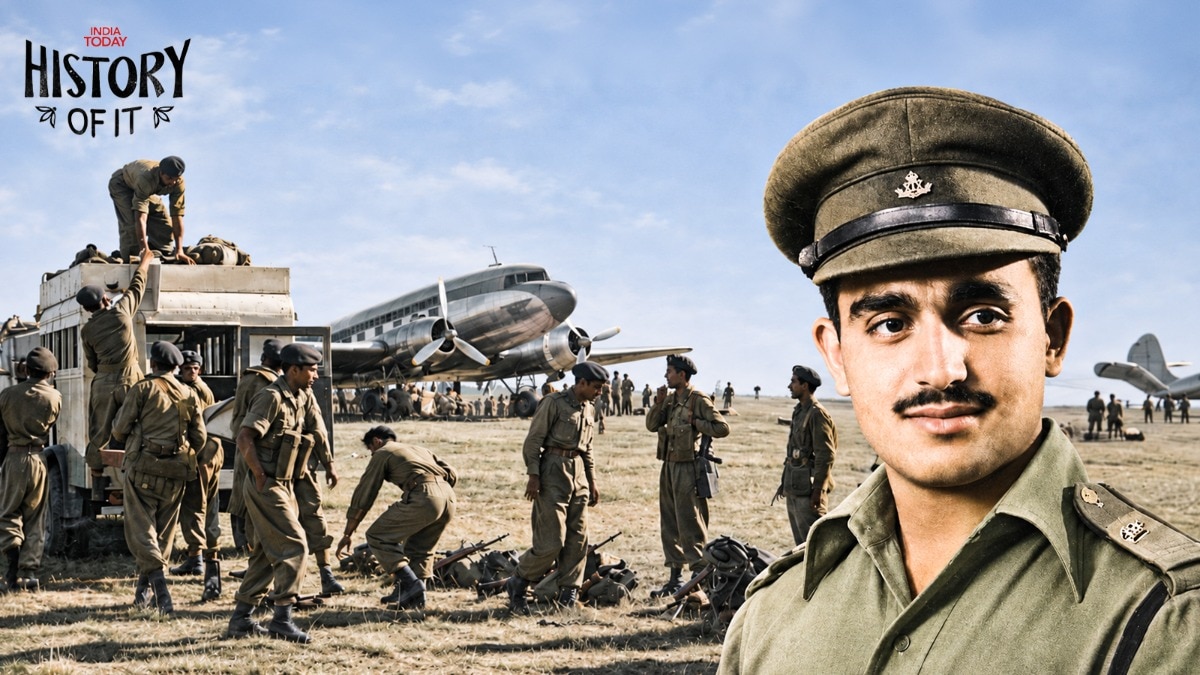
"The enemy are only 50 yards from us. We are heavily outnumbered. We are under devastating fire. I shall not withdraw an inch but will fight to the last man and the last round." This was the message Major Somnath Sharma, commanding officer of the company that held Badgam on the outskirts of Srinagar, radioed on November 3, 1947. It was not even three months since India gained independence and Pakistan had thrust upon a war on it.
Soldiers from the 4th Battalion of the Kumaon Regiment under Major Sharma's command had dug in at the village of Badgam in Jammu and Kashmir. Behind them lay Srinagar, the summer capital of the princely state, and its vital airfield. Major Sharma was still recovering from a fractured arm and wearing a plaster cast.
In front of them stood hundreds of Pathan tribal fighters, trained, equipped and led by Pakistani army officers. If they broke through, they could reach Srinagar's airfield, where Indian Army troops were still being flown in. There, a hundred Indian soldiers led by Major Sharma were trying to prevent around 500 heavily armed militia men commanded by Pakistani army officers.
Major Sharma's company, outnumbered and outgunned, was fighting desperately to hold its position. Mortar shells were exploding all around, while the enemy, attacking from three sides, had advanced to within 50 yards of the Indian troops. It was amid such a situation that Major Somnath Sharma radioed the message to Brigade Headquarters.
The heavy fighting went on for six hours.
By the time fighting subsided, the Pakistan-backed mujaheedeen were in full retreat, beaten back by Major Sharma's men who were supported by the Indian Air Force. Badgam remained firmly in Indian hands. The immediate threat to Srinagar and its airfield had been blunted. But the officer who transmitted the message pledging to fight till the last was no more. Major Sharma was killed after a mortar shell exploded near him. His troops, however, stood by his pledge and followed his orders.
For his bravery, Sharma would become the very first Indian to be awarded the Param Vir Chakra (PVC), India's highest wartime military award.
The reason we are revisiting the Battle of Badgam is that November 3, marked 79 years since Major Somnath Sharma laid down his life defending Jammu and Kashmir. His last stand not only saved Srinagar and its strategically vital airfield but also helped prevent the Pakistan-backed invaders from overrunning Kashmir Valley at a critical moment in the 1947 war.
In 1947, barely two months after gaining independence, India and Pakistan were drawn into their first war over Jammu and Kashmir, a Muslim-majority princely state ruled by Hindu Maharaja Hari Singh, who had initially chosen to remain independent rather than join either country. Seeing an opportunity, the Pakistani army, along with mujaheedeens, invaded Kashmir on October 22.
As they forced their way into Jammu and Kashmir through Muzaffarabad and advanced towards Srinagar, Maharaja Hari Singh sought India's military assistance and signed the Instrument of Accession on October 26 to join India. That's when Indian troops were flown into Srinagar the following morning to repel the invaders.
This is the story of Major Somnath Sharma, his last stand at Badgam, how he saved Jammu and Kashmir and became the first recipient of the Param Vir Chakra. Lt Gen Surindra Nath Sharma (Retd) salutes his brother late Major Somnath Sharma. (Image: Indian Army) THE ROAD TO WAR IN KASHMIR
On August 15, 1947, British rule over the subcontinent ended, giving rise to two independent nations, India and Pakistan. But independence came at a terrible cost. Partition triggered one of the largest mass migrations in history, with nearly a million people killed and millions more displaced.
The British also left behind hundreds of princely states, ruled by hereditary kings, maharajas and nawabs. These ranged from tiny estates to kingdoms as large as Jammu and Kashmir, Hyderabad, Mysore and Travancore. In 1947, around 565 princely states accounted for nearly 40% of the subcontinent's territory and 23% of its population.
With British paramountcy ending, their rulers had to decide whether to accede to India or Pakistan. Most eventually joined one of the two dominions, but a few remained holdouts. One of them was Jammu and Kashmir.
In 1947, the kingdom was ruled by Maharaja Hari Singh, a Hindu monarch from the Dogra dynasty. It was also strategically located, sharing borders with both India and Pakistan, as well as Tibet.
Hari Singh wanted the kingdom to remain independent.
But as the Maharaja sought to preserve his kingdom's independence, tensions within it were mounting. Sheikh Abdullah's National Conference, which opposed Dogra rule and favoured accession to India, was gaining political influence. At the same time, an armed rebellion was brewing against the Maharaja's administration, particularly in Poonch, due to grievances over taxation and political repression. Maharaja Hari Singh of Kashmir. (Image: Wikimedia Commons) advertisementTHE FIRST WAR FOR KASHMIREven as the Maharaja sought to buy time, events were moving faster than he could control.
On October 22, 1947, thousands of armed tribal fighters from Pakistan's North-West Frontier Province crossed into Jammu and Kashmir. Supported and led by Pakistan Army officers, they overran Muzaffarabad and advanced towards Srinagar, looting and killing as they went.
On October 24, the raiders entered Baramulla, a town on the road to Srinagar. What followed was a spree of looting, arson and killings, with residents, including members of the Christian community, among those targeted. The violence and looting also slowed the raiders' advance, giving the defenders precious time.
The Maharaja's forces, weakened by desertions and the growing rebellion within the state, struggled to stop the invasion. On October 24, Hari Singh's government formally sought military assistance from India. New Delhi agreed to send troops, but made accession to India a prerequisite.
With the raiders advancing along the Jhelum Valley road towards Srinagar, the Maharaja had little choice. On October 26, Hari Singh signed the Instrument of Accession, formally bringing Jammu and Kashmir into the Indian Union. Governor-General Lord Mountbatten accepted it the following day.
New Delhi moved swiftly. With difficult terrain and poor road connectivity making a rapid ground deployment impractical, an airlift to Srinagar became crucial. Indian Air Force Dakota DC-3 aircraft ferried troops and equipment from Delhi.
On October 27, the first Indian Army troops, from the 1st Battalion of the Sikh Regiment, landed at Srinagar's airfield. Reinforcements followed. Among the troops being sent to defend the Valley was Major Somnath Sharma and his company of the 4th Battalion, Kumaon Regiment. Indian troops land at Srinagar airfield. (Image: Indian Army) MAJOR SOMNATH SHARMA'S LAST STAND AT BADGAM
When Major Somnath Sharma arrived in Srinagar with his Kumaon company, he was already a battle-hardened officer.
Born on January 31, 1923, into a military family in Himachal Pradesh, Sharma was commissioned into the 8th Battalion of the 19th Hyderabad Regiment of the British Indian Army on February 22, 1942. The regiment would later become the 4th Battalion of the Kumaon Regiment.
He had fought the Imperial Japanese Army in the jungles of Burma during the Second World War. His service in the bloody Arakan campaign earned him a Mention in Dispatches, according to a biographical tribute published in the government's New India Samachar.
By October 1947, Sharma was commanding the D Company of 4 Kumaon. His company was airlifted to Srinagar on October 31. Sharma, who was still recovering from a fractured arm and wearing a plaster cast, insisted on accompanying his troops despite being advised rest, according to a Press Information Bureau publication.
On November 3, Sharma's company was ordered on a fighting patrol to Badgam, a village close to Srinagar's airfield.
The position was strategically crucial. The airfield was India's only air link with the Kashmir Valley and the route through which reinforcements, weapons and supplies were being flown in. If the raiders broke through the Badgam defences and advanced via Humhama, they could threaten both Srinagar and its airfield, jeopardising India's entire military effort in the Valley. The official Param Vir Chakra citation specifically identifies this danger. Major Somnath Sharma's defense of Bagdam prevented Pakistani raiders from threatening Srinagar airfield.
Initially, the Indian troops encountered no major enemy force. But later that afternoon, an estimated 500 tribal raiders attacked Sharma's company from three sides, using mortars and automatic weapons, according to his official gallantry citation.
The Kumaon company came under intense fire and began suffering heavy casualties. Sharma, his arm bound in a plaster cast, fearlessly moved across open ground, exposing himself to enemy fire as he directed his men and urged them to hold their positions. Despite his fractured arm, he also began filling ammunition magazines and distributing them to the light machine-gunners to keep the company's firepower from weakening. These acts are recorded in his Param Vir Chakra citation.
"The enemy are only 50 yards from us. We are heavily outnumbered. We are under devastating fire. I shall not withdraw an inch but will fight to the last man and the last round."
Moments later, a mortar shell exploded amid the ammunition near him, killing Sharma. His men, however, continued fighting. According to the official citation, the company held its position and delayed the enemy's advance for six hours, buying precious time for Indian reinforcements to reach the area and block the route towards Srinagar.
The National War Memorial's official account records that Sharma's leadership inspired his men to continue fighting for hours after his death. The PIB's New India Samachar likewise credits the company's six-hour resistance with giving reinforcements time to arrive.
For his leadership, conspicuous gallantry and supreme sacrifice, Sharma was posthumously awarded the Param Vir Chakra, becoming the first recipient of India's highest wartime gallantry award.
His last stand at Badgam helped prevent the raiders from reaching Srinagar's airfield at a critical moment. By holding them back, Sharma and his men bought the Indian Army time to bring in the reinforcements needed to defend the Valley. Had the airfield fallen, India's ability to sustain its military presence in Kashmir would have been jeopardised.
The first India-Pakistan war would drag on until January 1949. Both sides would fight two more wars over Jammu and Kashmir, in 1965 and 1999, resulting in the deaths of thousands of soldiers and civilians alike. Islamabad continues to illegally occupy a significant portion of Jammu and Kashmir even now. But Major Somnath Sharma's bravery and sacrifice ensured that Jammu and Kashmir remains an integral part of India.- Ends
A history and geopolitics buff, Shounak is a newly minted writer. He looks to bring his interests into his stories. When not at work, he can be found consumed in books, videogames and drawing.