How ‘national security’ has become Trump’s crutch for getting his way in Washington
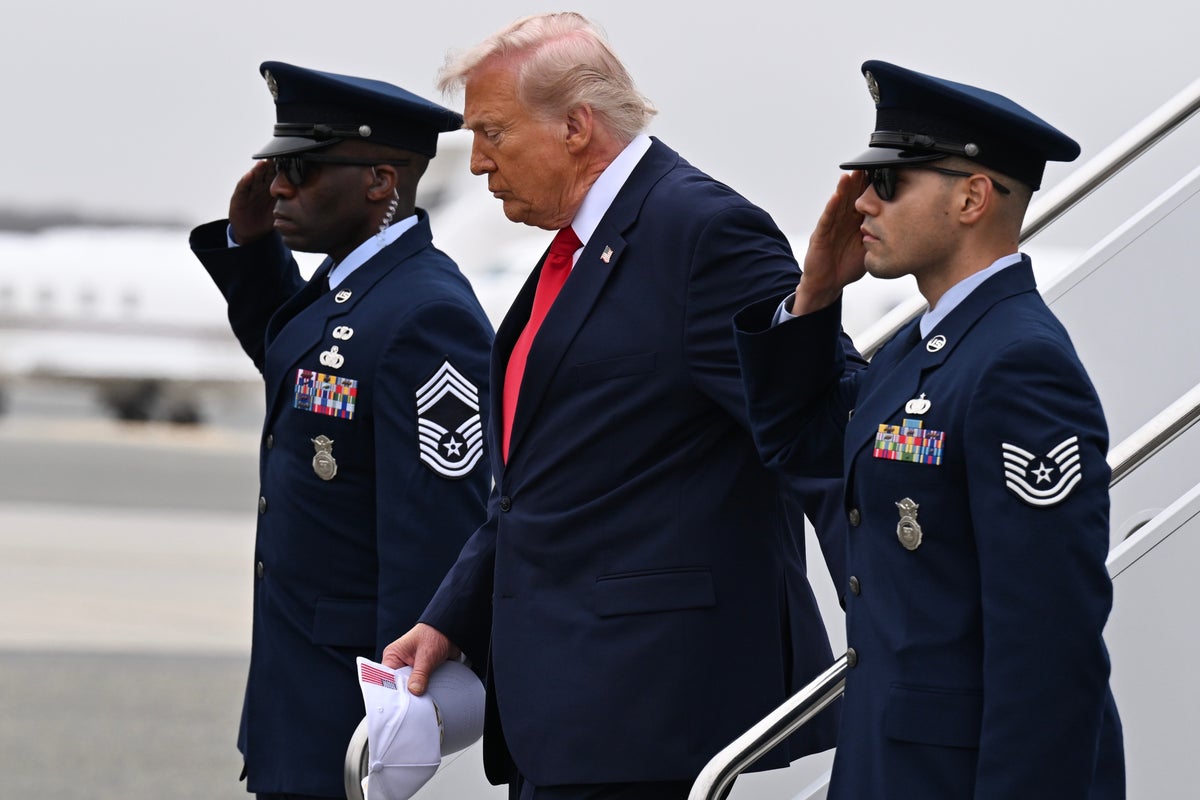
Donald Trump announced on Sunday that he would be placing a sniper’s nest in the front of Arlington National Cemetery.
In any other moment, the act would have been truly confusing. Presidents are not generally known for advertising the whereabouts of specific U.S. military fortifications, even those placed in such scenic and somber locations. But Trump’s announcement followed a pattern: His planned fortification of this hallowed ground comes as the president has leaned into national security and his role as commander-in-chief to justify his physical transformation of the nation’s capital and the White House.
On Truth Social, the president wrote Sunday that he was transforming his planned “triumphal arch” into another D.C. military installation, complete with “large numbers of drones, plus Snipers.” If that sounds familiar, it’s because he recently attempted the same transformation with the plans for his White House ballroom, now dubbed a “DronePort” in several seemingly AI-generated mockups of the structure planned for the grounds of the former East Wing.
Despite Congress turning up its nose at the prospect of providing money for the White House’s construction plans under the guise of security funding, Trump’s aim seems to be clear: Presenting his desired development projects as crucial to national security — and painting his critics as standing in the way of protecting Washington, D.C.
The northern Virginia congressman representing the region, which includes Arlington National Cemetery, Rep. Don Beyer, responded to that attempt to establish that pretext on Sunday and he called it “idiotic.”
“Putting a drone-launching site directly in the landing path for DCA [airport] is a stupid, dangerous, and unworkable idea.Trump clearly expects to lose a lawsuit and therefore wants to set up a pretext to argue that the arch is tied to national security. Which is obviously idiotic,” said the congressman.
Transforming the nation’s capital and its surrounding areas, including parts of Maryland and Virginia, under the banner of “security” has been one of Trump’s main focuses since returning to the White House. In an unprecedented move last year, he deployed National Guard troops to Washington D.C. and a handful of other cities with the mission of stopping waves of crime and lawlessness that Trump promised were washing over liberal cities nationwide.
In reality, troops around D.C. spent much of their time on these same beautification projects; they picked up trash, raked leaves, replanted grass, and so on. More smoke-and-mirrors to achieve Trump’s dream of a squeaky-clean seat of power.
Trump even used a variation of this explanation on Monday when he gave his supposed reasoning for banning MS Now, CNN, and Politico from the White House, calling them a “threat to democracy.”
“[The] Kennedy Center will next become a national security issue as well. We need a drone port on roof and ammo in the basement,” wrote one X user on Sunday.
To the administration, the lack of official justification for the necessity of these fortifications doesn’t seem to matter. The White House sought to quickly shovel money for the White House ballroom/”DronePort” into the second Republican reconciliation package passed by Congress this summer, which broke a deadlock on ICE and Border Patrol funding.
That effort failed, but there doesn’t seem to be any effort by any arm of the administration, including the Pentagon, to try and justify the need for these new fortifications, including backing up Trump’s assertion that the military had requested his proposed changes to the White House in the first place.
Trump’s ballroom will likely continue as long as a court does not block the administration from using privately-raised funds and other money diverted from the Secret Service and White House Military Office for its construction. But the arch is another story; a number of groups have already filed to block its construction, and a federal judge has refused to allow the administration to begin major construction projects on the plot without providing notice to the court.
Bizzarely, after a year of DOGE taking an axe to whole federal agencies and sub-agencies, and the president’s radical transformation of departments like Education and Defense, the real test of Trump’s executive power in front of the courts may end up being fought around his D.C. beautification efforts. A relatively small part of the president’s agenda, they’ve still consumed much of the president’s attention as his renovation efforts around the city have been the most direct, immediate and viewable extension of his political will.
How much of that will survives after November is another story.